WB result of Phospho-Nucleophosmin (Thr199) Recombinant Rabbit mAb
Primary antibody: Phospho-Nucleophosmin (Thr199) Recombinant Rabbit mAb at 1/1000 dilution
Lane 1: untreated HT-29 whole cell lysate 20 µg
Lane 2: HT-29 treated with 100 ng/ml Nocodazole for 16 hours whole cell lysate 20 µg
Secondary antibody: Goat Anti-rabbit IgG (H+L), HRP conjugated at 1/10000 dilution
Predicted MW: 33 kDa
Observed MW: 37 kDa
Phospho-Nucleophosmin (Thr199) Recombinant Rabbit mAb (S-4973-62)
Phospho-Nucleophosmin (Thr199) Recombinant Rabbit mAb (S-4973-62)
Price:
Regular price
$100 USD
Regular price
Sale price
$100 USD
Unit price
per
For shipping services or bulk orders, you may request a quotation.
Secure checkout with

View full details
Product Details
Product Details
Product Specification
| Host | Rabbit |
| Antigen | Phospho-Nucleophosmin (Thr199) |
| Synonyms | Nucleophosmin; Nucleolar phosphoprotein B23; Nucleolar protein NO38; Numatrin; NPM; NPM1 |
| Immunogen | Synthetic Peptide |
| Location | Nucleus |
| Accession | P06748 |
| Clone Number | S-4973-62 |
| Antibody Type | Recombinant mAb |
| Isotype | IgG |
| Application | WB, IHC-P |
| Reactivity | Hu, Ms |
| Predicted Reactivity | BV |
| Purification | Protein A |
| Concentration | 0.5 mg/ml |
| Conjugation | Unconjugated |
| Physical Appearance | Liquid |
| Storage Buffer | PBS, 40% Glycerol, 0.05% BSA, 0.02% sodium azide |
| Stability & Storage | 12 months from date of receipt / reconstitution, -20 °C as supplied |
Dilution
| application | dilution | species |
| WB | 1:1000-1:10000 | Hu |
| IHC-P | 1:2000 | Hu, Ms, Rt |
Background
Phospho-Nucleophosmin (Thr199) refers to the modified form of nucleophosmin (NPM/B23) generated upon phosphorylation at the Thr199 residue; this phosphorylation event is catalyzed by the CDK2-cyclin E complex and serves as a key molecular switch regulating the initiation of centrosome duplication. Mechanistically, unphosphorylated NPM is associated with unduplicated centrosomes, whereas phosphorylation at Thr199 promotes the dissociation of NPM from centrosomes, a step that is a necessary prerequisite for centrosomes to initiate duplication; expression of the non-phosphorylatable T199A mutant can dominantly negatively inhibit centrosome duplication and causes NPM to persist on centrosomes. Beyond centrosome regulation, NPM phosphorylated at Thr199 is also recruited to ionizing radiation-induced DNA damage foci, and this recruitment depends on RNF8/RNF168-mediated K63-linked ubiquitin chains, suggesting its involvement in DNA double-strand break repair. At the experimental detection level, specific antibodies against the neoepitope of Thr199 phosphorylation have been widely used in applications such as Western blot, immunohistochemistry, and immunofluorescence to distinguish phosphorylated from total NPM protein levels. In preclinical prostate cancer studies, N6L treatment reduces NPM phosphorylation at Thr199, suggesting that this phosphorylation event may serve as a potential pharmacodynamic marker for therapeutic intervention.
Picture
Picture
Western Blot
Immunohistochemistry
IHC shows positive staining in paraffin-embedded human testis. Anti-Phospho-Nucleophosmin (Thr199) antibody was used at 1/2000 dilution, followed by a HRP Polymer for Rabbit IgG (ready to use). Counterstained with hematoxylin. Heat mediated antigen retrieval with Tris/EDTA buffer pH9.0 was performed before commencing with IHC staining protocol.
IHC shows reduced staining in paraffin-embedded human testis treated with phosphatase. Anti-Phospho-Nucleophosmin (Thr199) antibody was used at 1/2000 dilution, followed by a HRP Polymer for Rabbit IgG (ready to use). Counterstained with hematoxylin. Heat mediated antigen retrieval with Tris/EDTA buffer pH9.0 was performed before commencing with IHC staining protocol.
IHC shows positive staining in paraffin-embedded human cervical squamous cell carcinoma. Anti-Phospho-Nucleophosmin (Thr199) antibody was used at 1/2000 dilution, followed by a HRP Polymer for Rabbit IgG (ready to use). Counterstained with hematoxylin. Heat mediated antigen retrieval with Tris/EDTA buffer pH9.0 was performed before commencing with IHC staining protocol.
IHC shows reduced staining in paraffin-embedded human cervical squamous cell carcinoma treated with phosphatase. Anti-Phospho-Nucleophosmin (Thr199) antibody was used at 1/2000 dilution, followed by a HRP Polymer for Rabbit IgG (ready to use). Counterstained with hematoxylin. Heat mediated antigen retrieval with Tris/EDTA buffer pH9.0 was performed before commencing with IHC staining protocol.
IHC shows positive staining in paraffin-embedded human lung cancer. Anti-Phospho-Nucleophosmin (Thr199) antibody was used at 1/2000 dilution, followed by a HRP Polymer for Rabbit IgG (ready to use). Counterstained with hematoxylin. Heat mediated antigen retrieval with Tris/EDTA buffer pH9.0 was performed before commencing with IHC staining protocol.
IHC shows reduced staining in paraffin-embedded human lung cancer treated with phosphatase. Anti-Phospho-Nucleophosmin (Thr199) antibody was used at 1/2000 dilution, followed by a HRP Polymer for Rabbit IgG (ready to use). Counterstained with hematoxylin. Heat mediated antigen retrieval with Tris/EDTA buffer pH9.0 was performed before commencing with IHC staining protocol.
IHC shows positive staining in paraffin-embedded mouse liver. Anti-Phospho-Nucleophosmin (Thr199) antibody was used at 1/2000 dilution, followed by a HRP Polymer for Rabbit IgG (ready to use). Counterstained with hematoxylin. Heat mediated antigen retrieval with Tris/EDTA buffer pH9.0 was performed before commencing with IHC staining protocol.
IHC shows reduced staining in paraffin-embedded mouse liver treated with phosphatase. Anti-Phospho-Nucleophosmin (Thr199) antibody was used at 1/2000 dilution, followed by a HRP Polymer for Rabbit IgG (ready to use). Counterstained with hematoxylin. Heat mediated antigen retrieval with Tris/EDTA buffer pH9.0 was performed before commencing with IHC staining protocol.
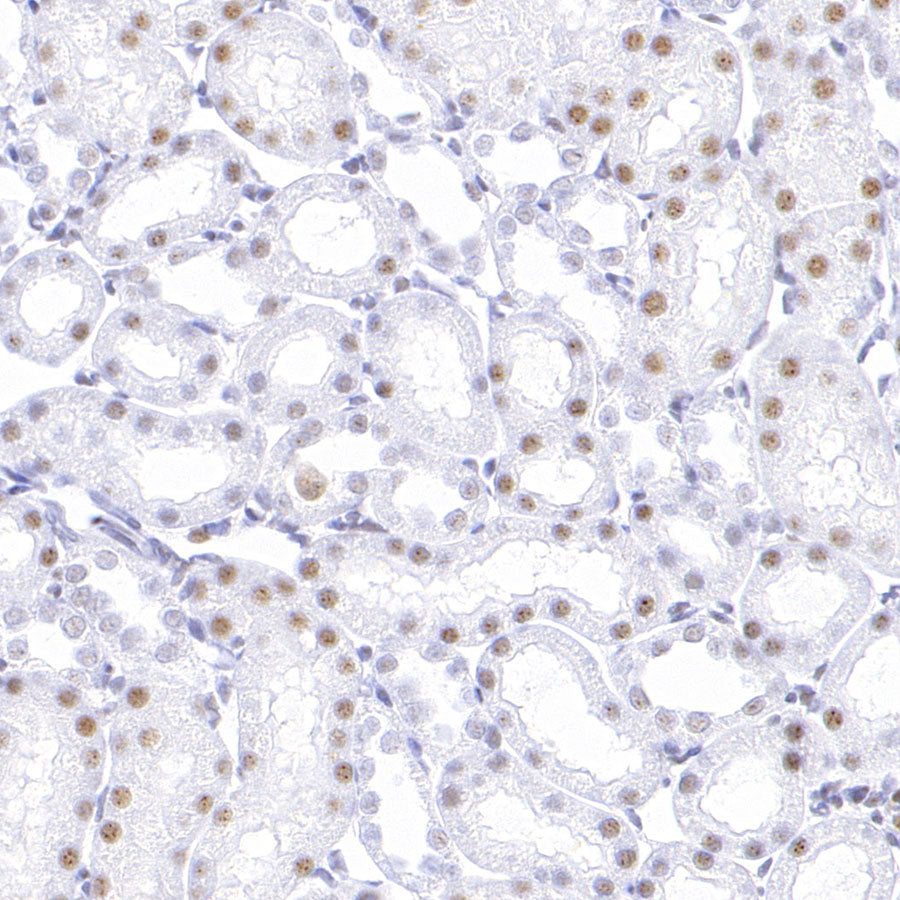
IHC shows positive staining in paraffin-embedded rat kidney. Anti-Phospho-Nucleophosmin (Thr199) antibody was used at 1/2000 dilution, followed by a HRP Polymer for Rabbit IgG (ready to use). Counterstained with hematoxylin. Heat mediated antigen retrieval with Tris/EDTA buffer pH9.0 was performed before commencing with IHC staining protocol.
IHC shows reduced staining in paraffin-embedded rat kidney treated with phosphatase. Anti-Phospho-Nucleophosmin (Thr199) antibody was used at 1/2000 dilution, followed by a HRP Polymer for Rabbit IgG (ready to use). Counterstained with hematoxylin. Heat mediated antigen retrieval with Tris/EDTA buffer pH9.0 was performed before commencing with IHC staining protocol.