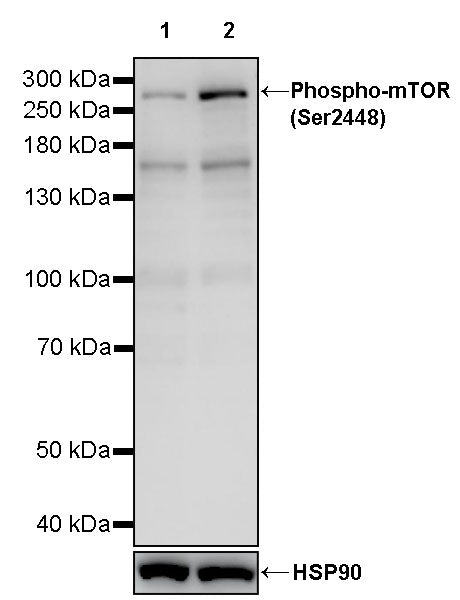
WB result of Phospho-mTOR (Ser2448) Recombinant Rabbit mAb
Blocking/Diluting buffer and concentration: 5% NFDM/TBST
Primary antibody incubation conditions: overnight at 4°C
Primary antibody: Phospho-mTOR (Ser2448) Recombinant Rabbit mAb at 1/1000 dilution
Lane 1: untreated HeLa whole cell lysate 20 µg
Lane 2: HeLa starve overnight, then treated with 200 nM PMA for 4 hours whole cell lysate 20 µg
Secondary antibody: Goat Anti- rabbit IgG, (H+L), HRP conjugated at 1/10000 dilution
Predicted MW: 289 kDa
Observed MW: 289 kDa
Phospho-mTOR (Ser2448) Recombinant Rabbit mAb (S-3555)
Phospho-mTOR (Ser2448) Recombinant Rabbit mAb (S-3555)
Price:
Regular price
$100 USD
Regular price
Sale price
$100 USD
Unit price
per
For shipping services or bulk orders, you may request a quotation.
Secure checkout with

View full details
Product Details
Product Details
Product Specification
| Host | Rabbit |
| Antigen | Phospho-mTOR (Ser2448) |
| Synonyms | Serine/threonine-protein kinase mTOR; FK506-binding protein 12-rapamycin complex-associated protein 1; FKBP12-rapamycin complex-associated protein; Mammalian target of rapamycin (mTOR); Mechanistic target of rapamycin; Rapamycin and FKBP12 target 1; FRAP; FRAP1; FRAP2; RAFT1; RAPT1; MTOR |
| Location | Cytoplasm, Nucleus, Lysosome, Mitochondrion, Cell membrane, Endoplasmic reticulum |
| Accession | P42345 |
| Clone Number | S-3555 |
| Antibody Type | Recombinant mAb |
| Isotype | IgG |
| Application | WB |
| Reactivity | Hu, Ms, Rt, Mk |
| Purification | Protein A |
| Concentration | 0.5 mg/ml |
| Conjugation | Unconjugated |
| Physical Appearance | Liquid |
| Storage Buffer | PBS, 40% Glycerol, 0.05% BSA, 0.03% Proclin 300 |
| Stability & Storage | 12 months from date of receipt / reconstitution, -20 °C as supplied |
Dilution
| application | dilution | species |
| WB | 1:500-1:1000 | Hu, Ms, Rt |
Background
Phospho-mTOR (Ser2448) refers to the phosphorylated form of the mammalian target of rapamycin (mTOR) at serine residue 2448, representing a key molecular marker of the activated state of mTOR complex 1 (mTORC1). This site is located within the C-terminal negative regulatory domain of mTOR and is primarily directly phosphorylated by the upstream PI3K-Akt signaling pathway—activated Akt kinase recognizes and modifies Ser2448, thereby partially relieving mTOR's intrinsic autoinhibition and enhancing its kinase activity toward downstream substrates such as S6K1 and 4E-BP1. Additionally, other kinases such as p38 MAPK and RSK can also contribute to the phosphorylation of this site under certain cellular conditions. Under physiological conditions, the phosphorylation level of Ser2448 dynamically reflects the cellular integration of growth factors, amino acids, and energy status, regulating protein synthesis, cell growth, and metabolic homeostasis. Pathologically, hyperphosphorylation of this site is commonly observed in various cancers (e.g., breast cancer, renal cancer, colorectal cancer), tuberous sclerosis complex, and overgrowth syndromes, closely associated with aberrant activation of the mTOR signaling pathway. In basic research and clinical applications, detecting Phospho-mTOR (Ser2448) is the most widely used biomarker for assessing mTORC1 activity.
Picture
Picture
Western Blot