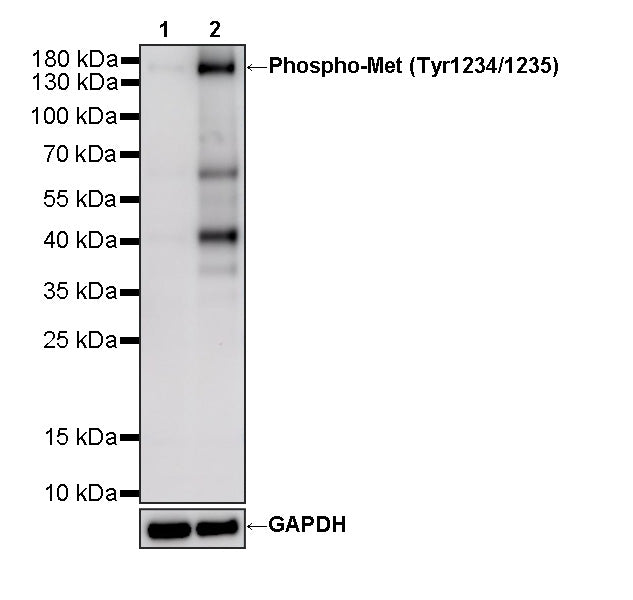
WB result of Phospho-Met (Tyr1234/1235) Recombinant Rabbit mAb
Primary antibody: Phospho-Met (Tyr1234/1235) Recombinant Rabbit mAb at 1/1000 dilution
Primary antibody incubation conditions: overnight at 4°C
Lane 1: untreated H-4-II-E whole cell lysate 20 μg
Lane 2: H-4-II-E serum starvation overnight then treated with 40 ng/ml HGF for 10mins whole Cell lysate 20 μg
Secondary antibody: Goat Anti-Rabbit IgG (H+L), HRP conjugated at 1/10000 dilution
Predicted MW: 156 kDa
Observed MW: 145 kDa
This blot was developed with high sensitivity substrate
Phospho-Met (Tyr1234/1235) Recombinant Rabbit mAb (S-3457)
Phospho-Met (Tyr1234/1235) Recombinant Rabbit mAb (S-3457)
Price:
Regular price
$100 USD
Regular price
Sale price
$100 USD
Unit price
per
For shipping services or bulk orders, you may request a quotation.
Secure checkout with

View full details
Product Details
Product Details
Product Specification
| Host | Rabbit |
| Antigen | Phospho-Met (Tyr1234/1235) |
| Synonyms | Hepatocyte growth factor receptor; HGF/SF receptor; Proto-oncogene c-Met; Scatter factor receptor (SF receptor); Tyrosine-protein kinase Met; MET |
| Location | Secreted |
| Accession | P08581 |
| Clone Number | S-3457 |
| Antibody Type | Recombinant mAb |
| Isotype | IgG |
| Application | WB |
| Reactivity | Hu, Ms, Rt |
| Purification | Protein A |
| Concentration | 2 mg/ml |
| Conjugation | Unconjugated |
| Physical Appearance | Liquid |
| Storage Buffer | PBS, 40% Glycerol, 0.05% BSA, 0.02% sodium azide |
| Stability & Storage | 12 months from date of receipt / reconstitution, -20 °C as supplied |
Dilution
| application | dilution | species |
| WB | 1:500-1:1000 | Hu, Ms, Rt |
Background
Phospho-Met (Tyr1234/1235) refers to the activated form of the c-Met receptor tyrosine kinase, a critical transmembrane protein encoded by the MET proto-oncogene, wherein phosphorylation at tyrosine residues 1234 and 1235 within the intracellular kinase activation loop serves as a definitive molecular switch for its enzymatic activity. This specific dual phosphorylation event is induced upon binding of its primary ligand, hepatocyte growth factor (HGF), leading to conformational changes that stabilize the active kinase state, thereby facilitating downstream signal transduction through major pathways such as PI3K/Akt, RAS/MAPK, and STAT, which collectively regulate essential cellular processes including proliferation, survival, motility, and morphogenesis. Due to its pivotal role in tissue regeneration and embryonic development, as well as its frequent dysregulation in various malignancies where it drives tumor growth, invasion, and metastasis, Phospho-Met (Tyr1234/1235) is widely utilized as a specific biomarker in research and clinical diagnostics to monitor c-Met pathway activation and to evaluate the efficacy of targeted therapeutic inhibitors designed to block this oncogenic signaling axis.
Picture
Picture
Western Blot