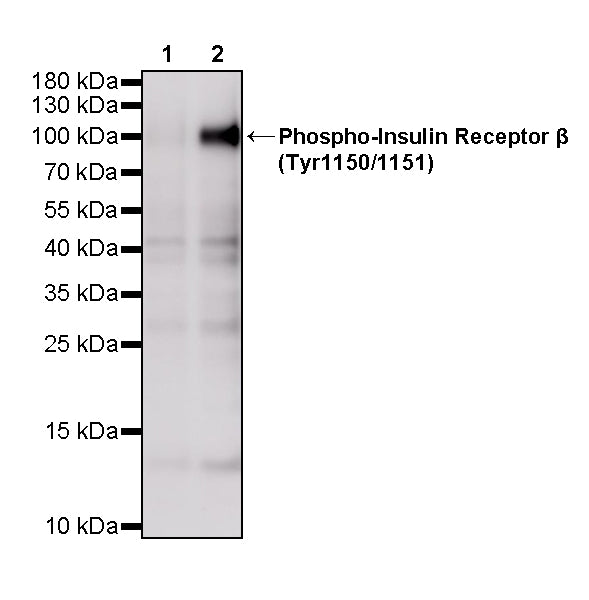
WB result of Phospho-Insulin Receptor β (Tyr1150/1151) Recombinant Rabbit mAb
Primary antibody: Phospho-Insulin Receptor β (Tyr1150/1151) Recombinant Rabbit mAb at 1/1000 dilution
Lane 1: untreated NIH/3T3 whole cell lysate 20 µg
Lane 2: NIH/3T3 treated with serum starvation overnight, add 150 nM insulin for 5 mins whole cell lysate 20 µg
Secondary antibody: Goat Anti-rabbit IgG (H+L), HRP conjugated at 1/10000 dilution
Predicted MW: 156 kDa
Observed MW: 100 kDa
This blot was developed with high sensitivity substrate
Phospho-Insulin Receptor β (Tyr1150/1151) Recombinant Rabbit mAb (S-4079-65)
Phospho-Insulin Receptor β (Tyr1150/1151) Recombinant Rabbit mAb (S-4079-65)
Price:
Regular price
$100 USD
Regular price
Sale price
$100 USD
Unit price
per
For shipping services or bulk orders, you may request a quotation.
Secure checkout with

View full details
Product Details
Product Details
Product Specification
| Host | Rabbit |
| Antigen | Phospho-Insulin Receptor β (Tyr1150/1151) |
| Synonyms | Insulin receptor; CD220; Insr |
| Immunogen | Synthetic Peptide |
| Location | Lysosome, Endosome, Cell membrane |
| Accession | P15208 |
| Clone Number | S-4079-65 |
| Antibody Type | Recombinant mAb |
| Isotype | IgG |
| Application | WB |
| Reactivity | Ms |
| Purification | Protein A |
| Concentration | 2 mg/ml |
| Conjugation | Unconjugated |
| Physical Appearance | Liquid |
| Storage Buffer | PBS, 40% Glycerol, 0.05% BSA, 0.02% sodium azide |
| Stability & Storage | 12 months from date of receipt / reconstitution, -20 °C as supplied |
Dilution
| application | dilution | species |
| WB | 1:1000 | Ms |
Background
Phospho-Insulin Receptor β (Tyr1150/1151) refers to the activated form of the insulin receptor beta subunit that has been specifically phosphorylated at tyrosine residues 1150 and 1151 within the kinase domain's activation loop, a critical post-translational modification that serves as a definitive biomarker for insulin receptor catalytic activity and downstream signal transduction. Upon insulin binding to the extracellular alpha subunits, the intrinsic tyrosine kinase activity of the beta subunit is triggered, leading to autophosphorylation at these specific sites which induces a conformational change that fully activates the kinase, thereby enabling the recruitment and phosphorylation of insulin receptor substrates (IRS) and initiating the PI3K-Akt and MAPK signaling cascades essential for glucose uptake, glycogen synthesis, and cell growth. Detection of this specific phospho-epitope using site-specific antibodies is widely utilized in biomedical research and drug discovery to assess insulin sensitivity, evaluate the efficacy of insulin mimetics or kinase inhibitors, and investigate the molecular pathophysiology of metabolic disorders such as type 2 diabetes and insulin resistance syndromes where impaired phosphorylation at Tyr1150/1151 directly correlates with defective insulin signaling.
Picture
Picture
Western Blot