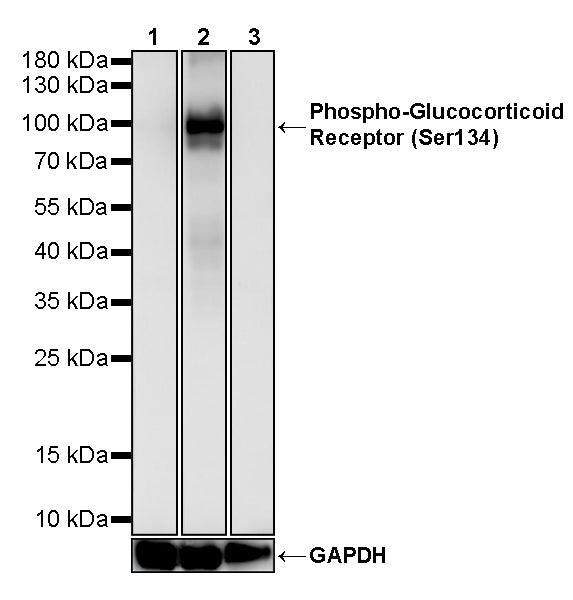
WB result of Phospho-Glucocorticoid Receptor (Ser134) Recombinant Rabbit mAb
Primary antibody: Phospho-Glucocorticoid Receptor (Ser134) Recombinant Rabbit mAb at 1/1000 dilution
Primary antibody incubation conditions: overnight at 4°C
Lane 1: untreated HeLa whole cell lysate 20 µg
Lane 2: HeLa treated with 100 mJ/cm2 UV, then recover 1 hour whole cell lysate 20 µg
Lane 3: HeLa treated with 100 mJ/cm2 UV, then recover 1 hour whole cell lysate 20 µg (phosphatase-treated membrane)
Secondary antibody: Goat Anti-rabbit IgG (H+L), HRP conjugated at 1/10000 dilution
Predicted MW: 86 kDa
Observed MW: 97 kDa
Phospho-Glucocorticoid Receptor (Ser134) Recombinant Rabbit mAb (S-5295)
Phospho-Glucocorticoid Receptor (Ser134) Recombinant Rabbit mAb (S-5295)
Price:
Regular price
$100 USD
Regular price
Sale price
$100 USD
Unit price
per
For shipping services or bulk orders, you may request a quotation.
Secure checkout with

View full details
Product Details
Product Details
Product Specification
| Host | Rabbit |
| Antigen | Phospho-Glucocorticoid receptor (Ser134) |
| Synonyms | GRL; NR3C1 |
| Location | Cytoplasm, Nucleus, Mitochondrion |
| Accession | P04150 |
| Clone Number | S-5295 |
| Antibody Type | Recombinant mAb |
| Isotype | IgG |
| Application | WB |
| Reactivity | Hu |
| Purification | Protein A |
| Concentration | 0.5 mg/ml |
| Conjugation | Unconjugated |
| Physical Appearance | Liquid |
| Storage Buffer | PBS, 40% Glycerol, 0.05% BSA, 0.02% sodium azide |
| Stability & Storage | 12 months from date of receipt / reconstitution, -20 °C as supplied |
Dilution
| application | dilution | species |
| WB | 1:1000-1:5000 | Hu |
Background
Phospho-Glucocorticoid receptor (Ser134), namely the phosphorylation modification of the glucocorticoid receptor (GR) at serine residue 134, is a critical and unique post-translational modification in the regulation of GR function. Unlike most GR phosphorylation events that are hormone-dependent, phosphorylation at Ser134 is mediated by p38 mitogen-activated protein kinase (p38 MAPK) and serves as a direct response to various cellular stress signals. This modification occurs independently of hormonal stimulation and can be induced by stressors such as glucose deprivation, ultraviolet irradiation, osmotic shock, and oxidative stress. Upon phosphorylation at this site, the binding affinity of GR for 14-3-3ζ protein is significantly enhanced. This association alters the chromatin-binding pattern of GR and attenuates its transcriptional activity, ultimately "blunting" hormone-dependent transcriptional responses in a gene-specific manner. The significance of this modification is particularly prominent under pathological conditions. For instance, in triple-negative breast cancer, factors such as transforming growth factor β (TGFβ) and hepatocyte growth factor (HGF) in the tumor microenvironment can induce p38 MAPK-mediated phosphorylation of GR at Ser134, allowing the phosphorylated GR to form complexes with molecules like 14-3-3ζ, which in turn regulates gene expression programs that promote tumor progression, including tumor cell survival, metabolic reprogramming, and migration/invasion. Therefore, the Ser134-phosphorylated GR acts as a "molecular sensor" that integrates intracellular and extracellular stress signals, converting various stress cues into finely tuned transcriptional outputs through a hormone-independent pathway.
Picture
Picture
Western Blot