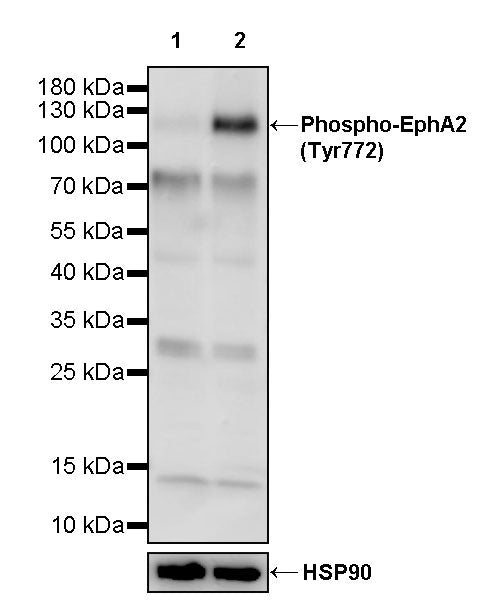
WB result of Phospho-EphA2 (Tyr772) Recombinant Rabbit mAb
Blocking/Diluting buffer and concentration: 5% NFDM/TBST
Primary antibody incubation conditions: overnight at 4°C
Primary antibody: Phospho-EphA2 (Tyr772) Recombinant Rabbit mAb at 1/1000 dilution
Lane 1: untreated MDA-MB-231 whole cell lysate 20 µg
Lane 2: MDA-MB-231 treated with 100 ng/ml Ephrin-A1-Fc for 5 minutes whole cell lysate 20 µg
Secondary antibody: Goat Anti- rabbit IgG, (H+L), HRP conjugated at 1/10000 dilution
Predicted MW: 108 kDa
Observed MW: 125 kDa
Phospho-EphA2 (Tyr772) Recombinant Rabbit mAb (S-3525-94)
Phospho-EphA2 (Tyr772) Recombinant Rabbit mAb (S-3525-94)
Price:
Regular price
$100 USD
Regular price
Sale price
$100 USD
Unit price
per
For shipping services or bulk orders, you may request a quotation.
Secure checkout with

View full details
Product Details
Product Details
Product Specification
| Host | Rabbit |
| Antigen | Phospho-EphA2 (Tyr772) |
| Synonyms | Ephrin type-A receptor 2; Epithelial cell kinase; Tyrosine-protein kinase receptor ECK; ECK; EPHA2 |
| Immunogen | Synthetic Peptide |
| Location | Cell membrane |
| Accession | P29317 |
| Clone Number | S-3525-94 |
| Antibody Type | Recombinant mAb |
| Isotype | IgG |
| Application | WB |
| Reactivity | Hu |
| Positive Sample | MDA-MB-231 (treated with 100 ng/ml Ephrin-A1-Fc for 5 minutes) |
| Purification | Protein A |
| Concentration | 0.5 mg/ml |
| Conjugation | Unconjugated |
| Physical Appearance | Liquid |
| Storage Buffer | PBS, 40% Glycerol, 0.05% BSA, 0.03% Proclin 300 |
| Stability & Storage | 12 months from date of receipt / reconstitution, -20 °C as supplied |
Dilution
| application | dilution | species |
| Dot Blot | 1:1000 | |
| WB | 1:1000 | Hu |
Background
Phospho-EphA2 (Tyr772) is a distinctive autophosphorylation site located within the activation loop of the EphA2 receptor tyrosine kinase. Its phosphorylation occurs independently of the juxtamembrane tyrosine diphosphorylation event typically required for canonical Eph receptor activation; phosphorylation of Tyr772 alone is sufficient to induce conformational activation of the kinase domain, revealing an alternative activation mechanism that distinguishes EphA2 from other family members such as EphB2. Functionally, phosphorylation at this site serves as a central switch for the ligand-dependent tumor-suppressive function of EphA2. Upon contact between tumor cells and ephrin-A1 ligands on endothelial cell surfaces, Tyr772 is rapidly phosphorylated, initiating cell-cell repulsion signals that inhibit tumor-endothelial adhesion and transendothelial migration. Conversely, inactivation of this site—via Y772F mutation or dephosphorylation mediated by the phosphatase LMW-PTP—directly releases this brake, promoting breast cancer cell extravasation and lung metastatic colonization. Notably, the phosphorylation status of Tyr772 and that of Ser897 exist in a mutually antagonistic equilibrium. The E3 ligase RNF5 downregulates Y772 phosphorylation by promoting EphA2 degradation, concomitantly enhancing oncogenic Ser897 phosphorylation. Conversely, inhibition of RNF5 stabilizes membrane EphA2 expression and shifts the balance toward the Y772 phosphorylation-dominated tumor-suppressive phenotype, increasing cell adhesion and suppressing HER2-negative breast cancer growth. Additionally, the Epstein-Barr virus latent membrane protein LMP2A modulates EphA2 Tyr772 modification via the PI3K-AKT signaling axis in gastric cancer, simultaneously restraining tumor progression and maintaining viral latency—highlighting the unique role of this site in pathogen-host interplay. Thus, pY772 not only serves as a functional epitope distinguishing the tumor-suppressive versus pro-oncogenic duality of EphA2 but also represents a molecular node where the metastatic "brake" fails, positioning it as a critical monitoring target for assessing metastatic potential and developing pro-phosphorylation intervention strategies.
Picture
Picture
Western Blot
Dot Blot
Dot blot result of Phospho-EphA2 (Tyr772) Recombinant Rabbit mAb
Lane 1: EphA2 (Tyr772) phospho peptide
Lane 2: EphA2 (Tyr772) unmodified peptide
Primary antibody: Phospho-EphA2 (Tyr772) Recombinant Rabbit mAb at 1/1000 dilution
Secondary antibody: Goat Anti-rabbit IgG, (H+L), HRP conjugated at 1/10000 dilution