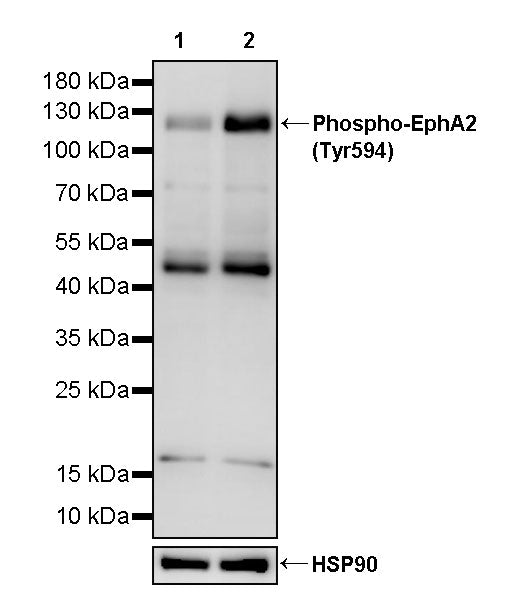
WB result of Phospho-EphA2 (Tyr594) Recombinant Rabbit mAb
Blocking/Diluting buffer and concentration: 5% NFDM/TBST
Primary antibody incubation conditions: overnight at 4°C
Primary antibody: Phospho-EphA2 (Tyr594) Recombinant Rabbit mAb at 1/1000 dilution
Lane 1: untreated MDA-MB-231 whole cell lysate 20 µg
Lane 2: MDA-MB-231 treated with 100 ng/ml Ephrin-A5-Fc for 5 minutes whole cell lysate 20 µg
Secondary antibody: Goat Anti- rabbit IgG, (H+L), HRP conjugated at 1/10000 dilution
Predicted MW: 109 kDa
Observed MW: 125 kDa
Phospho-EphA2 (Tyr594) Recombinant Rabbit mAb (S-3503-91)
Phospho-EphA2 (Tyr594) Recombinant Rabbit mAb (S-3503-91)
Price:
Regular price
$100 USD
Regular price
Sale price
$100 USD
Unit price
per
For shipping services or bulk orders, you may request a quotation.
Secure checkout with

View full details
Product Details
Product Details
Product Specification
| Host | Rabbit |
| Antigen | Phospho-EphA2 (Tyr594) |
| Synonyms | Ephrin type-A receptor 2; Epithelial cell kinase; Tyrosine-protein kinase receptor ECK; Tyrosine-protein kinase receptor MPK-5; Tyrosine-protein kinase receptor SEK-2; Eck; Myk2; Sek2; Epha2 |
| Immunogen | Synthetic Peptide |
| Location | Cell membrane |
| Accession | Q03145 |
| Clone Number | S-3503-91 |
| Antibody Type | Recombinant mAb |
| Isotype | IgG |
| Application | WB |
| Reactivity | Hu |
| Positive Sample | MDA-MB-231 treated with 100 ng/ml Ephrin-A5-Fc for 5 minutes |
| Purification | Protein A |
| Concentration | 2 mg/ml |
| Conjugation | Unconjugated |
| Physical Appearance | Liquid |
| Storage Buffer | PBS, 40% Glycerol, 0.05% BSA, 0.02% sodium azide |
| Stability & Storage | 12 months from date of receipt / reconstitution, -20 °C as supplied |
Dilution
| application | dilution | species |
| WB | 1:1000 | Hu |
Background
Phospho-EphA2 (Tyr594) is a specific modified form of the receptor tyrosine kinase EphA2 phosphorylated at tyrosine residue 594, a phosphorylation event mediated by ligand (e.g., ephrin-A1) activation or Src family kinases, representing an important indicator of its kinase activity. The activation of EphA2 involves phosphorylation at multiple tyrosine sites, among which Tyr594 is located in the activation loop within the kinase domain, and its phosphorylation is critical for stabilizing the active conformation of the kinase and enhancing its catalytic function. Phosphorylation at this site promotes the binding of EphA2 to downstream signaling molecules such as the p85 subunit of PI3K, thereby activating pro-survival and pro-proliferation pathways including PI3K-AKT and MAPK/ERK, and participating in processes such as angiogenesis, cell migration, and tissue boundary formation during normal development. However, in many malignant tumors (including breast cancer, lung cancer, glioblastoma, etc.), EphA2 is frequently hyperphosphorylated (including at the Tyr594 site), and this aberrant modification is closely associated with enhanced tumor cell invasiveness, epithelial-mesenchymal transition (EMT), and poor prognosis. Therefore, Phospho-EphA2 (Tyr594) not only serves as a functional phosphorylation site reflecting EphA2 kinase activity but is also widely used as a key molecular marker for studying the activation status of the EphA2 signaling pathway and its role in cancer progression, as well as a potential therapeutic intervention target.
Picture
Picture
Western Blot