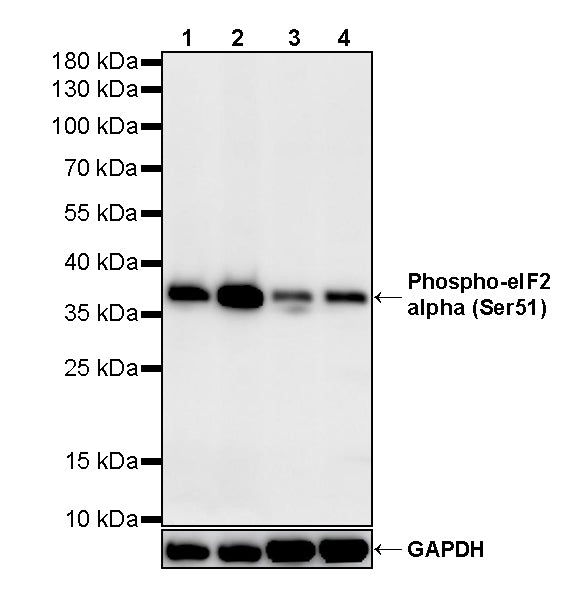
WB result of Phospho-eIF2 alpha (Ser51) Recombinant Rabbit mAb
Primary antibody: Phospho-eIF2 alpha (Ser51) Recombinant Rabbit mAb at 1/1000 dilution
Primary antibody incubation conditions: overnight at 4°C
Lane 1: untreated AR42J whole cell lysate 20 µg
Lane 2: AR42J treated with 1 μM Thapsigargin for 20 minutes whole cell lysate 20 µg
Lane 3: untreated C6 whole cell lysate 20 µg
Lane 4: C6 treated with 300 nM Thapsigargin for 2 hours whole cell lysate 20 µg
Secondary antibody: Goat Anti-rabbit IgG (H+L), HRP conjugated at 1/10000 dilution
Predicted MW: 36 kDa
Observed MW: 37 kDa
Phospho-eIF2 alpha (Ser51) Recombinant Rabbit mAb (S-6195)
Phospho-eIF2 alpha (Ser51) Recombinant Rabbit mAb (S-6195)
Price:
Regular price
$100 USD
Regular price
Sale price
$100 USD
Unit price
per
For shipping services or bulk orders, you may request a quotation.
Secure checkout with

View full details
Product Details
Product Details
Product Specification
| Host | Rabbit |
| Antigen | Phospho-eIF2 alpha (Ser51) |
| Location | Cytoplasm, Mitochondrion |
| Accession | P05198 |
| Clone Number | S-6195 |
| Antibody Type | Recombinant mAb |
| Isotype | IgG |
| Application | WB |
| Reactivity | Hu, Ms, Rt, Mk |
| Purification | Protein A |
| Concentration | 0.5 mg/ml |
| Conjugation | Unconjugated |
| Physical Appearance | Liquid |
| Storage Buffer | PBS, 40% Glycerol, 0.05% BSA, 0.02% sodiμM azide |
| Stability & Storage | 12 months from date of receipt / reconstitution, -20 °C as supplied |
Dilution
| application | dilution | species |
| WB | 1:1000 | Hu, Ms, Rt, Mk, Dm |
Background
Phospho-eIF2α (Ser51) refers to the phosphorylation of the eukaryotic translation initiation factor 2 alpha subunit at serine 51, a highly conserved and central signaling event in the integrated stress response (ISR). Under normal conditions, eIF2 delivers initiator tRNA to the ribosome in its active GTP-bound state; phosphorylation at Ser51 blocks the guanine nucleotide exchange factor eIF2B, preventing the recycling of eIF2-GDP back to eIF2-GTP and thereby rapidly and globally attenuating cap-dependent protein synthesis. This modification is catalyzed by one of four stress-responsive kinases—PERK (ER stress), PKR (viral infection), GCN2 (amino acid deprivation), and HRI (heme deficiency/oxidative stress)—each responding to distinct cellular threats. While global translation is suppressed, phospho-eIF2α paradoxically promotes the selective translation of certain mRNAs containing upstream open reading frames, most notably the transcription factor ATF4, which then drives the expression of adaptive genes involved in amino acid metabolism, antioxidant defense, and stress recovery. The magnitude and duration of this phosphorylation determine cell fate: transient activation supports survival and proteostasis, whereas chronic phosphorylation can lead to maladaptive outcomes and cell death. The modification is tightly regulated by phosphatases; GADD34 and CReP recruit protein phosphatase 1 to dephosphorylate eIF2α, restoring translation and forming a negative feedback loop essential for cellular homeostasis. In disease contexts, persistent phospho-eIF2α has been implicated in tμMor hypoxia tolerance, chemotherapy resistance, and neurodegenerative pathology, and small-molecule inhibitors such as ISRIB that block its downstream effects have emerged as promising tools for modulating memory and cellular stress responses.
Picture
Picture
Western Blot