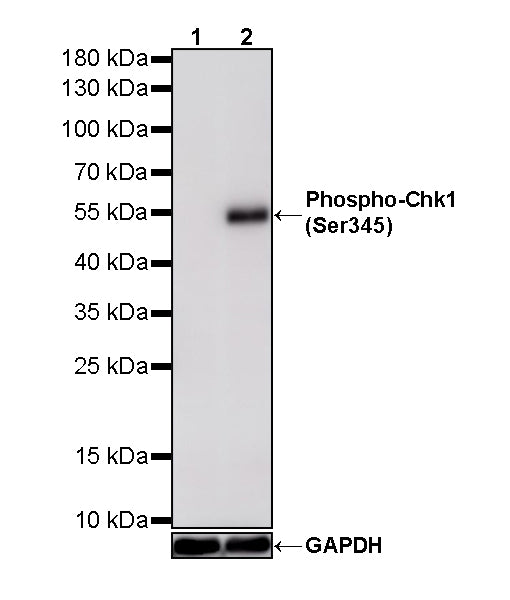
WB result of Phospho-Chk1 (Ser345) Recombinant Rabbit mAb
Primary antibody: Phospho-Chk1 (Ser345) Recombinant Rabbit mAb at 1/1000 dilution
Blocking/Diluting buffer and concentration: 5% NFDM/TBST
Primary antibody incubation conditions: overnight at 4°C
Lane 1: untreated HeLa whole cell lysate 20 µg
Lane 2: HeLa treated with 100 mJ/cm2 UV then recovery 2 hours whole cell lysate 20 µg
Secondary antibody: Goat Anti-rabbit IgG (H+L), HRP conjugated at 1/10000 dilution
Predicted MW: 54 kDa
Observed MW: 55 kDa
Phospho-Chk1 (Ser345) Recombinant Rabbit mAb (S-6275)
Phospho-Chk1 (Ser345) Recombinant Rabbit mAb (S-6275)
Price:
Regular price
$100 USD
Regular price
Sale price
$100 USD
Unit price
per
For shipping services or bulk orders, you may request a quotation.
Secure checkout with

View full details
Product Details
Product Details
Product Specification
| Host | Rabbit |
| Antigen | Phospho-Chk1 (Ser345) |
| Synonyms | Serine/threonine-protein kinase Chk1; CHK1 checkpoint homolog; Checkpoint kinase-1; Chk1; Chek1 |
| Location | Cytoplasm, Cytoskeleton, Nucleus |
| Accession | Q91ZN7 |
| Clone Number | S-6275 |
| Antibody Type | Recombinant mAb |
| Isotype | IgG |
| Application | WB |
| Reactivity | Hu, Ms, Rt |
| Purification | Protein A |
| Concentration | 0.5 mg/ml |
| Conjugation | Unconjugated |
| Physical Appearance | Liquid |
| Storage Buffer | PBS, 40% Glycerol, 0.05% BSA, 0.02% sodium azide |
| Stability & Storage | 12 months from date of receipt / reconstitution, -20 °C as supplied |
Dilution
| application | dilution | species |
| WB | 1:1000 | Hu, Ms, Rt |
Background
Phospho-Chk1 (Ser345) refers to the activated form of checkpoint kinase 1 (Chk1) generated upon phosphorylation at the Ser345 residue, and represents a core marker event of ATR signaling pathway activation in the DNA damage response and under replication stress. Under genotoxic stress conditions (such as ultraviolet radiation, ionizing radiation, or hydroxyurea treatment), ATR kinase directly catalyzes phosphorylation of Chk1 at Ser345; this phosphorylation event in turn promotes Chk1 autophosphorylation at Ser296 and enhances its kinase activity. Mechanistically, Ser345 phosphorylation creates a binding site for 14-3-3 proteins, and 14-3-3 binding relieves autoinhibition of the Chk1 catalytic domain and retains activated Chk1 in the nucleoplasm, thereby enabling it to access and phosphorylate key substrates such as Cdc25A and Cdc25C, ultimately leading to cell cycle arrest to allow time for DNA repair. In experimental and clinical applications, the phosphorylation level at Ser345 is widely used as a pharmacodynamic marker of ATR kinase activity: treatment with ATR inhibitors significantly reduces phospho-Chk1 (Ser345) levels, whereas direct Chk1 inhibitors do not affect phosphorylation at this site (the latter is marked by Ser296 autophosphorylation). Clinical studies have further shown that high levels of cytoplasmic phospho-Chk1 (Ser345) in breast cancer are associated with an aggressive phenotype and poor prognosis, and can serve as a predictive indicator of early local recurrence and radiotherapy resistance.
Picture
Picture
Western Blot
WB result of Phospho-Chk1 (Ser345) Recombinant Rabbit mAb
Primary antibody: Phospho-Chk1 (Ser345) Recombinant Rabbit mAb at 1/1000 dilution
Blocking/Diluting buffer and concentration: 5% NFDM/TBST
Primary antibody incubation conditions: overnight at 4°C
Lane 1: untreated NIH/3T3 whole cell lysate 20 µg
Lane 2: NIH/3T3 treated with 100 mJ/cm2 UV then recovery 2 hours whole cell lysate 20 µg
Secondary antibody: Goat Anti-rabbit IgG (H+L), HRP conjugated at 1/10000 dilution
Predicted MW: 54 kDa
Observed MW: 55 kDa
This blot was developed with high sensitivity substrate
WB result of Phospho-Chk1 (Ser345) Recombinant Rabbit mAb
Primary antibody: Phospho-Chk1 (Ser345) Recombinant Rabbit mAb at 1/1000 dilution
Blocking/Diluting buffer and concentration: 5% NFDM/TBST
Primary antibody incubation conditions: overnight at 4°C
Lane 1: untreated C6 whole cell lysate 20 µg
Lane 2: C6 treated with 40 mJ/cm2 UV then recovery 30 minutes whole cell lysate 20 µg
Secondary antibody: Goat Anti-rabbit IgG (H+L), HRP conjugated at 1/10000 dilution
Predicted MW: 54 kDa
Observed MW: 54 kDa
This blot was developed with high sensitivity substrate