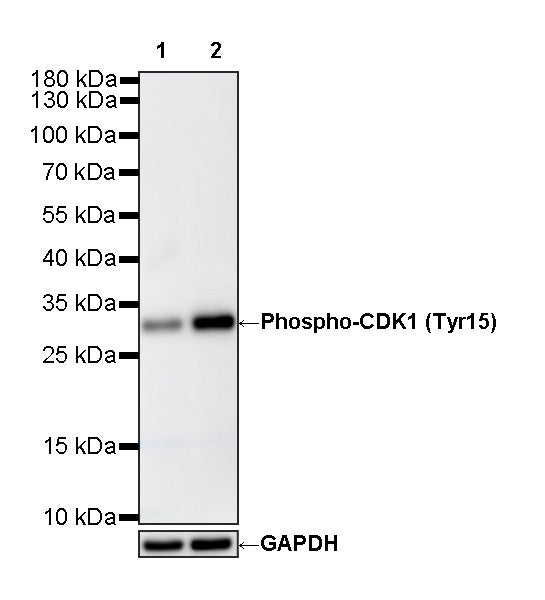
WB result of Phospho-CDK1 (Tyr15) Recombinant Rabbit mAb Primary antibody: Phospho-CDK1 (Tyr15) Recombinant Rabbit mAb at 1/1000 dilution
Blocking/Diluting buffer and concentration: 5% NFDM/TBST
Lane 1: untreated HeLa whole cell lysate 20 µg
Lane 2: HeLa treated with 4mM Hydroxyurea for 20 hours whole cell lysate 20 µg
Secondary antibody: Goat Anti-Rabbit IgG (H+L), HRP conjugated at 1/10000 dilution
Predicted MW: 54 kDa
Observed MW: 31 kDa
Phospho-CDK1 (Tyr15) Recombinant Rabbit mAb (S-6330)
Phospho-CDK1 (Tyr15) Recombinant Rabbit mAb (S-6330)
Price:
Regular price
$100 USD
Regular price
Sale price
$100 USD
Unit price
per
For shipping services or bulk orders, you may request a quotation.
Secure checkout with

View full details
Product Details
Product Details
Product Specification
| Host | Rabbit |
| Antigen | Phospho-CDK1 (Tyr15) |
| Synonyms | Serine/threonine-protein kinase Chk1; CHK1 checkpoint homolog; Cell cycle checkpoint kinase; Checkpoint kinase-1; CHK1; CHEK1 |
| Location | Cytoplasm, Cytoskeleton, Nucleus |
| Accession | O14757 |
| Clone Number | S-6330 |
| Antibody Type | Recombinant mAb |
| Isotype | IgG |
| Application | WB |
| Reactivity | Hu |
| Purification | Protein A |
| Concentration | 0.5 mg/ml |
| Conjugation | Unconjugated |
| Physical Appearance | Liquid |
| Storage Buffer | PBS, 40% Glycerol, 0.05% BSA, 0.02% sodium azide |
| Stability & Storage | 12 months from date of receipt / reconstitution, -20 °C as supplied |
Dilution
| application | dilution | species |
| WB | 1:1000-1:2000 | Hu |
Background
Phospho-CDK1 (Tyr15) refers to the inactive form of cyclin-dependent kinase 1 (CDK1) generated upon phosphorylation at the Tyr15 residue, and represents a core molecular event in G2/M checkpoint regulation. Once CDK1 binds Cyclin B, it is poised to drive cells into mitosis, but phosphorylation of Tyr15 by Wee1 kinase inhibits its kinase activity, causing cells to arrest in G2 phase to allow completion of DNA repair or to cope with replication stress. When cells are ready to divide, the Cdc25 phosphatase removes the phosphate group at Tyr15, and CDK1 becomes activated and triggers mitotic entry. In experimental detection, the phosphorylation level at Tyr15 is commonly used as a marker of CDK1 inactivation and G2/M arrest: low levels of phospho-CDK1 (Tyr15) indicate that CDK1 is activated and cells are entering mitosis, whereas elevated phosphorylation at this site reflects checkpoint activation or suppression of CDK1 activity. In clinically relevant studies, combined detection of phospho-CDK1 (Tyr15) and dephosphorylated CDK1 has been used to assess prognosis in non-small cell lung cancer, with both showing prognostic significance.
Picture
Picture
Western Blot