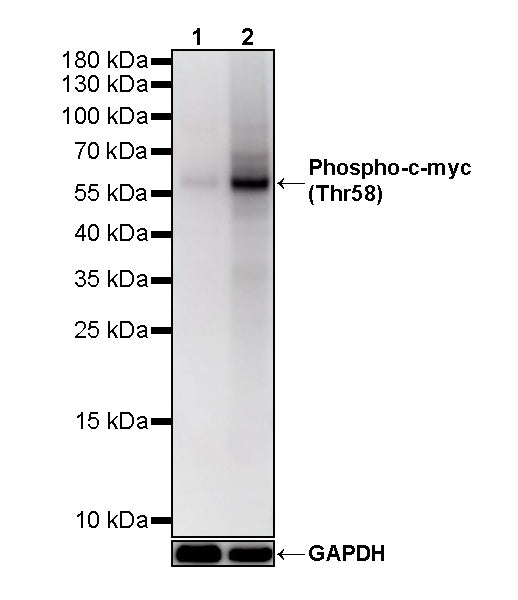
WB result of Phospho-c-myc(Thr58) Recombinant Rabbit mAb
Primary antibody: Phospho-c-myc(Thr58) Recombinant Rabbit mAb at 1/1000 dilution
Blocking/Diluting buffer and concentration: 5% NFDM/TBST
Lane 1: untreated HCT 116 whole cell lysate 20 µg
Lane 2: HCT 116 treated with 10 uM MG132 overnight whole cell lysate 20 µg
Secondary antibody: Goat Anti-rabbit IgG (H+L), HRP conjugated at 1/10000 dilution
Predicted MW: 51 kDa
Observed MW: 60 kDa
Phospho-c-Myc (Thr58) Recombinant Rabbit mAb (S-1060-277)
Phospho-c-Myc (Thr58) Recombinant Rabbit mAb (S-1060-277)
Price:
Regular price
$100 USD
Regular price
Sale price
$100 USD
Unit price
per
For shipping services or bulk orders, you may request a quotation.
Secure checkout with

View full details
Product Details
Product Details
Product Specification
| Host | Rabbit |
| Antigen | Phospho-c-Myc (Thr58) |
| Synonyms | Myc proto-oncogene protein; Class E basic helix-loop-helix protein 39 (bHLHe39); Proto-oncogene c-Myc; Transcription factor p64; BHLHE39; MYC |
| Immunogen | Synthetic Peptide |
| Location | Cytoplasm, Nucleus |
| Accession | P01106 |
| Clone Number | S-1060-277 |
| Antibody Type | Recombinant mAb |
| Isotype | IgG |
| Application | WB |
| Reactivity | Hu |
| Purification | Protein A |
| Concentration | 2 mg/ml |
| Conjugation | Unconjugated |
| Physical Appearance | Liquid |
| Storage Buffer | PBS, 40% Glycerol, 0.05% BSA, 0.02% sodium azide |
| Stability & Storage | 12 months from date of receipt / reconstitution, -20 °C as supplied |
Dilution
| application | dilution | species |
| WB | 1:1000-2000 | Hu |
Background
Phospho-c-Myc (Thr58) refers to the modified form of the transcription factor c-Myc generated upon phosphorylation at the Thr58 residue, and represents a core molecular event regulating c-Myc protein stability and degradation. Phosphorylation at this site is catalyzed by glycogen synthase kinase-3 (GSK-3) and requires prior phosphorylation at Ser62 as a "priming" signal. Following Thr58 phosphorylation, c-Myc is recognized by the Fbw7-SCF ubiquitin ligase complex, undergoes polyubiquitination, and is rapidly degraded via the proteasome pathway. In terms of functional consequences, Thr58 is a mutational hotspot in aggressive lymphomas such as Burkitt lymphoma; mutation at this site abolishes phosphorylation and markedly increases protein stability, thereby enhancing the transforming potential of c-Myc. In addition, Thr58 phosphorylation alters the subnuclear localization of c-Myc, enhancing its accumulation in discrete nuclear bodies. In experimental detection, the Thr58 phosphorylation level is often used as an indicator of the integrity of the c-Myc degradation pathway: reduced or absent phosphorylation at this site suggests abnormally increased c-Myc protein stability, which may be associated with tumorigenesis.
Picture
Picture
Western Blot