WB result of PHD-2 Recombinant Rabbit mAb
Primary antibody: PHD-2 Recombinant Rabbit mAb at 1/1000 dilution
Lane 1: SH-SY5Y whole cell lysate 20 µg
Lane 2: HeLa whole cell lysate 20 µg
Lane 3: HepG2 whole cell lysate 20 µg
Lane 4: HEK-293 whole cell lysate 20 µg
Secondary antibody: Goat Anti- rabbit IgG, (H+L), HRP conjugated at 1/10000 dilution
Predicted MW: 46 kDa
Observed MW: 46 kDa
PHD-2 Recombinant Rabbit mAb (S-4111-17)
PHD-2 Recombinant Rabbit mAb (S-4111-17)
Price:
Regular price
$100 USD
Regular price
Sale price
$100 USD
Unit price
per
For shipping services or bulk orders, you may request a quotation.
Secure checkout with

View full details
Product Details
Product Details
Product Specification
| Host | Rabbit |
| Antigen | PHD-2 |
| Synonyms | Egl nine homolog 1; Hypoxia-inducible factor prolyl hydroxylase 2 (HIF-PH2; HIF-prolyl hydroxylase 2; HPH-2); Prolyl hydroxylase domain-containing protein 2 (PHD2); SM-20; C1orf12; EGLN1 |
| Immunogen | Synthetic Peptide |
| Location | Cytoplasm, Nucleus |
| Accession | Q9GZT9 |
| Clone Number | S-4111-17 |
| Antibody Type | Recombinant mAb |
| Isotype | IgG |
| Application | WB, ICC |
| Reactivity | Hu, Ms, Rt, Mk |
| Positive Sample | SH-SY5Y, HeLa, HepG2, HEK-293, NIH/3T3, mouse brain, C6, rat brain, COS-7 |
| Purification | Protein A |
| Concentration | 0.5 mg/ml |
| Conjugation | Unconjugated |
| Physical Appearance | Liquid |
| Storage Buffer | PBS, 40% Glycerol, 0.05% BSA, 0.03% Proclin 300 |
| Stability & Storage | 12 months from date of receipt / reconstitution, -20 °C as supplied |
Dilution
| application | dilution | species |
| WB | 1:1000 | Hu, Ms, Rt, Mk |
| ICC | 1:50 | Hu |
Background
Prolyl hydroxylase domain-containing protein 2 (PHD2), also known as EGLN1, is a crucial iron- and oxygen-dependent dioxygenase that serves as the primary cellular oxygen sensor regulating the hypoxia-inducible factor (HIF) pathway under normoxic conditions. By catalyzing the hydroxylation of specific proline residues on the alpha subunits of HIF, PHD2 marks these transcription factors for von Hippel-Lindau (VHL)-mediated ubiquitination and subsequent proteasomal degradation, thereby preventing the accumulation of HIF and the activation of hypoxia-responsive genes when oxygen levels are sufficient. This enzymatic activity is tightly coupled to cellular metabolic status, as it requires molecular oxygen, ferrous iron, and 2-oxoglutarate as cofactors, making PHD2 a central node in integrating oxygen availability with metabolic signaling; consequently, its dysfunction or inhibition leads to HIF stabilization, which drives adaptive responses such as angiogenesis, erythropoiesis, and metabolic reprogramming, highlighting its significant potential as a therapeutic target for conditions ranging from anemia and ischemic diseases to cancer.
Picture
Picture
Western Blot
WB result of PHD-2 Recombinant Rabbit mAb
Primary antibody: PHD-2 Recombinant Rabbit mAb at 1/1000 dilution
Lane 1: NIH/3T3 whole cell lysate 20 µg
Lane 2: mouse brain lysate 20 µg
Secondary antibody: Goat Anti- rabbit IgG, (H+L), HRP conjugated at 1/10000 dilution
Predicted MW: 46 kDa
Observed MW: 46 kDa
WB result of PHD-2 Recombinant Rabbit mAb
Primary antibody: PHD-2 Recombinant Rabbit mAb at 1/1000 dilution
Lane 1: C6 whole cell lysate 20 µg
Lane 2: rat brain lysate 20 µg
Secondary antibody: Goat Anti- rabbit IgG, (H+L), HRP conjugated at 1/10000 dilution
Predicted MW: 46 kDa
Observed MW: 46 kDa
WB result of PHD-2 Recombinant Rabbit mAb
Primary antibody: PHD-2 Recombinant Rabbit mAb at 1/1000 dilution
Lane 1: COS-7 whole cell lysate 20 µg
Secondary antibody: Goat Anti- rabbit IgG, (H+L), HRP conjugated at 1/10000 dilution
Predicted MW: 46 kDa
Observed MW: 46 kDa
Immunocytochemistry
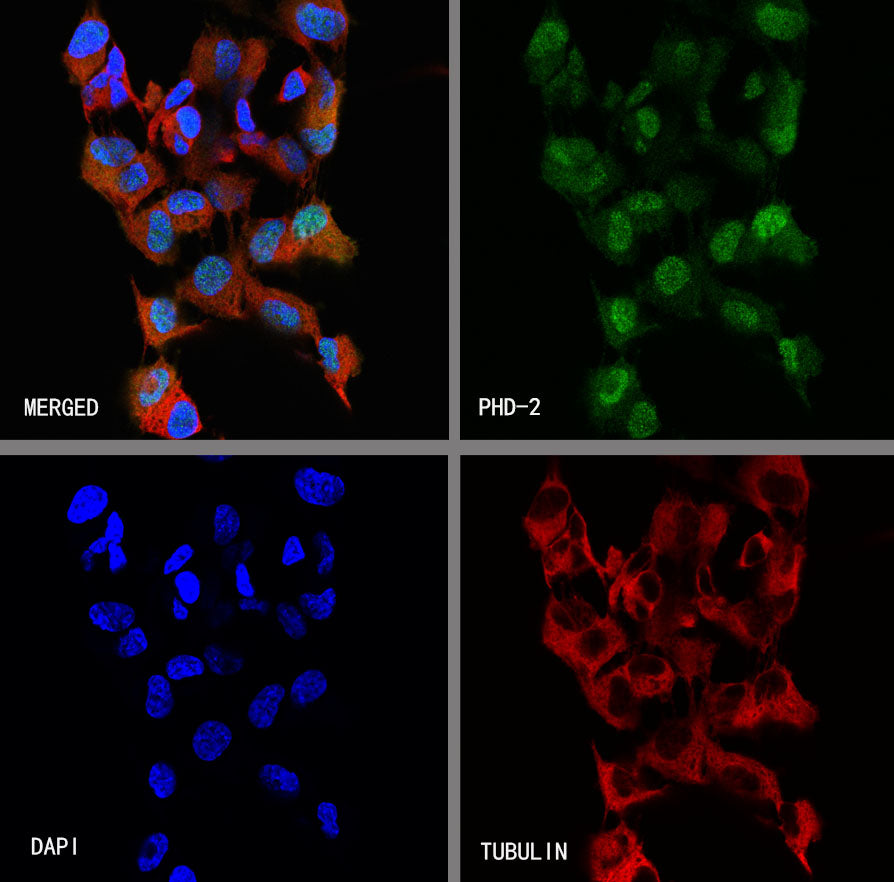
ICC shows positive staining in SH-SY5Y cells. Anti-PHD-2 antibody was used at 1/50 dilution (Green) and incubated overnight at 4°C. Goat polyclonal Antibody to Rabbit IgG - H&L (Alexa Fluor® 488) was used as secondary antibody at 1/1000 dilution. The cells were fixed with 4% PFA and permeabilized with 0.1% PBS-Triton X-100. Nuclei were counterstained with DAPI (Blue). Counterstain with tubulin (Red).