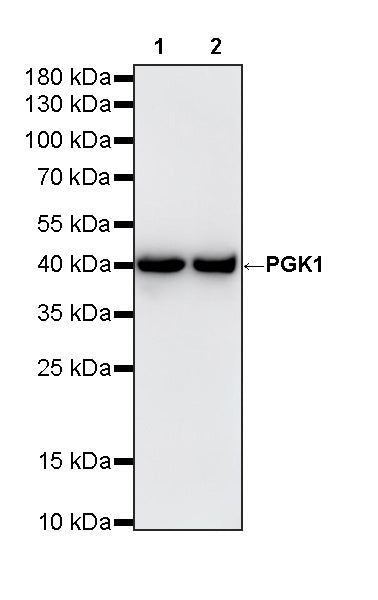
WB result of PGK1 Recombinant Rabbit mAb
Primary antibody:PGK1 Recombinant Rabbit mAb at 1/1000 dilution
Lane 1: HeLa whole cell lysate 20 µg
Lane 2: HepG2 whole cell lysate 20 µg
Lane 3: K-562 whole cell lysate 20 µg
Lane 4: HT-29 whole cell lysate 20 µg
Secondary antibody: Goat Anti-Rabbit IgG, (H+L), HRP conjugated at 1/10000 dilution
Predicted MW: 45 kDa
Observed MW: 40 kDa
PGK1 Recombinant Rabbit mAb
PGK1 Recombinant Rabbit mAb
Price:
Regular price
$100 USD
Regular price
Sale price
$100 USD
Unit price
per
For shipping services or bulk orders, you may request a quotation.
Secure checkout with

View full details
Product Details
Product Details
Product Specification
| Host | Rabbit |
| Antigen | PGK1 |
| Synonyms | Phosphoglycerate kinase 1; Cell migration-inducing gene 10 protein; Primer recognition protein 2 (PRP 2); PGKA |
| Location | Cytoplasm, Mitochondrion |
| Accession | P00558 |
| Antibody Type | Recombinant mAb |
| Isotype | IgG |
| Application | WB |
| Reactivity | Hu, Ms, Rt |
| Positive Sample | HeLa, HepG2, K-562, HT-29, NIH/3T3, mouse brain, C6, rat brain |
| Purification | Protein A |
| Concentration | 0.5 mg/ml |
| Conjugation | Unconjugated |
| Physical Appearance | Liquid |
| Storage Buffer | PBS, 40% Glycerol, 0.05% BSA, 0.02% sodium azide |
| Stability & Storage | 12 months from date of receipt / reconstitution, -20 °C as supplied |
Dilution
| application | dilution | species |
| WB | 1:1000-1:10000 | Hu, Ms, Rt |
Background
PGK1 (phosphoglycerate kinase 1) is a key metabolic enzyme in the glycolytic pathway, encoded by the PGK1 gene. It catalyzes the reversible transfer of a phosphate group between 1,3-bisphosphoglycerate and ADP in the cytoplasm, generating 3-phosphoglycerate and ATP—this constitutes the first ATP-producing step in glycolysis, playing an indispensable role in maintaining the cellular supply of energy currency. This protein belongs to the phosphoglycerate kinase family and features a typical two-domain three-dimensional structure connected by a hinge region, undergoing conformational changes upon substrate binding to achieve catalytic function. It is also an evolutionarily highly conserved enzyme, with homologs found in virtually all organisms. Beyond its classical metabolic function, PGK1 also possesses non-enzymatic functions, such as acting as an angiogenic factor when secreted extracellularly or participating in the regulation of fibrinolysis by binding to cell surface receptors. In tumor biology, PGK1 expression is often upregulated by HIF-1α-mediated hypoxic responses, thereby enhancing the glycolytic capacity of tumor cells to adapt to the hypoxic microenvironment, and its overexpression is closely associated with poor prognosis in various cancers (including liver, gastric, and lung cancers). Furthermore, defects or mutations in the PGK1 gene can lead to phosphoglycerate kinase deficiency, a rare X-linked recessive disorder in which patients primarily present with hemolytic anemia, rhabdomyolysis, and neurological dysfunction (such as epilepsy and ataxia), reflecting the multiple important roles of this protein in erythrocyte energy metabolism, muscle contractile function, and neuronal activity maintenance.
Picture
Picture
Western Blot
WB result of PGK1 Recombinant Rabbit mAb
Primary antibody:PGK1 Recombinant Rabbit mAb at 1/1000 dilution
Lane 1: NIH/3T3 whole cell lysate 20 µg
Lane 2: mouse brain lysate 20 µg
Secondary antibody: Goat Anti-Rabbit IgG, (H+L), HRP conjugated at 1/10000 dilution
Predicted MW: 45 kDa
Observed MW: 40 kDa
WB result of PGK1 Recombinant Rabbit mAb
Primary antibody:PGK1 Recombinant Rabbit mAb at 1/1000 dilution
Lane 1: C6 whole cell lysate 20 µg
Lane 2: rat brain lysate 20 µg
Secondary antibody: Goat Anti-Rabbit IgG, (H+L), HRP conjugated at 1/10000 dilution
Predicted MW: 45 kDa
Observed MW: 40 kDa