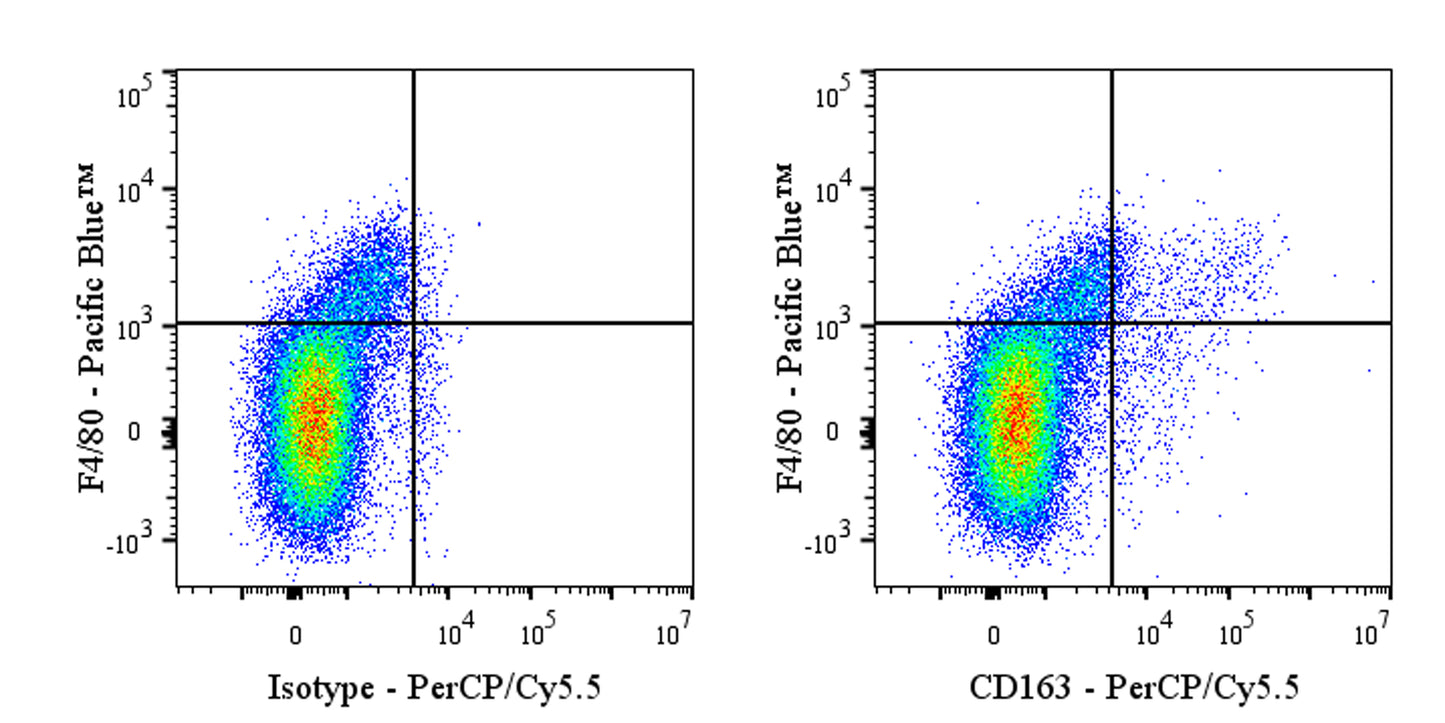
Flow cytometric analysis of Mouse CD163 expression on BALB/c mouse peritoneal exudates cells. BALB/c mouse peritoneal exudates cells were stained with Pacific Blue™ Rat Anti-Mouse F4/80 Antibody and either PerCP-Cy5.5 Rat IgG2a, κ Isotype Control (left panel) or SDT PerCP-Cy5.5 Rat Anti-Mouse CD163 Antibody (right panel) at 5 μl/test treated with True-Stain Monocyte Blocker™. Flow cytometry and data analysis were performed using BD FACSymphony™ A1 and FlowJo™ software.
PerCP-Cy5.5 Rat Anti-Mouse CD163 Antibody (S-R608)
PerCP-Cy5.5 Rat Anti-Mouse CD163 Antibody (S-R608)
Price:
Regular price
$158 USD
Regular price
Sale price
$158 USD
Unit price
per
For shipping services or bulk orders, you may request a quotation.
Secure checkout with

View full details
Product Details
Product Details
Product Specification
| Host | Rat |
| Antigen | CD163 |
| Synonyms | Cd163 |
| Location | Membrane |
| Accession | B7ZMW6 |
| Clone Number | S-R608 |
| Antibody Type | Rat mAb |
| Isotype | IgG2a,k |
| Application | FCM |
| Reactivity | Ms |
| Positive Sample | BALB/c mouse peritoneal exudates cells |
| Purification | Protein G |
| Concentration | 0.2 mg/ml |
| Conjugation | PerCP-Cy5.5 |
| Physical Appearance | Liquid |
| Storage Buffer | PBS, 1% BSA, 0.3% Proclin 300 |
| Stability & Storage | 12 months from date of receipt / reconstitution, 2 to 8 °C as supplied |
Dilution
| application | dilution | species |
| FCM | 1μg per million cells in 100μl volume | Ms |
Background
CD163 is a 130 kDa type I transmembrane glycoprotein and a member of the scavenger receptor cysteine-rich (SRCR) superfamily. It is exclusively expressed on monocytes and macrophages and is involved in the clearance and endocytosis of hemoglobin-haptoglobin complexes, which helps protect tissues from oxidative damage caused by free hemoglobin. The protein consists of nine SRCR domains, a single transmembrane segment, and a short cytoplasmic tail. CD163 is upregulated in macrophages during the switch to alternative activated phenotypes in inflammation and is considered a marker for anti-inflammatory macrophages. Elevated levels of soluble CD163, which result from the shedding of the membrane-bound form, have been observed in various acute and chronic inflammatory disorders, making it a potential biomarker for inflammation. Additionally, CD163 is being explored as a therapeutic target for delivering drugs to macrophages in inflammatory conditions.
Picture
Picture
FC