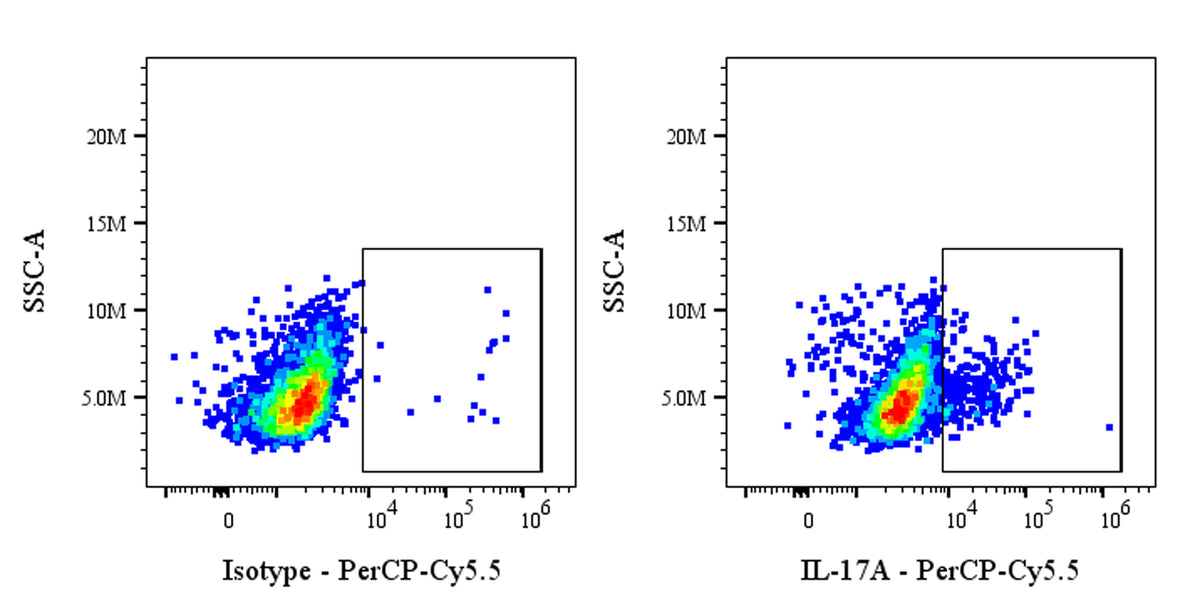
Flow cytometric analysis of IL-17A expression in human PBMCs polarized with Th17 Polarization Kit, Human (UA090019). Th17 polarized human PBMCs were harvested and restimulated for 5 hr with PMA and Ionomycin in the presence of Brefeldin A.
The cells were harvested and fixed with 4% PFA and permeabilized with Intracellular Fixation & Permeabilization Buffer Set. The cells were then stained with either PerCP-Cy5.5 Mouse IgG1, κ Isotype Control (left panel) or SDT PerCP-Cy5.5 Mouse Anti-Human IL-17A Antibody at 5 μl/test (right panel) treated with True-Stain Monocyte Blocker™. Total viable cells, as determined by Fixable Viability Dye 452 (S0B88801), were used for analysis. Flow cytometry and data analysis were performed using Agilent NovoCyte Quanteon and FlowJo™ software.
PerCP-Cy5.5 Mouse Anti-Human IL-17A Antibody (S-3341)
PerCP-Cy5.5 Mouse Anti-Human IL-17A Antibody (S-3341)

Product Details
Product Details
Product Specification
| Host | Mouse |
| Antigen | IL-17A |
| Location | Secreted |
| Accession | Q16552 |
| Clone Number | S-3341 |
| Antibody Type | Mouse mAb |
| Isotype | IgG1,k |
| Isotype Control | S0B1582 |
| Application | ICFCM |
| Reactivity | Hu |
| Positive Sample | Th17 polarized human PBMC |
| Purification | Protein G |
| Concentration | 0.2 mg/ml |
| Conjugation | PerCP-Cy5.5 |
| Physical Appearance | Liquid |
| Storage Buffer | PBS, 1% BSA, 0.09% sodium azide |
| Stability & Storage | 12 months from date of receipt / reconstitution, 2 to 8 °C as supplied |
Background
IL-17A is a 155-amino-acid, disulfide-linked homodimeric pro-inflammatory cytokine secreted primarily by Th17 cells, γδ T cells and innate lymphoid cells; it engages the ubiquitously expressed IL-17RA/RC receptor complex to trigger TRAF6- and Act1-dependent signaling cascades that activate NF-κB, MAPKs and C/EBP transcription factors, thereby inducing massive release of neutrophil-mobilizing chemokines (CXCL1, CXCL8), G-CSF, IL-6 and antimicrobial peptides, orchestrating granulopoiesis, extracellular-matrix remodeling and barrier immunity; dysregulated IL-17A underlies autoimmune pathologies such as psoriasis, ankylosing spondylitis and multiple sclerosis, making it the target of FDA-approved biologics like secukinumab and ixekizumab.
Picture
Picture
FC