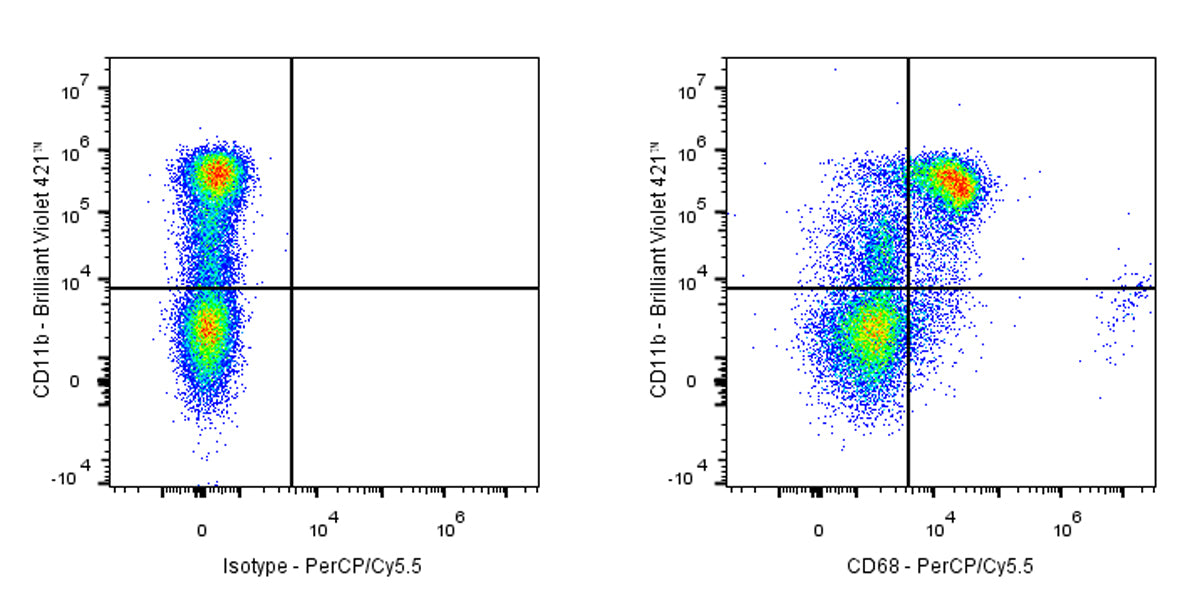
Human PBMC (human peripheral blood mononuclear cells) were fixed with 4% PFA and permeabilization with the 0.1% Tween. Cells were then intracellularly stained with Brilliant Violet 421™ Mouse Anti-Human CD11b and either PerCP-Cy5.5 Mouse IgG2b, κ Isotype Control / (Left panel) or PerCP-Cy5.5 Mouse Anti-Human CD68 Antibody at 1.25μl/test / (Right panel) treated with True-Stain Monocyte Blocker™. Flow cytometry and data analysis were performed using BD FACSymphony™ A1 and FlowJo™ software.
PerCP-Cy5.5 Mouse Anti-Human CD68 Antibody (Y1/82A)
PerCP-Cy5.5 Mouse Anti-Human CD68 Antibody (Y1/82A)
Price:
Regular price
$200 USD
Regular price
Sale price
$200 USD
Unit price
per
For shipping services or bulk orders, you may request a quotation.
Secure checkout with

View full details
Product Details
Product Details
Product Specification
| Host | Mouse |
| Antigen | CD68 |
| Synonyms | Macrosialin; Gp110 |
| Location | Cell membrane |
| Accession | P34810 |
| Clone Number | Y1/82A |
| Antibody Type | Mouse mAb |
| Isotype | IgG2b,k |
| Application | FCM |
| Reactivity | Hu |
| Positive Sample | Human PBMC |
| Purification | Protein A |
| Concentration | 0.2 mg/ml |
| Conjugation | PerCP-Cy5.5 |
| Physical Appearance | Liquid |
| Storage Buffer | PBS, 1% BSA, 0.3% Proclin 300 |
| Stability & Storage | 12 months from date of receipt / reconstitution, 2 to 8 °C as supplied |
Dilution
| application | dilution | species |
| ICFCM | 1.25μl per million cells in 100μl volume | Hu |
Background
CD68 is a heavily glycosylated, 110 kDa type I transmembrane glycoprotein of the lysosome-associated membrane protein (LAMP) family (also called LAMP-4) that is highly expressed on human monocytes, macrophages, osteoclasts, and other myeloid cells, where it predominantly localizes to lysosomes and endosomes and participates in phagocytosis, debris clearance, and inflammatory responses via its scavenger-receptor activity, while alternative splicing produces multiple isoforms and its presence on tumor cells and ability to bind selectins implicate it in metastasis, making it a widely used histological macrophage marker.
Picture
Picture
FC