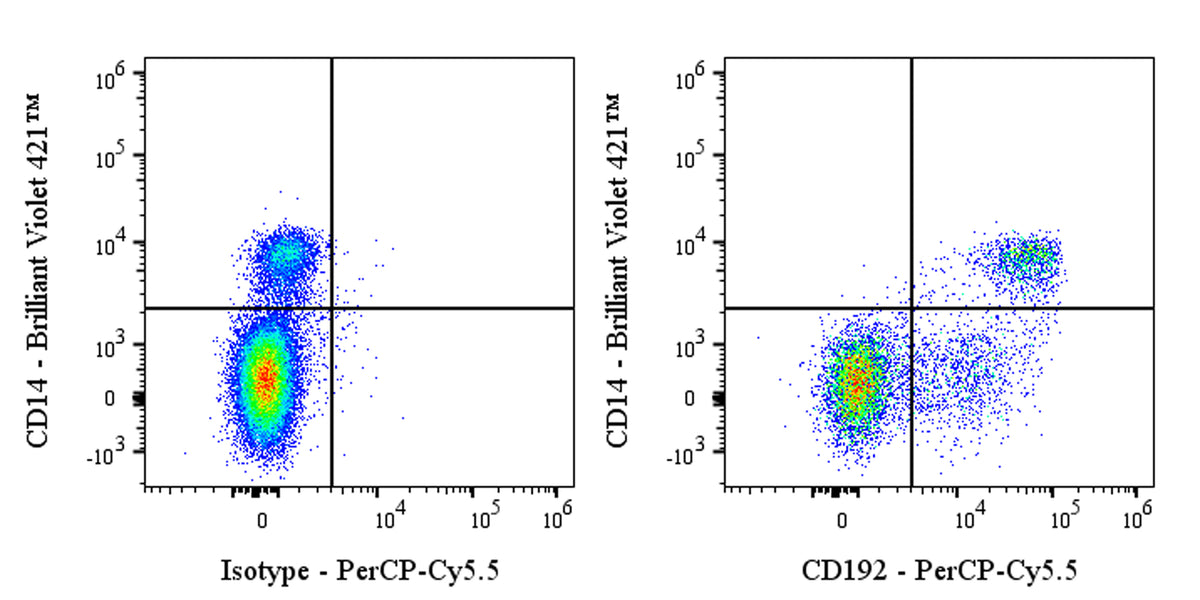
Flow cytometric analysis of human CD192 expression on human PBMCs (human peripheral blood mononuclear cells). Human PBMCs were stained with Brilliant Violet 421™ Mouse Anti-Human CD14 Antibody and either PerCP-Cy5.5 Mouse IgG2a, k Isotype Control (left panel) or SDT PerCP-Cy5.5 Mouse Anti-Human CD192 Antibody (right panel) at 5 μl/test treated with True-Stain Monocyte Blocker™. Flow cytometry and data analysis were performed using Agilent NovoCyte Quanteon and FlowJo™ software.
PerCP-Cy5.5 Mouse Anti-Human CD192 Antibody (S-2971)
PerCP-Cy5.5 Mouse Anti-Human CD192 Antibody (S-2971)
Price:
Regular price
$230 USD
Regular price
Sale price
$230 USD
Unit price
per
For shipping services or bulk orders, you may request a quotation.
Secure checkout with

View full details
Product Details
Product Details
Product Specification
| Host | Mouse |
| Antigen | CD192 |
| Synonyms | C-C chemokine receptor type 2; C-C CKR-2; CC-CKR-2; CCR-2; CCR2; Monocyte chemoattractant protein 1 receptor (MCP-1-R); CMKBR2 |
| Location | Cell membrane |
| Accession | P41597 |
| Clone Number | S-2971 |
| Antibody Type | Mouse mAb |
| Isotype | IgG2a,k |
| Isotype Control | S0B80056 |
| Application | FCM |
| Reactivity | Hu |
| Positive Sample | Human PBMC |
| Purification | Protein A |
| Concentration | 0.2 mg/ml |
| Conjugation | PerCP-Cy5.5 |
| Physical Appearance | Liquid |
| Storage Buffer | PBS, 1% BSA, 0.09% sodium azide |
| Stability & Storage | 12 months from date of receipt / reconstitution, 2 to 8 °C as supplied |
Dilution
| application | dilution | species |
| FCM | 5μl per million cells in 100μl volume | Hu |
Background
CD192, also called CCR2, is a 42 kDa seven-transmembrane G-protein-coupled receptor expressed mainly on monocytes, macrophages and basophils that binds the chemokines MCP-1 (CCL2), MCP-3 (CCL7) and MCP-4 (CCL13), triggers intracellular calcium flux and inhibition of adenylyl cyclase, thereby directing chemotaxis and bone marrow homeostasis, and has been implicated in inflammatory diseases such as rheumatoid arthritis, atherosclerosis and cancer as well as serving as an alternative HIV-1 coreceptor with CD4.
Picture
Picture
FC