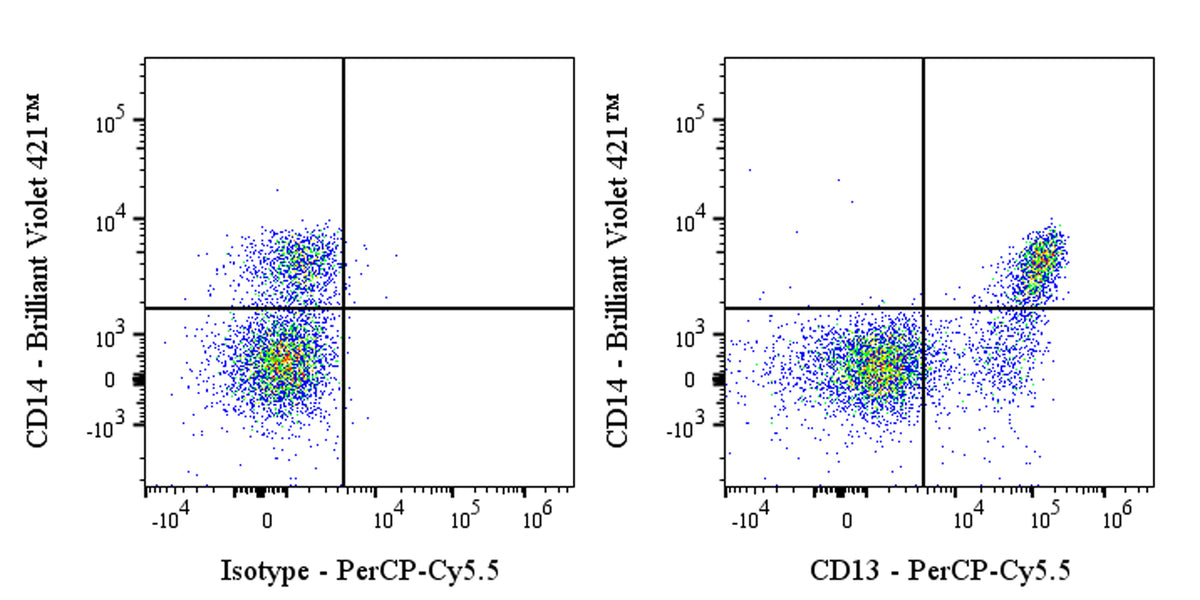
Flow cytometric analysis of CD13 expression on Human PBMCs. Human PBMCs (peripheral blood mononuclear cells) were stained with Brilliant Violet 421™ Mouse Anti-Human CD14 Antibody and either PerCP-Cy5.5 Mouse IgG1, κ Isotype Control (left panel) or SDT PerCP-Cy5.5 Mouse Anti- Human CD13 Antibody (right panel) at 5 μl/test treated with True-Stain Monocyte Blocker™. Total viable cells, as determined by Fixable Viability Dye 452 (S0B88801), were used for analysis. Flow cytometry and data analysis were performed using Agilent NovoCyte Quanteon and FlowJo™ software.
PerCP-Cy5.5 Mouse Anti-Human CD13 Antibody (S-689-37)
PerCP-Cy5.5 Mouse Anti-Human CD13 Antibody (S-689-37)
Price:
Regular price
$100 USD
Regular price
Sale price
$100 USD
Unit price
per
For shipping services or bulk orders, you may request a quotation.
Secure checkout with

View full details
Product Details
Product Details
Product Specification
| Host | Mouse |
| Antigen | CD13 |
| Synonyms | Aminopeptidase N; AP-N; hAPN; Alanyl aminopeptidase; Aminopeptidase M (AP-M); Microsomal aminopeptidase; Myeloid plasma membrane glycoprotein CD13; gp150; APN; PEPN; ANPEP |
| Immunogen | Recombinant Protein |
| Location | Cell membrane |
| Accession | P15144 |
| Clone Number | S-689-37 |
| Antibody Type | Mouse mAb |
| Isotype | IgG1,k |
| Isotype Control | S0B1582 |
| Application | FCM |
| Reactivity | Hu |
| Positive Sample | Human PBMC |
| Purification | Protein G |
| Concentration | 0.2 mg/ml |
| Conjugation | PerCP-Cy5.5 |
| Physical Appearance | Liquid |
| Storage Buffer | PBS, 1% BSA, 0.09% sodium azide |
| Stability & Storage | 12 months from date of receipt / reconstitution, 2 to 8 °C as supplied |
Dilution
| application | dilution | species |
| FCM | 5μl per million cells in 100μl volume | Hu |
Background
CD13, also known as aminopeptidase N, is a 150 kDa type II transmembrane metalloprotease expressed on myeloid cells, endothelial cells, fibroblasts, and epithelial cells, functioning both as a Zn²⁺-dependent ectoenzyme that trims N-terminal amino acids from peptides such as cytokines, chemokines, and hormones to modulate their bioactivity, and as a signaling adhesion molecule that regulates immune cell trafficking, inflammatory responses, cell–cell fusion (e.g., syncytiotrophoblast, myotube, and osteoclast formation), and receptor recycling, thereby exerting context-dependent roles in tissue repair, angiogenesis, and pathologic inflammation.
Picture
Picture
FC