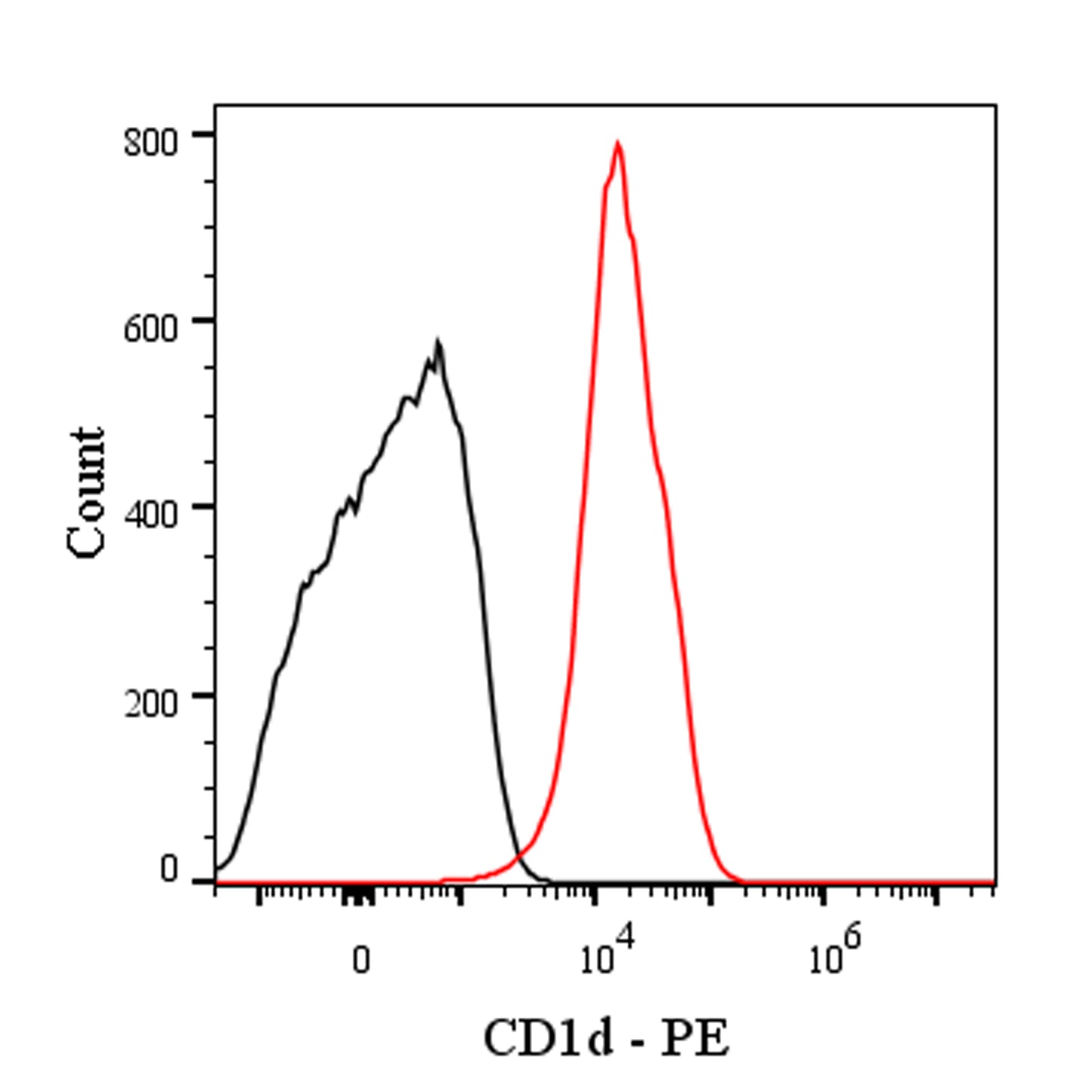
C57BL/6 mouse splenocytes treated 72h with 2.5 μg/ml Concanavalin A (right panel) or untreated (left panel) was stained with SDT PE Rat Anti-Mouse CD1d Antibody at 1.25 μl/test. Flow cytometry and data analysis were performed using BD FACSymphony™ A1 and FlowJo™ software.
PE Rat Anti-Mouse CD1d Antibody (1B1)
PE Rat Anti-Mouse CD1d Antibody (1B1)
Price:
Regular price
$75 USD
Regular price
Sale price
$75 USD
Unit price
per
For shipping services or bulk orders, you may request a quotation.
Secure checkout with

View full details
Product Details
Product Details
Product Specification
| Host | Rat |
| Antigen | CD1d |
| Synonyms | Antigen-presenting glycoprotein CD1d1; CD1d.1; Cd1.1; Cd1d1 |
| Location | Cell membrane |
| Accession | P11609 |
| Clone Number | 1B1 |
| Antibody Type | Rat mAb |
| Isotype | IgG2b,k |
| Isotype Control | Rat mAb IgG2b Isotype Control (S-R486) |
| Application | FCM |
| Reactivity | Ms |
| Positive Sample | ConA treated with C57BL/6 mouse splenocytes |
| Purification | Protein G |
| Concentration | 0.2 mg/ml |
| Conjugation | PE |
| Physical Appearance | Liquid |
| Storage Buffer | PBS, 1% BSA, 0.3% Proclin 300 |
| Stability & Storage | 12 months from date of receipt / reconstitution, 2 to 8 °C as supplied |
Dilution
| application | dilution | species |
| FCM | 0.25μg per million cells in 100μl volume | Ms |
Background
CD1d is a non-polymorphic, MHC class I-like glycoprotein that plays a crucial role in presenting lipid antigens to invariant natural killer T (iNKT) cells. It is widely expressed in both hematopoietic and non-hematopoietic cells, including professional antigen-presenting cells (APCs), thymocytes, hepatic stellate cells, hepatocytes, adipocytes, and intestinal epithelial cells. Structurally, CD1d consists of a heavy chain with three extracellular domains (α1, α2, and α3) that interact non-covalently with beta-2-microglobulin (B2M). The antigen-binding groove of CD1d, formed by two anti-parallel α helices and one anti-parallel β helix, is deeper than that of typical MHC class I molecules and is specialized for binding lipid antigens. CD1d presents a wide range of lipid antigens, including diacylglycerols, phospholipids, glycosphingolipids, ether lipids, and lipopeptides, to CD1d-restricted T cells. This interaction is critical for activating iNKT cells, which have potent immunoregulatory functions and contribute to immune responses against cancer, infections, and autoimmune diseases.
Picture
Picture
FC