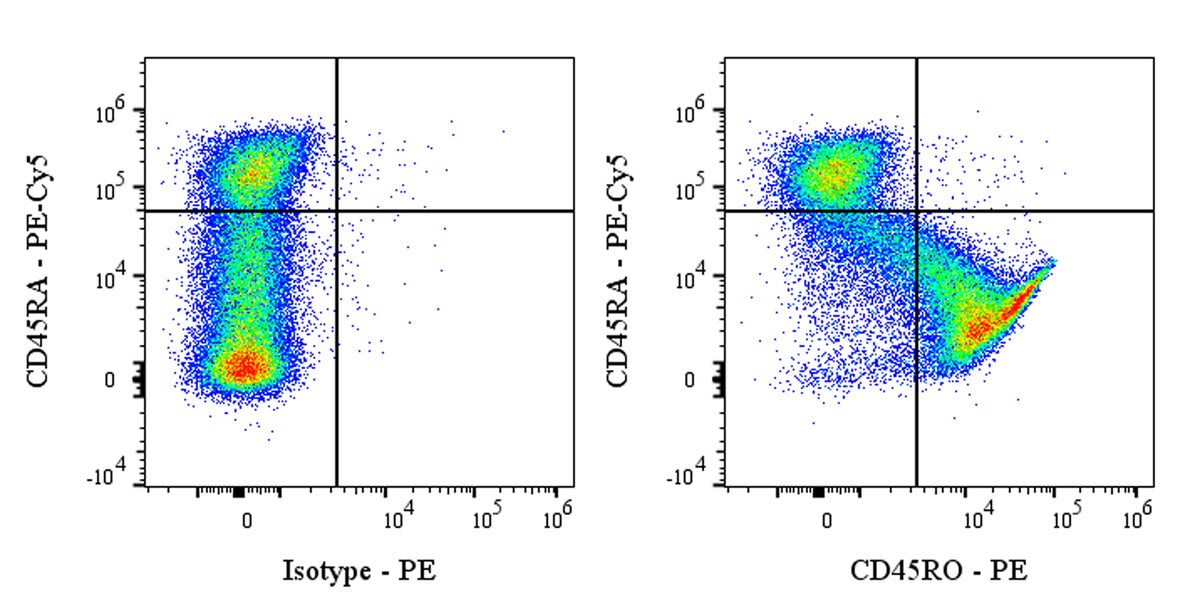
Flow cytometric analysis of Human CD45RO expression on human PBMCs (human peripheral blood mononuclear cells). Human PBMCs were stained with PE-Cy5 Mouse Anti-Human CD45RA Antibody and either PE Mouse IgG2a, κ Isotype Control (left panel) or SDT PE Mouse Anti- Human CD45RO Antibody (right panel) at 5 μl/test. Flow cytometry and data analysis were performed using Agilent NovoCyte Quanteon and FlowJo™ software.
PE Mouse Anti-Human CD45RO Antibody (UCHL1)
PE Mouse Anti-Human CD45RO Antibody (UCHL1)
Price:
Regular price
$65 USD
Regular price
Sale price
$65 USD
Unit price
per
For shipping services or bulk orders, you may request a quotation.
Secure checkout with

View full details
Product Details
Product Details
Product Specification
| Host | Mouse |
| Antigen | CD45 |
| Synonyms | Receptor-type tyrosine-protein phosphatase C; Leukocyte common antigen (L-CA); T200; CD45; PTPRC |
| Location | Cell membrane, Synapse |
| Accession | P08575 |
| Clone Number | UCHL1 |
| Antibody Type | Mouse mAb |
| Isotype | IgG2a,k |
| Isotype Control | S0B8530 |
| Application | FCM |
| Reactivity | Hu |
| Positive Sample | Human PBMC |
| Purification | Protein A |
| Concentration | 0.2 mg/ml |
| Conjugation | PE |
| Physical Appearance | Liquid |
| Storage Buffer | PBS, 1% BSA, 0.09% sodium azide |
| Stability & Storage | 12 months from date of receipt / reconstitution, 2 to 8 °C as supplied |
Dilution
| application | dilution | species |
| FCM | 5μl per million cells in 100μl volume | Hu |
Background
CD45RO is a transmembrane protein tyrosine phosphatase with a molecular weight of approximately 180-220 kDa, belonging to a splice variant of the leukocyte common antigen CD45 family. It is generated through alternative splicing of the CD45 gene, lacking the exon-encoded A, B, and C regions, thus possessing the smallest extracellular domain among CD45 isoforms. CD45RO is predominantly expressed on memory T cells (including effector memory T cells and central memory T cells), activated T cells, monocytes, and macrophages, serving as a key surface marker for memory T cells. Its intracellular domain contains two highly conserved protein tyrosine phosphatase domains, which regulate the phosphorylation status of Src family kinases (e.g., Lck and Fyn) and play a crucial role in T-cell receptor (TCR) signaling, modulating T-cell activation, proliferation, and immune responses. CD45RO expression is closely associated with pathological processes such as chronic inflammation, autoimmune diseases, and transplant rejection, and it is also an important indicator for assessing T-cell immune function in HIV infection. Given its dynamic expression levels reflecting immune status, CD45RO holds potential value in immune monitoring and disease diagnosis.
Picture
Picture
FC