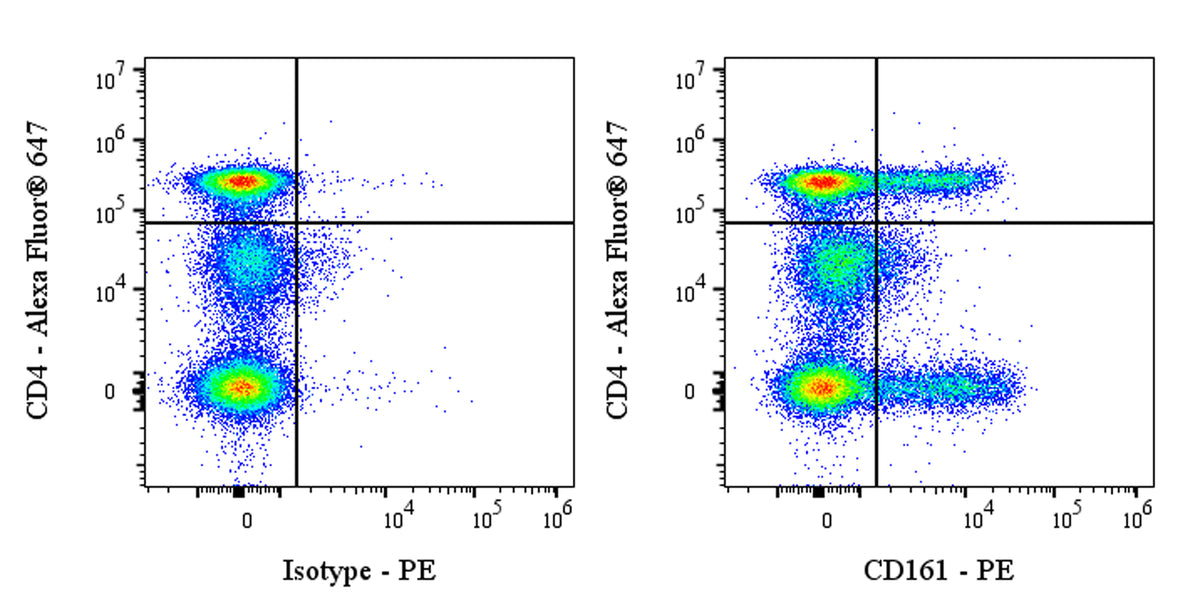
Flow cytometric analysis of Human CD161 expression on human PBMCs (human peripheral blood mononuclear cells). Human PBMCs were stained with Alexa Fluor® 647 Mouse Anti-Human CD4 Antibody and either PE Mouse IgG1, κ Isotype Control (left panel) or SDT PE Mouse Anti-Human CD161 Antibody (right panel) at 2 μl/test. Flow cytometry and data analysis were performed using Agilent NovoCyte Quanteon and FlowJo™ software.
PE Mouse Anti-Human CD161 Antibody (S-R581)
PE Mouse Anti-Human CD161 Antibody (S-R581)
Price:
Regular price
$170 USD
Regular price
Sale price
$170 USD
Unit price
per
For shipping services or bulk orders, you may request a quotation.
Secure checkout with

View full details
Product Details
Product Details
Product Specification
| Host | Mouse |
| Antigen | CD161 |
| Synonyms | Killer cell lectin-like receptor subfamily B member 1; C-type lectin domain family 5 member B; HNKR-P1a (NKR-P1A); Natural killer cell surface protein P1A; CLEC5B; NKRP1A; KLRB1 |
| Location | Membrane |
| Accession | Q12918 |
| Clone Number | S-R581 |
| Antibody Type | Mouse mAb |
| Isotype | IgG1,k |
| Isotype Control | S0B5756 |
| Application | FCM |
| Reactivity | Hu |
| Positive Sample | Human PBMC |
| Purification | Protein G |
| Concentration | 0.1 mg/ml |
| Conjugation | PE |
| Physical Appearance | Liquid |
| Storage Buffer | PBS, 1% BSA, 0.09% sodium azide |
| Stability & Storage | 12 months from date of receipt / reconstitution, 2 to 8 °C as supplied |
Dilution
| application | dilution | species |
| FCM | 2μl per million cells in 100μl volume | Hu |
Background
CD161 (encoded by KLRB1) is a C-type lectin-like type II transmembrane protein expressed on natural killer (NK) cells and subsets of T cells, where it functions as an inhibitory receptor on NK cells to suppress cytotoxicity and cytokine secretion, while on T cells it acts as a costimulatory receptor that enhances responsiveness to T-cell receptor (TCR) stimulation by interacting with its ligand LLT1 and is associated with improved survival in various cancers due to its role in amplifying TCR signaling and promoting rapid effector functions.
Picture
Picture
FC