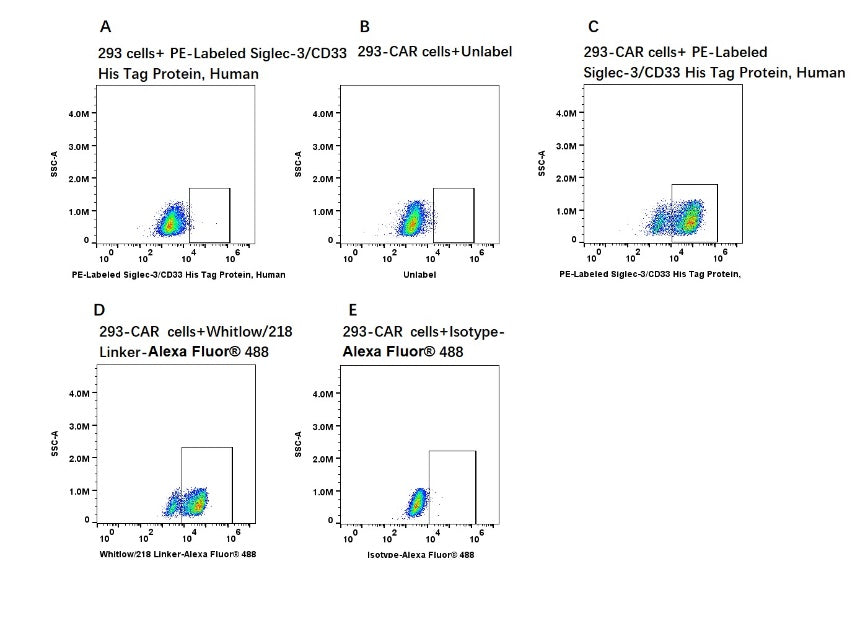
2e5 of transient transfected anti- Siglec-3 ScFv CAR-293 cells were stained with 0.1ug PE-Labeled Siglec-3/CD33 His Tag Protein, Human, (Cat. No. UA016159) and unlable respectively (Fig. C and B), and non-transfected 293 cells were used as a control (Fig. A). PE signal was used to evaluate the binding activity.
2e5 of transient transfected anti- Siglec-3 ScFv CAR-293 cells were stained with isotype and Whitlow/218 Linker-Alexa Fluor® 488 (Fig. D and E). Alexa Fluor® 488 signal was used to evaluate the binding activity.
PE-Labeled Siglec-3/CD33 His Tag Protein, Human
PE-Labeled Siglec-3/CD33 His Tag Protein, Human
Price:
Regular price
$390 USD
Regular price
Sale price
$390 USD
Unit price
per
For shipping services or bulk orders, you may request a quotation.
Secure checkout with

View full details
Product Details
Product Details
Product Specification
| Species | Human |
| Synonyms | CD33, SIGLEC3, gp67 |
| Accession | P20138 |
| Amino Acid Sequence | Asp18-His259 with His Tag at C-Terminus |
| Expression System | HEK293 |
| Molecular Weight | 43-54kDa (Reducing) |
| Conjugation | PE |
| Tag | His Tag |
| Physical Appearance | Liquid |
| Storage Buffer | PBS 7.4 |
| Stability & Storage | · 12 months from date of receipt stored at -20 to -80℃. |
Background
Sialic acid-binding immunoglobulin-like lectins (Siglecs)1 are transmembrane sialic acid-binding proteins of the immunoglobulin (Ig) superfamily characterized by the presence of an N-terminal V-set Ig-like domain and variable numbers of C2 set domains. The first Siglecs to be characterized were Siglec-1, Siglec-2, Siglec-3 and myelin-associated Siglec-4 which share ∼25–30% sequence identity within the extracellular regions. Recent studies have uncovered the existence of a cluster of genes on human chromosome 19q13.3-4 that encode novel Siglecs highly related to CD33. This CD33-related subgroup includes Siglecs-3, -5, -6, -7, and -8, each of which share ∼50–70% sequence identity. These differences in expression and ligand binding suggest that each Siglec mediates a specific, nonredundant function in hemopoietic cell biology. CD33 (siglec-3) is the smallest siglec member. It preferentially binds to α-2, 6- and α-2, 3-sialylated glycans and strongly binds to sialylated ligands on leukemic cell line. Recently, the C1q complement system component has been established as a soluble ligand for CD33. CD33 is mainly expressed on the surface of human leukocytes of the myeloid lineage; however, it is important to note that it can also be expressed in lymphoid cells, including NK cells at several differentiation stages. Human CD33 is expressed on the cell membrane as two isoforms, CD33M, the full-length protein, and CD33m, lacking the V extracellular domain. The CD33 expression level has been recently related to Alzheimer’s disease pathology, autoimmune diseases such as systemic lupus erythematosus (SLE), type II diabetes, or infection.
Guidelines
Please strictly follow the recommended dosage for experiments. If the population clustering is not distinct, the recommended dosage may be appropriately increased by 2–5 folds.
Picture
Picture
FC