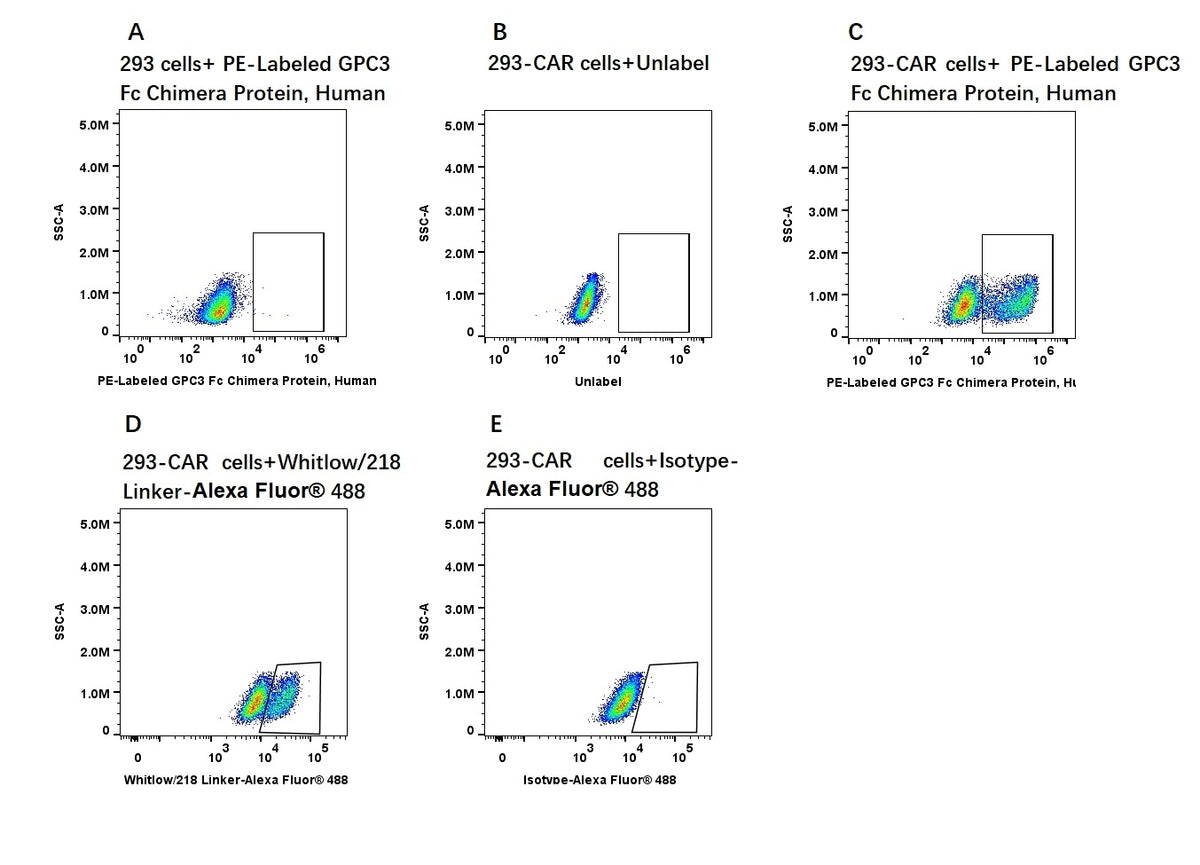
2e5 of transient transfected anti- GPC3 ScFv CAR-293 cells were stained with 1ug PE-Labeled GPC3 Fc Chimera Protein, Human, (Cat. No. UA016106) and unlable respectively (Fig. C and B), and non-transfected 293 cells were used as a control (Fig. A). PE signal was used to evaluate the binding activity.
2e5 of transient transfected anti- GPC3 ScFv CAR-293 cells were stained with isotype and Whitlow/218 Linker-Alexa Fluor® 488 (Fig. D and E). Alexa Fluor® 488 signal was used to evaluate the binding activity.
PE-Labeled GPC3/Glypican 3 Fc Chimera Protein, Human
PE-Labeled GPC3/Glypican 3 Fc Chimera Protein, Human
Price:
Regular price
$1,245 USD
Regular price
Sale price
$1,245 USD
Unit price
per
For shipping services or bulk orders, you may request a quotation.
Secure checkout with

View full details
Product Details
Product Details
Product Specification
| Species | Human |
| Synonyms | Glypican-3 |
| Accession | P51654-1 |
| Amino Acid Sequence | Gln25-His559 with hIgG1 Fc at the C-Terminus |
| Expression System | HEK293 |
| Molecular Weight | 95-180kDa (Reducing) |
| Conjugation | PE |
| Tag | Human IgG1 Fc |
| Physical Appearance | Liquid |
| Storage Buffer | PBS pH7.4 |
| Stability & Storage | · 12 months from date of receipt stored at -20 to -80℃. |
| Reference | 1.nature modern pathology original article article Published: 09 May 2008. Sarit Aviel-Ronen, Suzanne K Lau, Melania Pintilie, Davina Lau, Ni Liu, Ming Sound Tsao & Serge Jothy Modern Pathology volume 21, pages817–825 (2008). |
Background
Glypican-3 (GPC3) belongs to a six-member family of membrane-bound heparan sulfate proteoglycans with a gene that is localized to Xq26.2. GPC3 belongs to a family of cell-surface heparan sulfate proteoglycans and is highly expressed during embryogenesis and organ development. GPC3 has limited expression in adult tissues, including lung, ovaries, mammary epithelium, and mesothelium. Normally, the liver does not express detectable levels of GPC3, but it has been observed to be highly upregulated in hepatocellular carcinomas and hepatoblastomas. Glypican-3 has been shown to play a role in the control of cell growth through the induction of apoptosis. Mutations in glypican-3 result in cell overgrowth. Among all mammalian glypicans, only mutation of GPC3 is associated with a phenotype in humans. GPC3 spans more than 500 kb of genomic DNA and contains 8 exons. Loss-of-function mutations in GPC3 result in overgrowth of many organs (Simpson-Golabi-Behmel syndrome), including the liver, which has been confirmed using GPC3-deficient mice. This observation suggests that GPC3 plays a role in growth suppression and organ size control. GPC3 is highly expressed in yolk sac tumors and choriocarcinomas, with a cytoplasmic staining pattern. It is only variably expressed in teratomas and is absent in germinomas and embryonic carcinomas.
Guidelines
Please strictly follow the recommended dosage for experiments. If the population clustering is not distinct, the recommended dosage may be appropriately increased by 2–5 folds.
Picture
Picture
FC