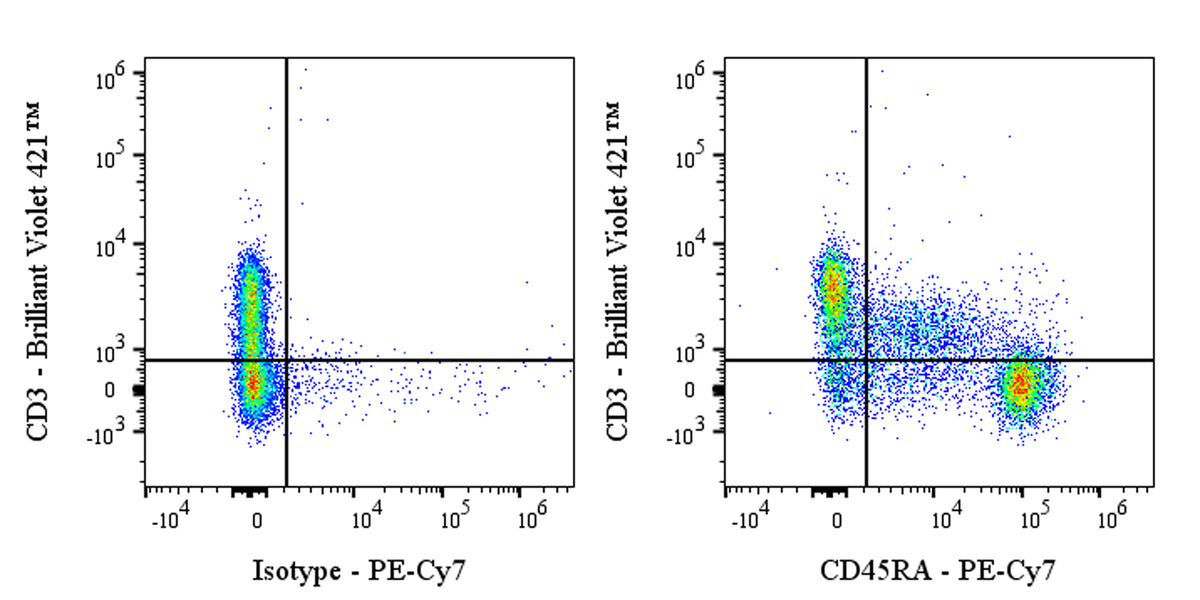
Flow cytometric analysis of Mouse CD45RA expression on C57BL/6 mouse splenocytes. C57BL/6 mouse splenocytes were stained with Brilliant Violet 421™ Rat Anti-Mouse CD3 and either PE-Cy7 Rat IgG2b, κ Isotype Control (left panel) or SDT PE-Cy7 Rat Anti-Mouse CD45RA Antibody (right panel) at 1 μl/test treated with True-Stain Monocyte Blocker™. Flow cytometry and data analysis were performed using Agilent NovoCyte Quanteon and FlowJo™ software.
PE-Cy7 Rat Anti-Mouse CD45RA Antibody (14.8)
PE-Cy7 Rat Anti-Mouse CD45RA Antibody (14.8)
Price:
Regular price
$155 USD
Regular price
Sale price
$155 USD
Unit price
per
For shipping services or bulk orders, you may request a quotation.
Secure checkout with

View full details
Product Details
Product Details
Product Specification
| Host | Rat |
| Antigen | CD45RA |
| Synonyms | Receptor-type tyrosine-protein phosphatase C; Leukocyte common antigen (L-CA); Lymphocyte antigen 5 (Ly-5); T200; CD45; Ly-5; Ptprc |
| Location | Cell membrane, Synapse |
| Accession | P06800 |
| Clone Number | 14.8 |
| Antibody Type | Rat mAb |
| Isotype | IgG2b,k |
| Application | FCM |
| Reactivity | Ms |
| Positive Sample | C57BL/6 mouse splenocytes |
| Purification | Protein G |
| Concentration | 0.2 mg/ml |
| Conjugation | PE-Cy7 |
| Physical Appearance | Liquid |
| Storage Buffer | PBS, 1% BSA, 0.09% sodium azide |
| Stability & Storage | 12 months from date of receipt / reconstitution, 2 to 8 °C as supplied |
Dilution
| application | dilution | species |
| FCM | 0.2μg per million cells in 100μl volume | Ms |
Background
CD45RA protein is a specific isoform of the CD45 receptor, also known as protein tyrosine phosphatase receptor type C (PTPRC), which is generated through alternative splicing of the CD45 gene. It is a marker for naive T cells and central memory T cells (TCM), characterized by the presence of exon 4 (A) but the absence of exons 5 (B) and 6 (C) in its mRNA. CD45RA is expressed on the surface of nucleated hematopoietic cells, including B cells, NK cells, naive/resting T cells, medullary thymocytes, and plasmacytoid dendritic cells. It plays a crucial role in the immune system by modulating T cell receptor (TCR) and B cell receptor (BCR) signaling pathways, facilitating the activation and proliferation of immune cells. In adults, CD45RA+ cells may help prevent autoimmune diseases, while reduced numbers of CD45RA+ CD4+ T cells have been associated with conditions such as biliary atresia, primary biliary cirrhosis, fetal distress, and preeclampsia. Pathologists use CD45RA to differentiate naive T cells (CD45RA+) from memory T cells (CD45RO+), although this distinction may not be applicable in adult allogeneic hematopoietic cell transplant recipients.
Picture
Picture
FC