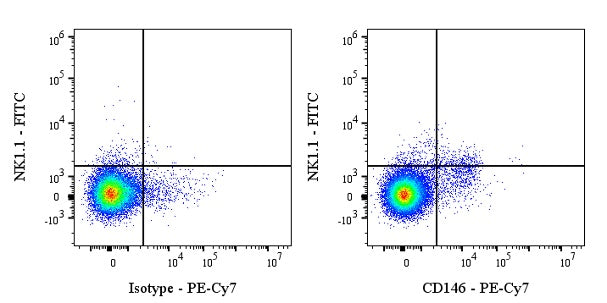
Flow cytometric analysis of Mouse CD146 expression on C57BL/6 mouse splenocytes. C57BL/6 mouse splenocytes were stained with FITC Rat Anti-Mouse NK1.1 Antibody (S0B1657) and either PE-Cy7 Rat IgG2a, κ Isotype Control (left panel) or PE-Cy7 Rat Anti-Mouse CD146 Antibody (right panel) at 5 μl/test treated with True-Stain Monocyte Blocker™. Flow cytometry and data analysis were performed using Agilent NovoCyte Quanteon and FlowJo™ software.
PE-Cy7 Rat Anti-Mouse CD146 Antibody (S-R606)
PE-Cy7 Rat Anti-Mouse CD146 Antibody (S-R606)
Price:
Regular price
$190 USD
Regular price
Sale price
$190 USD
Unit price
per
For shipping services or bulk orders, you may request a quotation.
Secure checkout with

View full details
Product Details
Product Details
Product Specification
| Host | Rat |
| Antigen | CD146 |
| Location | Membrane |
| Accession | Q8R2Y2 |
| Clone Number | S-R606 |
| Antibody Type | Rat mAb |
| Application | FCM |
| Reactivity | Ms |
| Positive Sample | C57BL/6 mouse splenocytes |
| Purification | Protein G |
| Concentration | 0.2 mg/ml |
| Conjugation | PE-Cy7 |
| Physical Appearance | Liquid |
| Storage Buffer | PBS, 1% BSA, 0.09% sodium azide |
| Stability & Storage | 12 months from date of receipt / reconstitution, 2 to 8 °C as supplied |
Dilution
| application | dilution | species |
| FCM | 1μg per million cells in 100μl volume | Ms |
Background
CD146, also known as melanoma cell adhesion molecule (MCAM), hemopoietic cell adhesion molecule (HEMCAM), MUC18, S-Endo1, or A32 antigen, is a highly glycosylated type I transmembrane protein and a member of the immunoglobulin superfamily. It is primarily expressed on endothelial cells and plays a crucial role in cell adhesion, migration, and proliferation. CD146 is involved in various physiological processes, such as embryonic development and tissue maintenance, and its abnormal expression is associated with diseases like cancer and inflammatory disorders. It can act as a receptor for several ligands, including laminin 421, galectin-3, and S100A8/A9, and is also a co-receptor for pro-angiogenic factor receptors like VEGFR2 and PDGFR-β.
Picture
Picture
FC