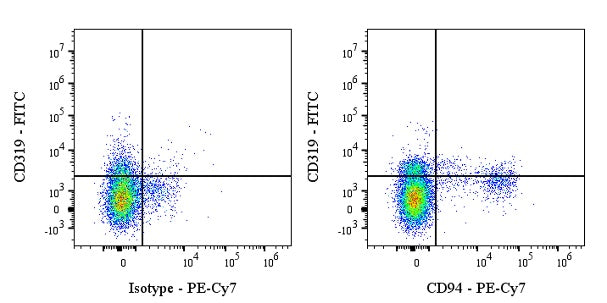
Flow cytometric analysis of CD94 expression on human peripheral blood cells. Human peripheral blood cells were stained with FITC Mouse Anti-Human CD319 Antibody and either PE-Cy7 Rabbit IgG Isotype Control (left panel) or SDT PE-Cy7 Rabbit Anti-Human CD94 Antibody (right panel) at 2 μl/test treated with True-Stain Monocyte Blocker™. Total viable cells, as determined by Fixable Viability Dye 662 (S0B88806), were used for analysis. Flow cytometry and data analysis were performed using Agilent NovoCyte Quanteon and FlowJo™ software.
PE-Cy7 Rabbit Anti-Human CD94 Antibody (S-2616-17)
PE-Cy7 Rabbit Anti-Human CD94 Antibody (S-2616-17)
Price:
Regular price
$160 USD
Regular price
Sale price
$160 USD
Unit price
per
For shipping services or bulk orders, you may request a quotation.
Secure checkout with

View full details
Product Details
Product Details
Product Specification
| Host | Rabbit |
| Antigen | CD94 |
| Immunogen | Recombinant Protein |
| Location | Cell membrane |
| Accession | Q13241 |
| Clone Number | S-2616-17 |
| Antibody Type | Recombinant mAb |
| Isotype | IgG |
| Isotype Control | S0B80059 |
| Application | FCM |
| Reactivity | Hu |
| Positive Sample | Human peripheral blood cells |
| Purification | Protein A |
| Concentration | 0.1 mg/ml |
| Conjugation | PE-Cy7 |
| Physical Appearance | Liquid |
| Storage Buffer | PBS, 1% BSA, 0.09% sodium azide |
| Stability & Storage | 12 months from date of receipt / reconstitution, 2 to 8 °C as supplied |
Dilution
| application | dilution | species |
| FCM | 2μl per million cells in 100μl volume | Hu |
Background
CD94, encoded by KLRD1, is a type II transmembrane C-type lectin glycoprotein expressed predominantly on natural killer (NK) cells and subsets of CD8⁺ T cells, where it covalently assembles with NKG2A, C, E or F subunits to form disulfide-linked heterodimers that recognize the non-classical MHC-I molecule HLA-E (or Qa-1 in mice) and deliver either inhibitory or activating signals that finely tune cytotoxicity, cytokine secretion and survival of effector lymphocytes, thereby playing a central role in innate and adaptive immunity, tumor immune evasion, viral defense and pregnancy tolerance.
Picture
Picture
FC