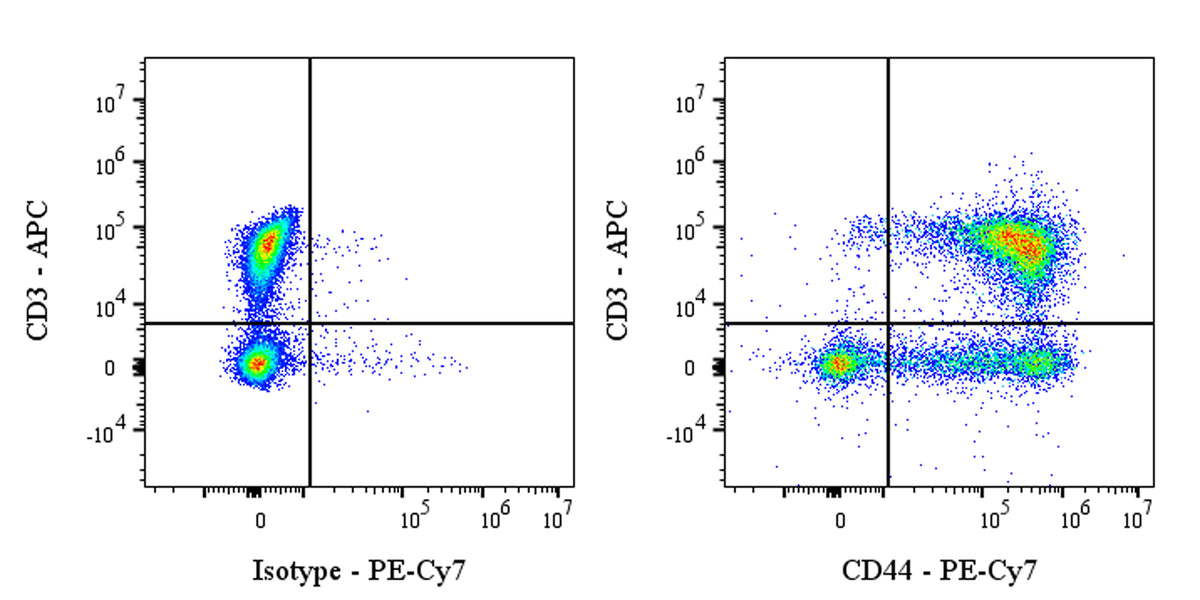
Flow cytometric analysis of Rat CD44 expression on Wister Rat splenocytes. Wister Rat splenocytes were stained with APC Mouse Anti-Rat CD3 Antibody and either PE-Cy7 Mouse IgG2a, k Isotype Control (left panel) or SDT PE-Cy7 Mouse Anti-Rat CD44 Antibody (right panel) at 1 μl/test treated with True-Stain Monocyte Blocker™. Flow cytometry and data analysis were performed using Agilent NovoCyte Quanteon and FlowJo™ software.
PE-Cy7 Mouse Anti-Rat CD44H Antibody (OX-49)
PE-Cy7 Mouse Anti-Rat CD44H Antibody (OX-49)
Price:
Regular price
$130 USD
Regular price
Sale price
$130 USD
Unit price
per
For shipping services or bulk orders, you may request a quotation.
Secure checkout with

View full details
Product Details
Product Details
Product Specification
| Host | Mouse |
| Antigen | CD44H |
| Synonyms | CD44 antigen; Extracellular matrix receptor III (ECMR-III); GP90 lymphocyte homing/adhesion receptor; HUTCH-I; Hermes antigen; Hyaluronate receptor; Cd44 |
| Location | Secreted, Cell membrane |
| Accession | P26051 |
| Clone Number | OX-49 |
| Antibody Type | Mouse mAb |
| Isotype | IgG2a,k |
| Application | FCM |
| Reactivity | Rt |
| Positive Sample | Wister Rat splenocytes |
| Purification | Protein A |
| Concentration | 0.2 mg/ml |
| Conjugation | PE-Cy7 |
| Physical Appearance | Liquid |
| Storage Buffer | PBS, 1% BSA, 0.09% sodium azide |
| Stability & Storage | 12 months from date of receipt / reconstitution, 2 to 8 °C as supplied |
Dilution
| application | dilution | species |
| FCM | 0.2μg per million cells in 100μl volume | Rt |
Background
CD44H, also termed CD44s or the “standard/hematopoietic” isoform, is the smallest CD44 splice variant (≈37 kDa core, 80–95 kDa fully glycosylated) that lacks all variably spliced exons and functions as the cell’s dominant hyaluronan receptor, orchestrating hematopoietic progenitor trafficking, T-cell activation, angiogenesis, and tumor metastasis by coupling extracellular matrix adhesion to cytoskeletal signaling through its cytoplasmic tail-ERM-actin linkage and by serving as a membrane scaffold for metalloproteinases and growth-factor presentation.
Picture
Picture
FC