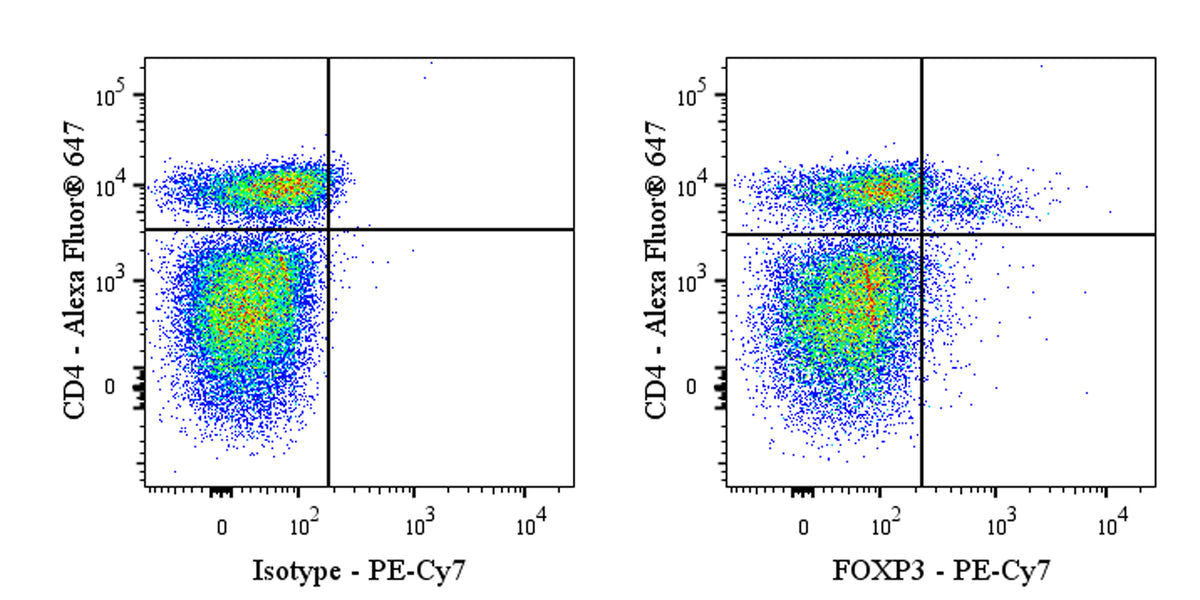
Flow cytometric analysis of FOXP3 expression in PBMCs (Human peripheral blood mononuclear cells). Human PBMCs were fixed and permeabilized with Foxp3 / Transcription Factor Staining Buffer Set. The cells were then stained with Alexa Fluor® 647 Mouse Anti-Human CD4 Antibody and either PE-Cy7 Mouse IgG1 Isotype Control or SDT PE-Cy7 Mouse Anti-Human FOXP3 Antibody at 2 μl/test treated with True-Stain Monocyte Blocker™. Flow cytometry and data analysis were performed using BD FACSymphony™ A1 and FlowJo™ software.
PE-Cy7 Mouse Anti-Human FOXP3 Antibody (S-2903)
PE-Cy7 Mouse Anti-Human FOXP3 Antibody (S-2903)
Price:
Regular price
$235 USD
Regular price
Sale price
$235 USD
Unit price
per
For shipping services or bulk orders, you may request a quotation.
Secure checkout with

View full details
Product Details
Product Details
Product Specification
| Host | Mouse |
| Antigen | FOXP3 |
| Location | Cytoplasm, Nucleus |
| Accession | Q9BZS1 |
| Clone Number | S-2903 |
| Antibody Type | Mouse mAb |
| Isotype | IgG1 |
| Isotype Control | S0B80046 |
| Application | ICFCM |
| Reactivity | Hu |
| Positive Sample | Human PBMC |
| Purification | Protein G |
| Concentration | 0.1 mg/ml |
| Conjugation | PE-Cy7 |
| Physical Appearance | Liquid |
| Storage Buffer | PBS, 1% BSA, 0.09% sodium azide |
| Stability & Storage | 12 months from date of receipt / reconstitution, 2 to 8 °C as supplied |
Dilution
| application | dilution | species |
| ICFCM | 2μl per million cells in 100μl volume | Hu |
Background
FOXP3 is a crucial transcription factor that plays a central role in the development and function of regulatory T cells (Tregs), which are essential for maintaining immune tolerance and preventing autoimmune diseases. It is predominantly expressed in Tregs and helps suppress the activity of other immune cells, thereby preventing excessive immune responses. Mutations or dysfunction in the FOXP3 gene can lead to severe autoimmune disorders such as IPEX syndrome, highlighting its importance in immune regulation. Additionally, FOXP3 has been implicated in various other biological processes, including cancer immunology, where its expression in tumor-infiltrating Tregs can influence the tumor microenvironment and affect the efficacy of immunotherapies.
Picture
Picture
FC