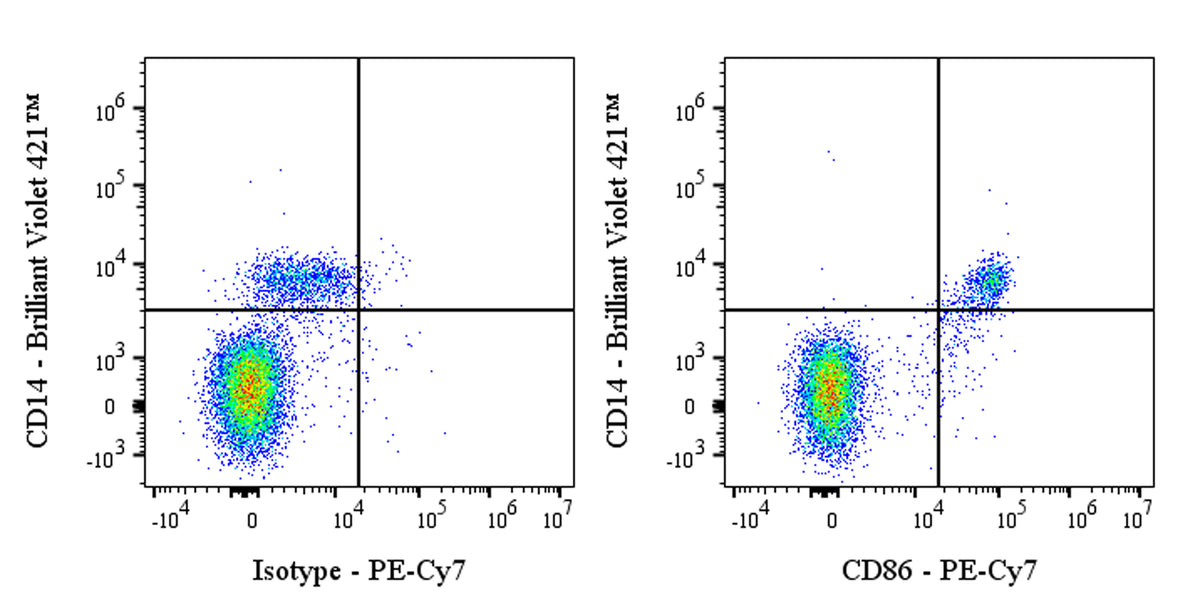
Flow cytometric analysis of Human CD86 expression on Human peripheral blood cells. Human peripheral blood cells were stained with Brilliant Violet 421™ Mouse Anti-Human CD14 Antibody and either PE-Cy7 Mouse IgG2b, κ Isotype Control (left panel) or SDT PE-Cy7 Mouse Anti-Human CD86 Antibody (right panel) at 2 μl/test treated with True-Stain Monocyte Blocker™. Flow cytometry and data analysis were performed using Agilent NovoCyte Quanteon and FlowJo™ software.
PE-Cy7 Mouse Anti-Human CD86 Antibody (IT2.2)
PE-Cy7 Mouse Anti-Human CD86 Antibody (IT2.2)
Price:
Regular price
$200 USD
Regular price
Sale price
$200 USD
Unit price
per
For shipping services or bulk orders, you may request a quotation.
Secure checkout with

View full details
Product Details
Product Details
Product Specification
| Host | Mouse |
| Antigen | CD86 |
| Synonyms | T-lymphocyte activation antigen CD86; Activation B7-2 antigen; B70; BU63; CTLA-4 counter-receptor B7.2; FUN-1; CD28LG2 |
| Location | Cell membrane |
| Accession | P42081 |
| Clone Number | IT2.2 |
| Antibody Type | Mouse mAb |
| Isotype | IgG2b,k |
| Isotype Control | S0B8230 |
| Application | FCM |
| Reactivity | Hu |
| Positive Sample | Human peripheral blood cells |
| Purification | Protein A |
| Concentration | 0.1 mg/ml |
| Conjugation | PE-Cy7 |
| Physical Appearance | Liquid |
| Storage Buffer | PBS, 1% BSA, 0.09% sodium azide |
| Stability & Storage | 12 months from date of receipt / reconstitution, 2 to 8 °C as supplied |
Dilution
| application | dilution | species |
| FCM | 2μl per million cells in 100μl volume | Hu |
Background
CD86, also known as B7-2, is a co-stimulatory molecule expressed on the surface of antigen-presenting cells (APCs) such as dendritic cells, macrophages, and B cells. It plays a crucial role in the immune response by interacting with CD28 on T cells to provide a necessary co-stimulatory signal for T cell activation, proliferation, and differentiation. Additionally, CD86 can also bind to CTLA-4, an inhibitory receptor on T cells, thereby regulating immune responses and maintaining immune homeostasis. This dual functionality makes CD86 a key target in immunotherapy research, particularly in the development of cancer treatments and autoimmune disease management strategies.
Picture
Picture
FC