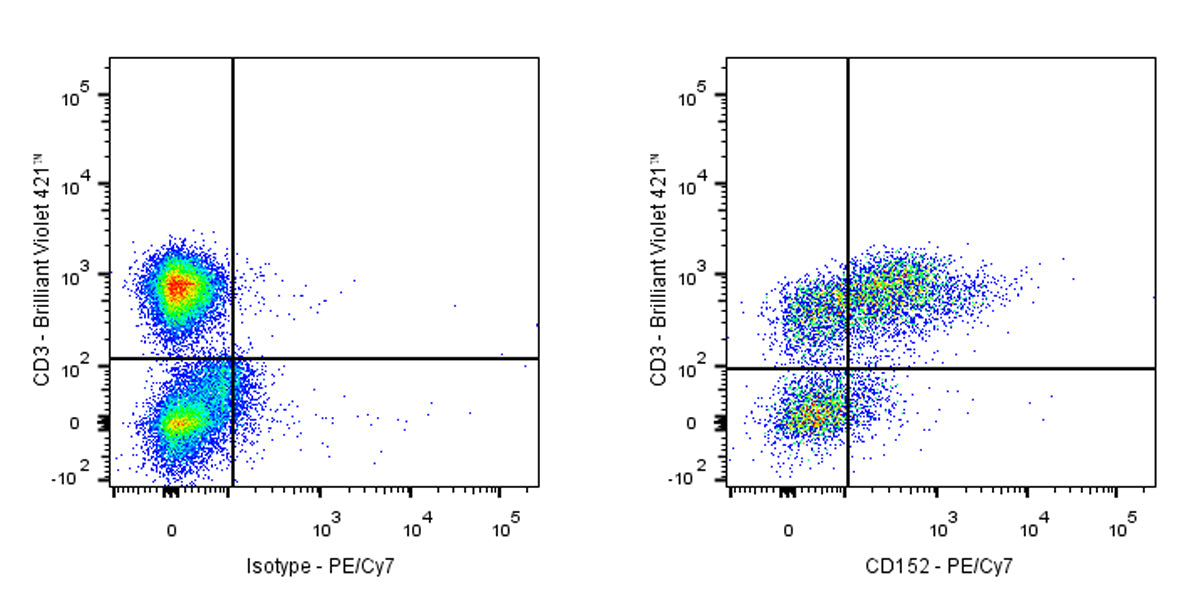
Flow cytometric analysis of CD152 expression in activated human PBMC (human peripheral blood mononuclear cell). PHA-activated (2 days) human PBMC were fixed with 4% PFA and permeabilization with the 0.1% Tween and then were stained with Brilliant Violet 421™ Mouse Anti-Human CD3 antibody and either PE-Cy7 Mouse IgG2a, κ Isotype Control (right panel) or SDT PE-Cy7 Mouse Anti-Human CD152 Antibody at 1.25 μl/test (right panel) treated with True-Stain Monocyte Blocker™. Flow cytometry and data analysis were performed using BD FACSymphony™ A1 and FlowJo™ software
PE-Cy7 Mouse Anti-Human CD152 Antibody (BNI3)
PE-Cy7 Mouse Anti-Human CD152 Antibody (BNI3)
Price:
Regular price
$413 USD
Regular price
Sale price
$413 USD
Unit price
per
For shipping services or bulk orders, you may request a quotation.
Secure checkout with

View full details
Product Details
Product Details
Product Specification
| Host | Mouse |
| Synonyms | Cytotoxic T-lymphocyte protein 4; Cytotoxic T-lymphocyte-associated antigen 4 (CTLA-4); CTLA4 |
| Location | Cell membrane |
| Accession | P16410 |
| Clone Number | BNI3 |
| Antibody Type | Mouse mAb |
| Isotype | IgG2a,k |
| Application | ICFCM |
| Reactivity | Hu |
| Purification | Protein A |
| Concentration | 0.2 mg/ml |
| Conjugation | PE-Cy7 |
| Physical Appearance | Liquid |
| Storage Buffer | PBS, 1% BSA, 0.3% Proclin 300 |
| Stability & Storage | 12 months from date of receipt / reconstitution, 2 to 8 °C as supplied |
Dilution
| application | dilution | species |
| ICFCM | 1.25μl per million cells in 100μl volume | Hu |
Background
CD152 is a 223-amino-acid transmembrane glycoprotein receptor expressed mainly on activated CD4+ and CD8+ T cells that functions as a critical negative regulator of immune responses by out-competing CD28 for binding to the costimulatory ligands CD80 (B7-1) and CD86 (B7-2) on antigen-presenting cells, thereby transducing inhibitory signals that attenuate T-cell proliferation, cytokine production, and cell cycle progression; the protein’s signal peptide is cleaved to yield a disulfide-linked homodimer whose extracellular Ig-like V-type domain mediates high-avidity ligand engagement, while its cytoplasmic tail contains a tyrosine-based motif that recruits phosphatases such as SHP-2 and PP2A to propagate inhibitory cascades, and genetic polymorphisms or therapeutic blockade of CD152 (e.g., the monoclonal antibody ipilimumab) can enhance antitumor immunity but also precipitate autoimmune toxicities, underscoring its pivotal role in maintaining immune homeostasis.
Picture
Picture
FC