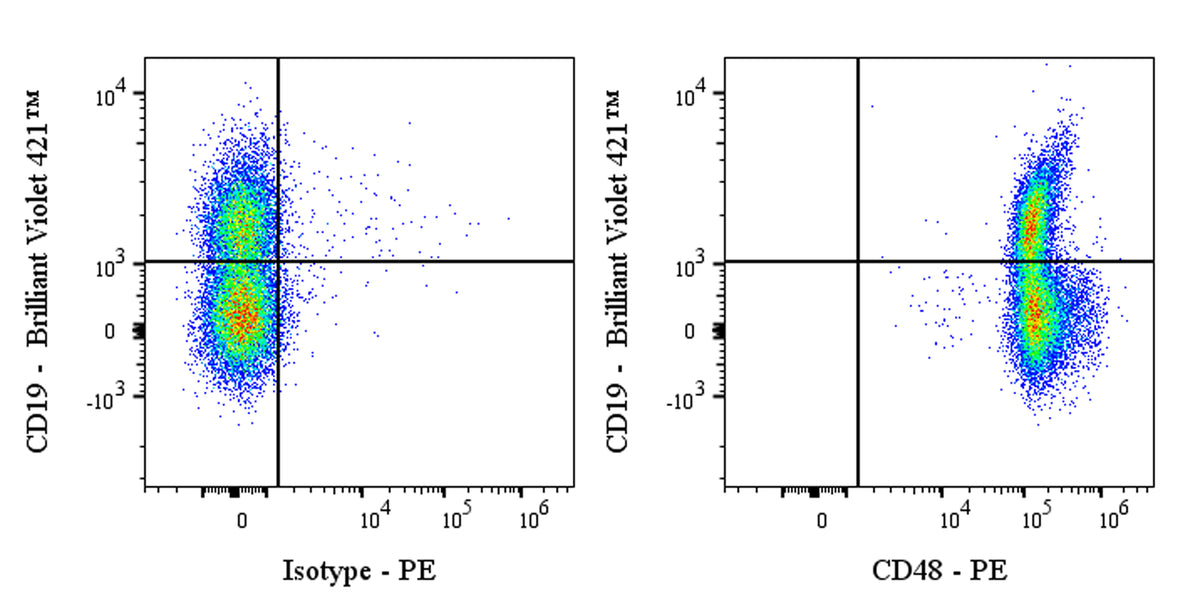
Flow cytometric analysis of mouse CD48 expression on C57BL/6 mouse splenocytes. C57BL/6 mouse splenocytes were stained with Brilliant Violet 421™ Rat Anti-Mouse CD19 Antibody and either PE Armenian hamster IgG Isotype Control (left panel) or SDT PE Armenian hamster Anti-Mouse CD48 Antibody (right panel) at 5 μl/test. Flow cytometry and data analysis were performed using Agilent NovoCyte Quanteon and FlowJo™ software.
PE Armenian hamster Anti-Mouse CD48 Antibody (HM48-1)
PE Armenian hamster Anti-Mouse CD48 Antibody (HM48-1)
Price:
Regular price
$200 USD
Regular price
Sale price
$200 USD
Unit price
per
For shipping services or bulk orders, you may request a quotation.
Secure checkout with

View full details
Product Details
Product Details
Product Specification
| Host | Armenian hamster |
| Antigen | CD48 |
| Synonyms | CD48 antigen; BCM1 surface antigen; BLAST-1; HM48-1; MRC OX-45 surface antigen; SLAM family member 2 (SLAMF2); Bcm-1; Cd48 |
| Location | Cell membrane |
| Accession | P18181 |
| Clone Number | HM48-1 |
| Antibody Type | Recombinant mAb |
| Isotype | IgG |
| Application | FCM |
| Reactivity | Ms |
| Positive Sample | C57BL/6 mouse splenocytes |
| Purification | Protein G |
| Concentration | 0.2 mg/ml |
| Conjugation | PE |
| Physical Appearance | Liquid |
| Storage Buffer | PBS, 1% BSA, 0.09% sodium azide |
| Stability & Storage | 12 months from date of receipt / reconstitution, 2 to 8 °C as supplied |
Dilution
| application | dilution | species |
| FCM | 1μg per million cells in 100μl volume | Ms |
Background
CD48, also known as B-lymphocyte activation marker BLAST-1 or homolog of mouse Lyb-2 (HML-2), is a glycosylphosphatidylinositol (GPI)-anchored cell surface glycoprotein belonging to the CD2 subfamily of the immunoglobulin superfamily, which lacks transmembrane and cytoplasmic domains and is broadly expressed on all hematopoietic cells except erythrocytes and plasma cells. Functioning as a critical co-stimulatory molecule in the immune system, CD48 serves as a high-affinity ligand for several receptors, most notably CD2 and 2B4 (SLAMF4) on natural killer (NK) cells and T cells, thereby facilitating essential cell-to-cell adhesion and bidirectional signaling pathways that regulate lymphocyte activation, proliferation, cytokine production, and cytotoxicity. By modulating these interactions, CD48 plays a pivotal role in both innate and adaptive immune responses, including the formation of the immunological synapse, while its dysregulation or overexpression has been implicated in various pathological conditions such as autoimmune diseases, allergic reactions, and certain hematologic malignancies, making it a significant target for therapeutic intervention and immunological research.
Picture
Picture
FC