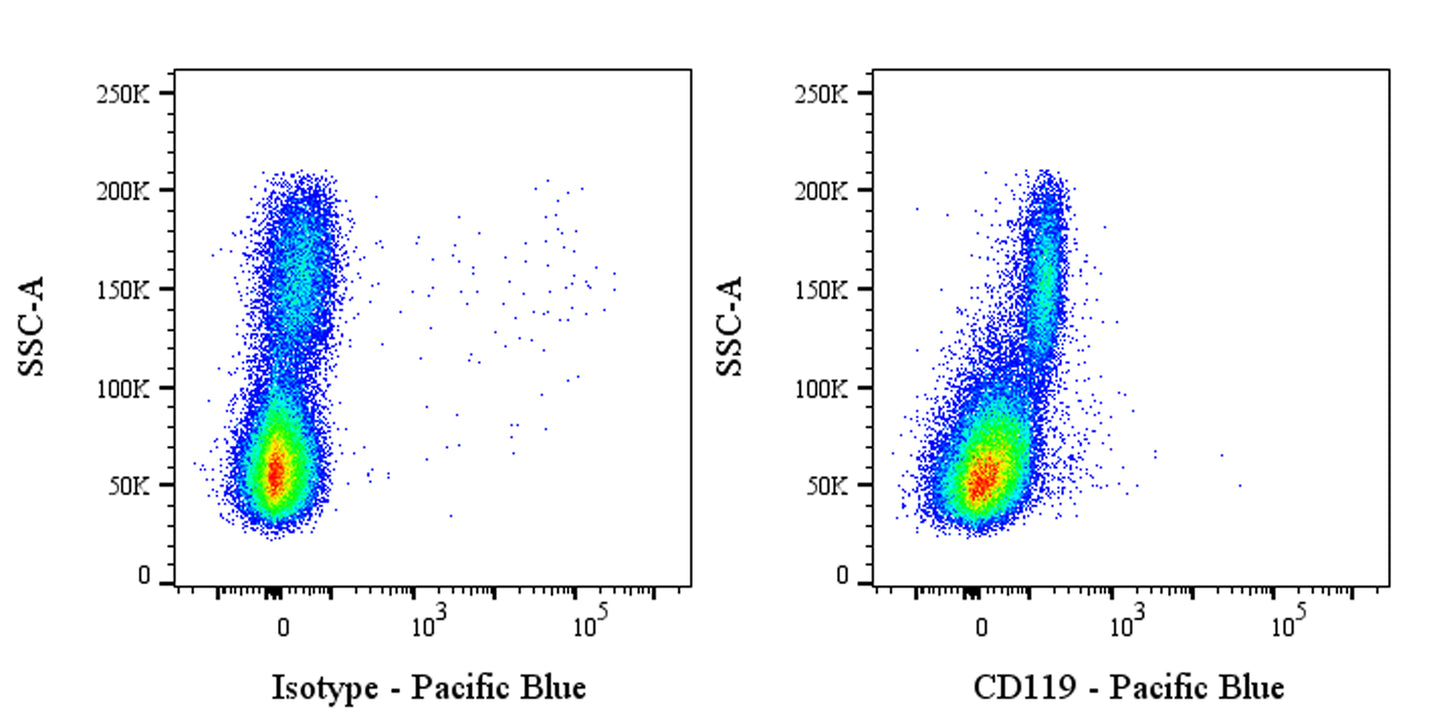
Flow cytometric analysis of human CD119 expression on human PBMC. Human PBMC were stained with either Pacific Blue IgG2b, k Isotype Control (left panel) or SDT Pacific Blue Mouse Anti-Human CD119 Antibody (right panel) at 5 μl/test. Flow cytometry and data analysis were performed using BD FACSymphony™ A1 and FlowJo™ software.
Pacific Blue Mouse Anti-Human CD119 Antibody (S-3124)
Pacific Blue Mouse Anti-Human CD119 Antibody (S-3124)
Price:
Regular price
$150 USD
Regular price
Sale price
$150 USD
Unit price
per
For shipping services or bulk orders, you may request a quotation.
Secure checkout with

View full details
Product Details
Product Details
Product Specification
| Host | Mouse |
| Antigen | CD119 |
| Synonyms | Interferon gamma receptor 1; IFN-gamma receptor 1; IFN-gamma-R1; CDw119; Interferon gamma receptor alpha-chain (IFN-gamma-R-alpha); IFNGR1 |
| Location | Cell membrane |
| Accession | P15260 |
| Clone Number | S-3124 |
| Antibody Type | Mouse mAb |
| Isotype | IgG2b,k |
| Application | FCM |
| Reactivity | Hu |
| Positive Sample | Human PBMC |
| Purification | Protein A |
| Concentration | 0.2 mg/ml |
| Conjugation | Pacific Blue |
| Physical Appearance | Liquid |
| Storage Buffer | PBS, 1% BSA, 0.3% Proclin 300 |
| Stability & Storage | 12 months from date of receipt / reconstitution, 2 to 8 °C as supplied |
Dilution
| application | dilution | species |
| FCM | 5μl per million cells in 100μl volume | Hu |
Background
CD119, also known as the Interferon Gamma Receptor 1 (IFNGR1), is a critical transmembrane protein that serves as the primary ligand-binding subunit of the type II interferon receptor complex, playing a pivotal role in the immune system's response to viral, bacterial, and parasitic infections. Structurally, CD119 consists of an extracellular domain responsible for high-affinity binding to interferon-gamma (IFN-γ), a single transmembrane helix, and an intracellular domain that initiates downstream signaling cascades by recruiting Janus kinase 1 (JAK1) and subsequently activating the Signal Transducer and Activator of Transcription 1 (STAT1) pathway, which leads to the transcription of genes involved in antigen presentation, macrophage activation, and pro-inflammatory responses. As an essential component of host defense, CD119 facilitates communication between immune cells, particularly enhancing the microbicidal activity of macrophages and promoting Th1 differentiation, while genetic mutations or deficiencies in the IFNGR1 gene can result in Mendelian Susceptibility to Mycobacterial Diseases (MSMD), highlighting its indispensable function in maintaining immunity against intracellular pathogens.
Picture
Picture
FC