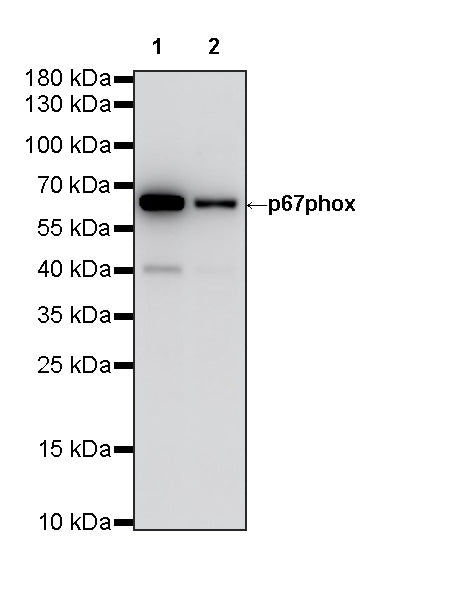
WB result of p67phox Rabbit Polyclonal Antibody
Primary antibody: p67phox Rabbit Polyclonal Antibody at 1/1000 dilution
Lane 1: J774A.1 whole cell lysate 20 µg
Lane 2: Raw 264.7 whole cell lysate 20 µg
Secondary antibody: Goat Anti-Rabbit IgG, (H+L), HRP conjugated at 1/10000 dilution
Predicted MW: 59 kDa
Observed MW: 67 kDa
This blot was developed with high sensitivity substrate
p67phox Rabbit Polyclonal Antibody
p67phox Rabbit Polyclonal Antibody
Price:
Regular price
$100 USD
Regular price
Sale price
$100 USD
Unit price
per
For shipping services or bulk orders, you may request a quotation.
Secure checkout with

View full details
Product Details
Product Details
Product Specification
| Host | Rabbit |
| Antigen | p67phox |
| Synonyms | Neutrophil cytosol factor 2; 67 kDa neutrophil oxidase factor; NADPH oxidase activator 2; Neutrophil NADPH oxidase factor 2; p67-phox; Noxa2; Ncf2 |
| Immunogen | Synthetic Peptide |
| Location | Cytoplasm |
| Accession | O70145 |
| Antibody Type | Polyclonal antibody |
| Isotype | IgG |
| Application | WB |
| Reactivity | Ms |
| Positive Sample | J774A.1, RAW264.7 |
| Predicted Reactivity | Bv |
| Purification | Immunogen Affinity |
| Concentration | 0.5 mg/ml |
| Conjugation | Unconjugated |
| Physical Appearance | Liquid |
| Storage Buffer | PBS, 40% Glycerol, 0.05% BSA, 0.02% sodium azide |
| Stability & Storage | 12 months from date of receipt / reconstitution, -20 °C as supplied |
Dilution
| application | dilution | species |
| WB | 1:1000 | Ms |
Background
p67phox protein (also known as NOXA2, neutrophil cytosolic factor 2) is a key cytosolic regulatory subunit of the NADPH oxidase complex, which is highly expressed primarily in phagocytes and plays a central role in host immune defense. This protein contains multiple tetratricopeptide repeat (TPR) domains and a PX domain, among which the TPR domains are responsible for high-affinity interactions with p47phox to mediate complex assembly, while the PX domain specifically binds phosphatidylinositol-3,4-bisphosphate (PI(3,4)P₂), helping to anchor the entire regulatory complex to the cell membrane and ensuring spatial precision of activation signals. Upon cellular stimulation, p67phox cooperates with p47phox and p40phox through its SH3 and PB1 domains, respectively, while its C-terminal Rac-binding site is responsible for directly binding to the activated small GTPase Rac (such as Rac1 or Rac2). This binding triggers a conformational change in p67phox, which in turn presents its N-terminal activation domain to the catalytic subunit gp91phox (i.e., NOX2), facilitating electron transfer from NADPH to FAD and ultimately initiating the burst generation of superoxide anions. Functional defects or gene mutations in this protein can directly lead to one subtype of chronic granulomatous disease (CGD), in which patients' neutrophils exhibit severely impaired respiratory burst activity, resulting in recurrent and severe bacterial and fungal infections—highlighting the irreplaceable role of p67phox in innate immunity.
Picture
Picture
Western Blot