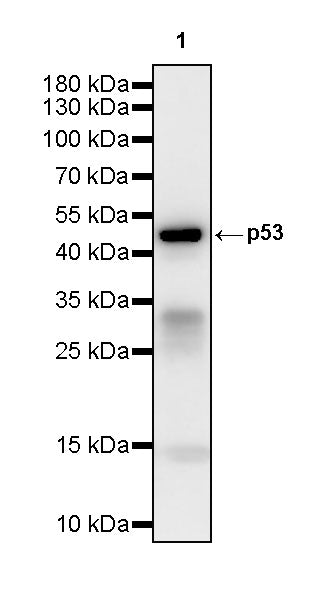
WB result of p53 Recombinant Rabbit mAb
Primary antibody: p53 Recombinant Rabbit mAb at 1/1000 dilution
Lane 1: NIH/3T3 whole cell lysate 20 µg
Secondary antibody: Goat Anti- rabbit IgG, (H+L), HRP conjugated at 1/10000 dilution
Predicted MW: 43 kDa
Observed MW: 53 kDa
This blot was developed with high sensitivity substrate
p53 Recombinant Rabbit mAb (S-3975-17)
p53 Recombinant Rabbit mAb (S-3975-17)
Price:
Regular price
$100 USD
Regular price
Sale price
$100 USD
Unit price
per
For shipping services or bulk orders, you may request a quotation.
Secure checkout with

View full details
Product Details
Product Details
Product Specification
| Host | Rabbit |
| Antigen | p53 |
| Synonyms | Cellular tumor antigen p53; P53; Trp53; Tp53 |
| Immunogen | Synthetic Peptide |
| Location | Cytoplasm, Cytoskeleton, Nucleus, Mitochondrion, Endoplasmic reticulum |
| Accession | P02340 |
| Clone Number | S-3975-17 |
| Antibody Type | Recombinant mAb |
| Isotype | IgG |
| Application | WB |
| Reactivity | Ms, Rt |
| Positive Sample | NIH/3T3, C6 |
| Purification | Protein A |
| Concentration | 2 mg/ml |
| Conjugation | Unconjugated |
| Physical Appearance | Liquid |
| Storage Buffer | PBS, 40% Glycerol, 0.05% BSA, 0.02% sodium azide |
| Stability & Storage | 12 months from date of receipt / reconstitution, -20 °C as supplied |
Dilution
| application | dilution | species |
| WB | 1:1000 | Ms, Rt |
Background
p53 is a nuclear phosphoprotein with a molecular weight of approximately 53 kDa, encoded by the TP53 gene, and is the most important tumor suppressor in the human body, often hailed as the "guardian of the genome." In normal cells, p53 is typically maintained at low levels; however, when cells are exposed to threats such as DNA damage, oxidative stress, oncogene activation, or ribosomal stress, p53 rapidly stabilizes and accumulates through various post-translational modifications (e.g., phosphorylation and acetylation), subsequently acting as a transcription factor to activate the expression of hundreds of downstream target genes. These target genes mediate p53's diverse antitumor functions, including inducing cell cycle arrest (e.g., via p21), initiating DNA repair, triggering apoptosis (e.g., via Bax and PUMA), inducing cellular senescence, and regulating metabolic reprogramming and inhibiting tumor angiogenesis. In addition, p53 also functions in a transcription-independent manner by directly localizing to mitochondria and regulating the extrinsic apoptotic pathway. Through this series of sophisticated "multitasking" functions, p53 effectively eliminates damaged cells and prevents the accumulation of mutations, thereby suppressing tumorigenesis. However, the TP53 gene is the most frequently mutated gene in cancer, with functional inactivating mutations of p53 present in over 50% of human malignancies. Mutant p53 not only loses its tumor-suppressive functions but may also gain oncogenic properties that promote tumor invasion and drug resistance. Consequently, targeting the p53 pathway—such as developing small-molecule drugs that restore wild-type p53 function or employing synthetic lethality strategies—has remained a frontier and focal area in cancer therapeutic research.
Picture
Picture
Western Blot
WB result of p53 Recombinant Rabbit mAb
Primary antibody: p53 Recombinant Rabbit mAb at 1/1000 dilution
Lane 1: C6 whole cell lysate 20 µg
Secondary antibody: Goat Anti- rabbit IgG, (H+L), HRP conjugated at 1/10000 dilution
Predicted MW: 43 kDa
Observed MW: 53 kDa
This blot was developed with high sensitivity substrate