WB result of p21 Waf1/Cip1 Recombinant Rabbit mAb
Primary antibody: p21 Waf1/Cip1 Recombinant Rabbit mAb at 1/1000 dilution
Lane 1: untreated NIH/3T3 whole cell lysate 20 µg
Lane 2: NIH/3T3 treated with 10 µM Nutlin 3a for 24 hours whole cell lysate 20 µg
Lane 3: untreated C2C12 whole cell lysate 20 µg
Lane 4: C2C12 treated with 10 µM Nutlin 3a for 24 hours whole cell lysate 20 µg
Lane 5: RAW264.7 whole cell lysate 20 µg
Lane 6: Neuro-2a whole cell lysate 20 µg
Secondary antibody: Goat Anti- rabbit IgG, (H+L), HRP conjugated at 1/10000 dilution
Predicted MW: 18 kDa
Observed MW: 21 kDa
p21 Waf1/Cip1 Recombinant Rabbit mAb (S-3909-60)
p21 Waf1/Cip1 Recombinant Rabbit mAb (S-3909-60)
Price:
Regular price
$100 USD
Regular price
Sale price
$100 USD
Unit price
per
For shipping services or bulk orders, you may request a quotation.
Secure checkout with

View full details
Product Details
Product Details
Product Specification
| Host | Rabbit |
| Antigen | p21 Waf1/Cip1 |
| Synonyms | Cyclin-dependent kinase inhibitor 1; CDK-interacting protein 1; Melanoma differentiation-associated protein; p21; Cip1; Waf1; Cdkn1a |
| Immunogen | Synthetic Peptide |
| Location | Cytoplasm, Nucleus |
| Accession | P39689 |
| Clone Number | S-3909-60 |
| Antibody Type | Recombinant mAb |
| Isotype | IgG |
| Application | WB |
| Reactivity | Ms, Rt |
| Positive Sample | NIH/3T3, NIH/3T3 (treated with 10 µM Nutlin 3a for 24 hours), C2C12, C2C12 (treated with 10 µM Nutlin 3a for 24 hours), RAW264.7 Neuro-2a, C6, PC-12 |
| Purification | Protein A |
| Concentration | 0.5 mg/ml |
| Conjugation | Unconjugated |
| Physical Appearance | Liquid |
| Storage Buffer | PBS, 40% Glycerol, 0.05% BSA, 0.03% Proclin 300 |
| Stability & Storage | 12 months from date of receipt / reconstitution, -20 °C as supplied |
Dilution
| application | dilution | species |
| WB | 1:1000 | Ms, Rt |
Background
p21 Waf1/Cip1, also known as CDKN1A, is a potent cyclin-dependent kinase inhibitor that serves as a critical downstream effector of the tumor suppressor p53 in response to DNA damage and cellular stress. Functioning primarily as a molecular brake on the cell cycle, p21 binds to and inhibits the activity of cyclin-CDK complexes, particularly those involving CDK2, CDK4, and CDK6, thereby preventing the phosphorylation of the retinoblastoma protein (Rb) and arresting cell progression at the G1/S checkpoint to allow time for DNA repair or to initiate senescence. Beyond its canonical role in cell cycle regulation, p21 exhibits complex, context-dependent functions by interacting with proliferating cell nuclear antigen (PCNA) to modulate DNA replication and repair mechanisms, while also influencing apoptosis through interactions with pro-apoptotic factors like ASK1 and caspases; notably, its expression can be induced via both p53-dependent and p53-independent pathways, making it a pivotal node in maintaining genomic stability and preventing tumorigenesis, although its overexpression in certain cancer contexts has been paradoxically associated with poor prognosis due to its potential anti-apoptotic effects.
Picture
Picture
Western Blot
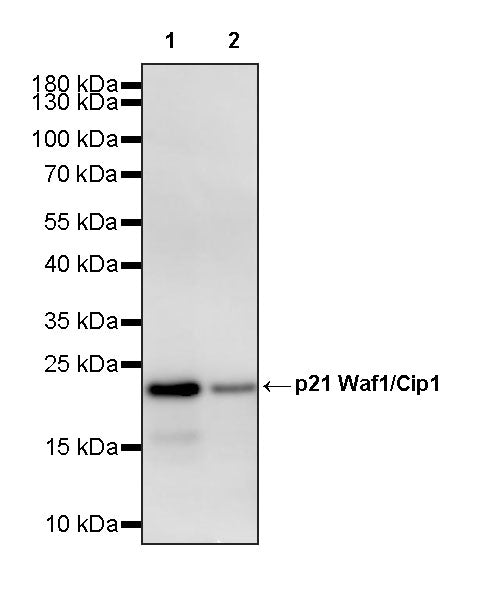
WB result of p21 Waf1/Cip1 Recombinant Rabbit mAb
Primary antibody: p21 Waf1/Cip1 Recombinant Rabbit mAb at 1/1000 dilution
Lane 1: C6 whole cell lysate 20 µg
Lane 2: PC-12 whole cell lysate 20 µg
Secondary antibody: Goat Anti- rabbit IgG, (H+L), HRP conjugated at 1/10000 dilution
Predicted MW: 18 kDa
Observed MW: 21 kDa