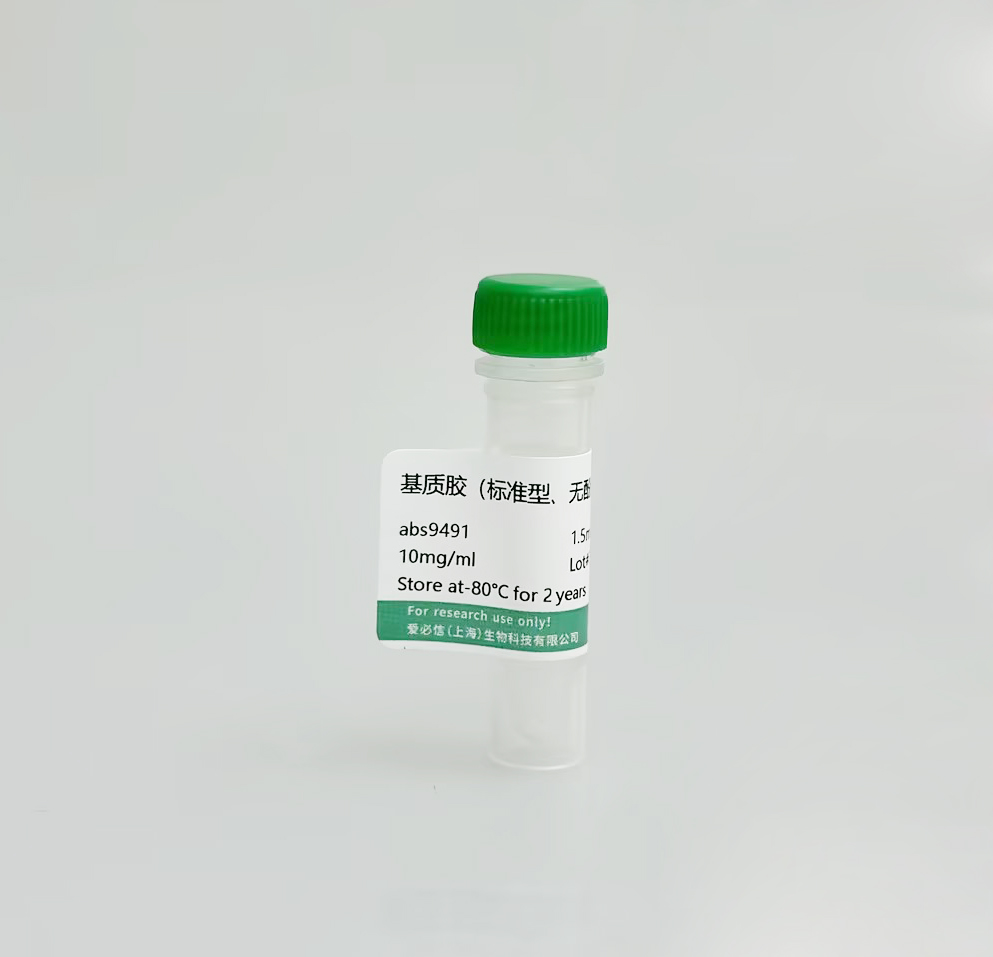
Standard OrganoGel Phenol red free
Standard OrganoGel Phenol red free
Price:
Regular price
$440 USD
Regular price
Sale price
$440 USD
Unit price
per
For shipping services or bulk orders, you may request a quotation.
Secure checkout with

View full details
Product Details
Product Details
Product Specification
| Usage | See the operating manual for details. |
| Form | This product is liquid at 4°C, but gels when heated to 37°C. After the matrix gum has set, it is placed back at 4° C. overnight and the matrix gum can be liquefied again. |
| Description | The basement membrane is a layer of matrix membrane on the basal surface of epithelial cells in animals. OrganoGel is a matrix gel formed from basement membrane components extracted from mouse tumor tissue. The main components of the matrix glue are: laminin, collagen IV, heparan sulfate proteoglycans (Kleinman et al. 1986). At the same time, the matrix glue also contains various growth factors, such as epidermal growth factor, nerve growth factor (Vukicevic et al. 1992). Product characteristics: This product is liquid at 4°C, but gels when heated to 37°C. After the matrix gum has set, it is placed back at 4° C. overnight and the matrix gum can be liquefied again. |
| Source | mouse tumor basement membrane components |
| General Notes | This matrix begins to solidify at temperatures above 10°C, so it is best to handle the matrix on ice. During organoid passage, in order to avoid enzymes affecting the organoids, the matrix gel can be slowly blown with 4°C pre-cooled basal medium to release the organoids from the matrix gel. |
| Storage Temp. | It is recommended that users repackage the product according to a single dose after the first thaw and store it in a refrigerator at -80°C. It has a shelf life of 2 years. |
| Applications | Suitable for experiments that require color detection (such as colorimetric method, fluorescence method). |
Picture
Picture
Immunohistochemistry