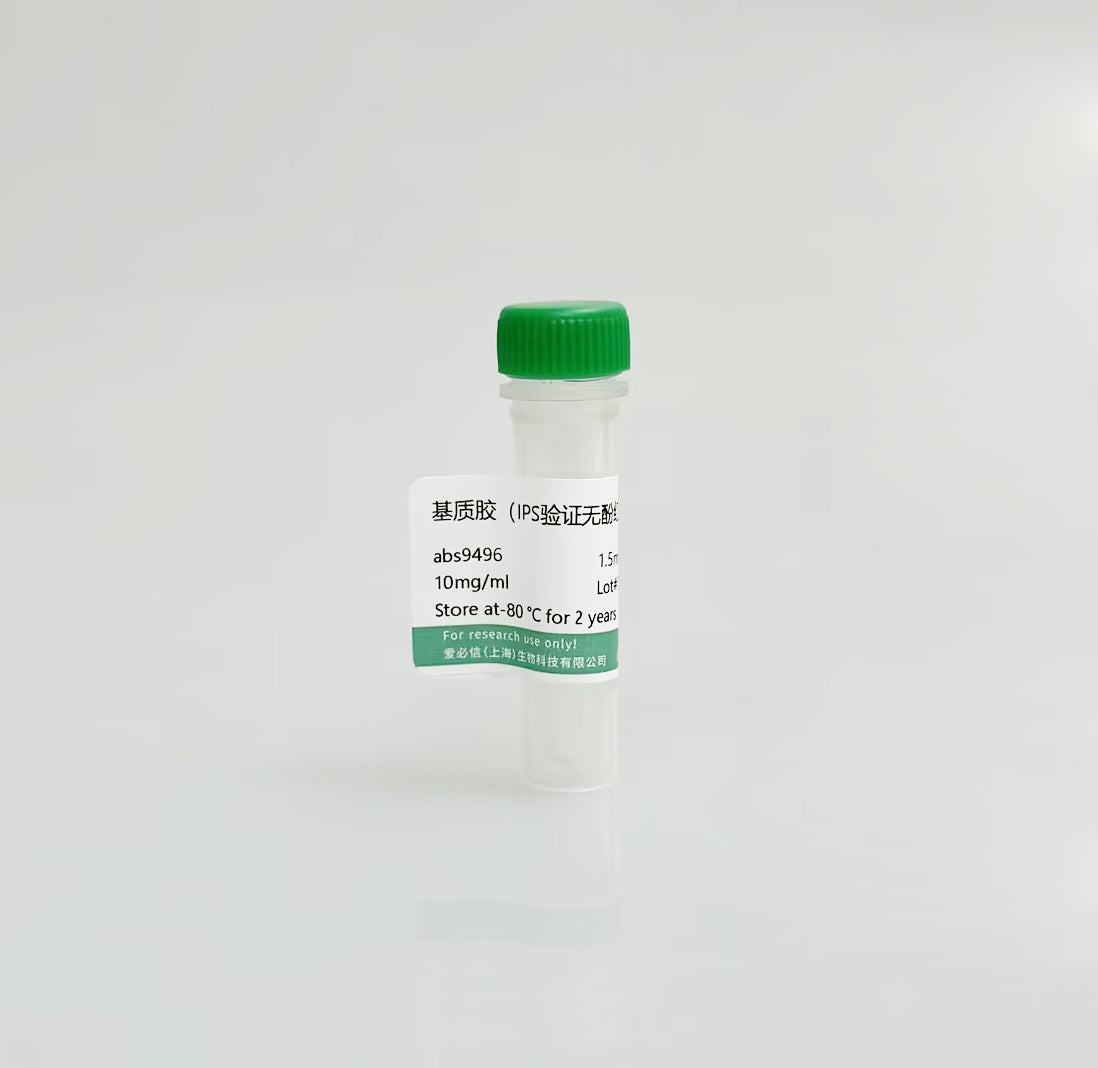
IPS-qualified OrganoGel Phenol red free
IPS-qualified OrganoGel Phenol red free
Price:
Regular price
$583 USD
Regular price
Sale price
$583 USD
Unit price
per
For shipping services or bulk orders, you may request a quotation.
Secure checkout with

View full details
Product Details
Product Details
Product Specification
| Usage | Human embryonic stem cells hES and induced pluripotent stem cells IPS feeder-free culture method (operation time required 1 hour) 1. Thaw the matrix gel overnight in an ice bath in a 4°C refrigerator, and slowly blow the matrix gel 5 times with a precooled gun tip to mix well. Be careful not to create bubbles. If bubbles occur, the bubbles are removed by briefly centrifuging at low speed using a handheld centrifuge. 2. Place the cell culture plate in an incubator to preheat. 3. Use a precooled gun tip to dispense the thawed matrix glue. 4. Dilute the matrix collagen solution in a ratio of 1:100 with serum-free medium precooled at 4°C, and then spread the matrix gel dilution evenly and completely cover the culture plate. The recommended amount of matrix gel diluent used to modify the culture plate is 300 ul/cm.2。 5. The culture plate containing the modification solution was allowed to stand at room temperature for one hour. 6. Aspirate off the modification solution and immediately plant the stem cell and culture medium (mTeSR1) mixture on the culture plate. Be careful not to allow the surface of the modified culture plate to dry out. |
| Description | The basement membrane is a layer of matrix membrane on the basal surface of epithelial cells in animals. OrganoGel is a matrix gel formed from basement membrane components extracted from mouse tumor tissue. The main components of the matrix glue are: laminin, collagen IV, heparan sulfate proteoglycans (Kleinman et al. 1986). At the same time, the matrix glue also contains a variety of growth factors, such as epidermal growth factor EFG, platelet-derived growth factor PDGF, nerve growth factor NGF, basic fibroblast growth factor FGF-2, B-type transforming growth factor TGF-beta and insulin-like growth factor ILGF (Vukicevic et al. 1992). Product Characteristics: This product is liquid at 4°C, but gels when heated to 37°C. After the matrix gum has set, it is placed back at 4° C. overnight and the matrix gum can be liquefied again. |
| Source | mouse tumor basement membrane components |
| General Notes | This matrix begins to solidify at temperatures above 10°C, so it is best to handle the matrix on ice. During organoid passage, in order to avoid enzymes affecting the organoids, the matrix gel can be slowly blown with 4°C pre-cooled basal medium to release the organoids from the matrix gel. |
| Concentration | See label |
| Storage Temp. | It is recommended that users repackage the product according to a single dose after the first thaw and store it in a refrigerator at -80°C. It has a shelf life of 2 years. |
| Applications | This product is suitable for the expansion and maintenance of human embryonic stem cells hES and induced pluripotent stem cells IPS by a feeder-free method. |
Picture
Picture
Immunohistochemistry