GFR OrganoGel with Phenol red
GFR OrganoGel with Phenol red
Price:
Regular price
$310 USD
Regular price
Sale price
$310 USD
Unit price
per
For shipping services or bulk orders, you may request a quotation.
Secure checkout with

View full details
Product Details
Product Details
Product Specification
| antigen | SFRS9 |
| Clonality | Polyclonal Antibody |
| Usage | See the operating manual for details. |
| Immunogen | A synthesized peptide derived from Human SRSF9(Accession Q13242), corresponding to amino acid residues Y77-P105. |
| Species Reactivity | Human;Mouse;Rat |
| UniProt | Q13242 |
| Purification | The antiserum was purified by peptide affinity chromatography using SulfoLink™ Coupling Resin . |
| Specificity | SFRS9 Antibody detects endogenous levels of total SFRS9. |
| Post-translational modifications | Extensively phosphorylated on serine residues in the RS domain. |
| Host | Rabbit |
| Description | The basement membrane is a layer of matrix membrane on the basal surface of epithelial cells in animals. OrganoGel is a matrix gel formed from basement membrane components extracted from mouse tumor tissue. The main components of the matrix glue are: laminin, collagen IV, heparan sulfate proteoglycans (Kleinman et al. 1986). At the same time, the matrix glue also contains a variety of growth factors, such as epidermal growth factor EFG, platelet-derived growth factor PDGF, nerve growth factor NGF, basic fibroblast growth factor FGF-2, B-type transforming growth factor TGF-beta and insulin-like growth factor ILGF (Vukicevic et al. 1992). Product characteristics: This product is liquid at 4°C, but gels when heated to 37°C. After the matrix gum has set, it is placed back at 4° C. overnight and the matrix gum can be liquefied again. |
| Source | mouse tumor basement membrane components |
| page_application | WB;IHC;ELISA |
| Storage Buffer | Rabbit IgG in phosphate buffered saline , pH 7.4, 150mM NaCl, 0.02% sodium azide and 50% glycerol.Store at -20 °C.Stable for 12 months from date of receipt. |
| tissuespecificity | Expressed at high levels in the heart, kidney, pancreas and placenta, and at lower levels in the brain, liver, lung and skeletal muscle. |
| Background | Plays a role in constitutive splicing and can modulate the selection of alternative splice sites. Represses the splicing of MAPT/Tau exon 10. |
| General Notes | This matrix begins to solidify at temperatures above 10°C, so it is best to handle the matrix on ice. During organoid passage, in order to avoid enzymes affecting the organoids, the matrix gel can be slowly blown with 4°C pre-cooled basal medium to release the organoids from the matrix gel. |
| Storage Temp. | It is recommended that users repackage the product according to a single dose after the first thaw and store it in a refrigerator at -80°C. It has a shelf life of 2 years. |
| Applications | It is suitable for studies related to growth factors, signaling pathways, etc., or studies that require highly defined basement membranes. |
| Cellular localization | Nucleus; |
Picture
Picture
Immunohistochemistry


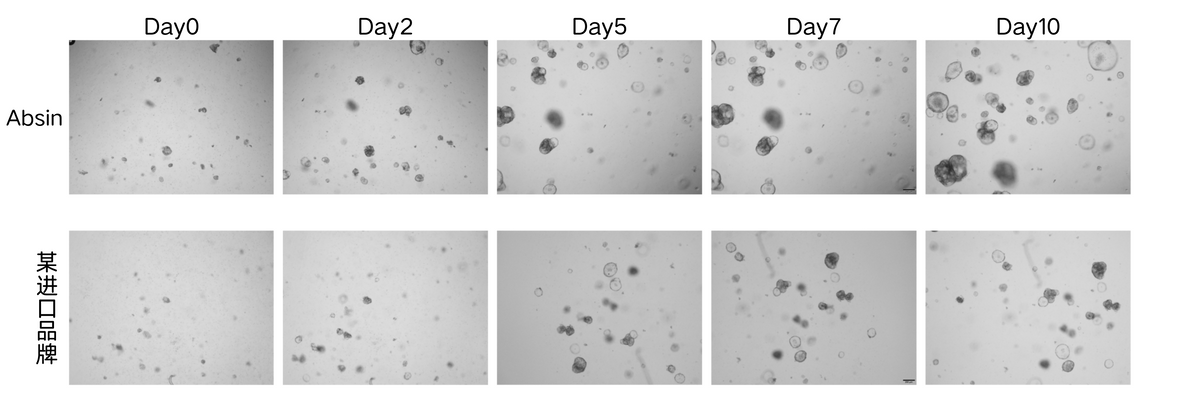
Comparison of organoids of colorectal cancer cultured with different brands of matrix gel (Figure 1)

Comparison of organoids of colorectal cancer cultured with different brands of matrix gel (Figure 2)