
OPN/SPP1 His Tag Protein, Human
OPN/SPP1 His Tag Protein, Human

Product Details
Product Details
Product Specification
| Species | Human |
| Antigen | OPN/SPP1 |
| Synonyms | BNSP, BSP-1 |
| Accession | P10451-5 |
| Amino Acid Sequence |
Ile17-Asn300, with C-terminal 8*His IPVKQADSGSSEEKQLYNKYPDAVATWLNPDPSQKQNLLAPQTLPSKSNESHDHMDDMDDEDDDDHVDSQDSIDSNDSDDVDDTDDSHQSDESHHSDESDELVTDFPTDLPATEVFTPVVPTVDTYDGRGDSVVYGLRSKSKKFRRPDIQYPDATDEDITSHMESEELNGAYKAIPVAQDLNAPSDWDSRGKDSYETSQLDDQSAETHSHKQSRLYKRKANDESNEHSDVIDSQELSKVSREFHSHEFHSHEDMLVVDPKSKEEDKHLKFRISHELDSASSEVNGGGSHHHHHHHH |
| Expression System | HEK293 |
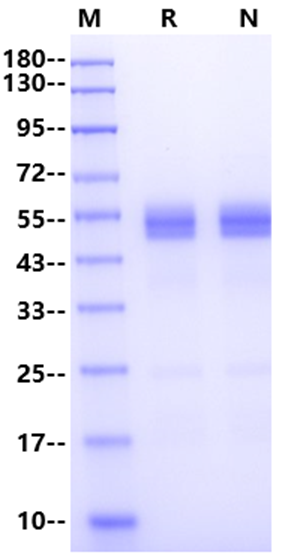
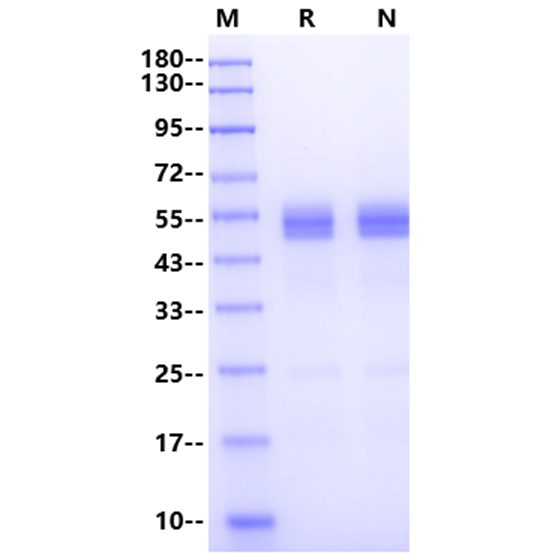
| Molecular Weight | 45-55kDa (Reducing) |
| Purity | >95% by SDS-PAGE |
| Endotoxin | <0.1EU/μg |
| Conjugation | Unconjugated |
| Tag | His Tag |
| Physical Appearance | Lyophilized Powder |
| Storage Buffer | PBS, pH7.4 |
| Reconstitution | Reconstitute at 0.1-1 mg/ml according to the size in ultrapure water after rapid centrifugation. |
| Stability & Storage | · 12 months from date of receipt, lyophilized powder stored at -20 to -80℃. · 3 months, -20 to -80℃ under sterile conditions after reconstitution. · 1 week, 2 to 8℃ under sterile conditions after reconstitution. · Please avoid repeated freeze-thaw cycles. |
| Reference | 1. Kung-Hao Liang. OPN sesame. Hepatobiliary Surg Nutr 2014;3(3):112-114. |
Background
OPN is an integrin-binding glycoprotein also known as secreted phosphoprotein 1 (SPP1). OPN is so named because it was first discovered in osteoblasts and osteoclasts. The latter is developed from the macrophage lineage. OPN protein has a secreted form and an intracellular form. The secreted OPN has two integrin-binding domains which can adhere to integrins on the surfaces of macrophages, making it a potent chemoattractant as well as an activator of macrophages. In innate immunological cells such as dendritic cells, OPN can be activated upon infection. The OPN-integrin binding can trigger downstream macrophage activities including TNF secretion, producing an inflammatory microenvironment. Poor prognosis of HCC was correlated with elevated OPN RNA, tissue OPN protein levels and pre-operative serum OPN protein levels. An anti-OPN antibody has been shown to defer the growth and metastasis of breast cancer in a mice model. As macrophages can also secret OPN, PTM and OPN form a vicious autocrine/paracrine cycle for the progression of cancer. Thus, in the future, novel strategies to break this cycle could bring to new anti-HCC treatments.
Picture
Picture
SDS-PAGE