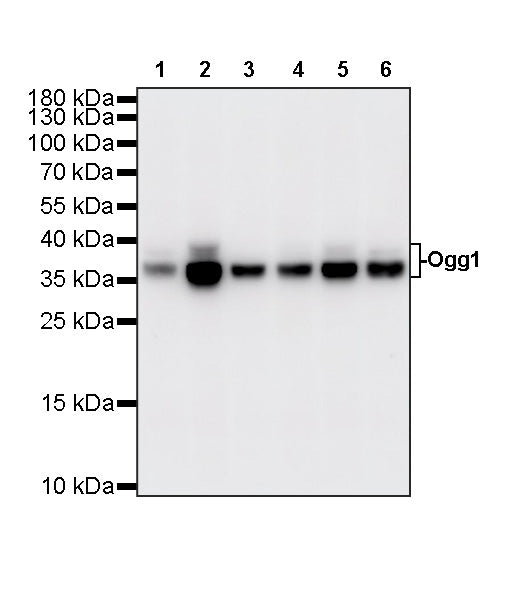
WB result of Ogg1 Recombinant Rabbit mAb
Primary antibody: Ogg1 Recombinant Rabbit mAb at 1/1000 dilution
Lane 1: A549 whole cell lysate 20 µg
Lane 2: Daudi whole cell lysate 20 µg
Lane 3: Hep G2 whole cell lysate 20 µg
Lane 4: 293T whole cell lysate 20 µg
Lane 5: HeLa whole cell lysate 20 µg
Lane 6: Raji whole cell lysate 20 µg
Secondary antibody: Goat Anti-Rabbit IgG (H+L), HRP conjugated at 1/10000 dilution
Predicted MW: 39 kDa
Observed MW: 36, 38 kDa
Ogg1 Recombinant Rabbit mAb (S-6056)
Ogg1 Recombinant Rabbit mAb (S-6056)
Price:
Regular price
$100 USD
Regular price
Sale price
$100 USD
Unit price
per
For shipping services or bulk orders, you may request a quotation.
Secure checkout with

View full details
Product Details
Product Details
Product Specification
| Host | Rabbit |
| Antigen | Ogg1 |
| Location | Nucleus |
| Accession | O15527 |
| Clone Number | S-6056 |
| Antibody Type | Recombinant mAb |
| Isotype | IgG |
| Application | WB |
| Reactivity | Hu |
| Positive Sample | A549, Daudi, Hep G2, 293T, HeLa, Raji |
| Purification | Protein A |
| Concentration | 0.5 mg/ml |
| Conjugation | Unconjugated |
| Physical Appearance | Liquid |
| Storage Buffer | PBS, 40% Glycerol, 0.05% BSA, 0.02% sodium azide |
| Stability & Storage | 12 months from date of receipt / reconstitution, -20 °C as supplied |
Dilution
| application | dilution | species |
| WB | 1:1000 | Hu |
Background
OGG1 (8-oxoguanine DNA glycosylase 1) is a bifunctional DNA repair enzyme that initiates the base excision repair (BER) pathway by recognizing and excising 7,8-dihydro-8-oxoguanine (8-oxoG), the most abundant oxidative DNA lesion generated by reactive oxygen species (ROS). The enzyme exhibits a strong preference for 8-oxoG paired with cytosine and catalyzes two successive reactions: hydrolysis of the N-glycosidic bond (glycosylase activity) followed by β-elimination at the 3'-side of the resulting apurinic/apyrimidinic (AP) site (lyase activity). Beyond its canonical repair role, OGG1 functions as an epigenetic reader that binds 8-oxoG lesions enriched in gene regulatory elements, particularly guanine-rich promoters, to facilitate the DNA binding of transcription factors such as NF-κB, thereby modulating inflammatory gene expression. OGG1 deficiency in mice leads to 8-oxoG accumulation in the genome and is associated with increased susceptibility to asbestos-induced pulmonary fibrosis, exacerbated doxorubicin-induced cardiac dysfunction, and altered brain development involving both DNA damage and epigenetic dysregulation. In the context of infection and inflammation, OGG1 bound to oxidative lesions promotes innate immune responses, and pharmacological inhibition of OGG1 substrate binding has emerged as a potential therapeutic strategy for pulmonary diseases and viral infections.
Picture
Picture
Western Blot