WB result of NSD2 Recombinant Rabbit mAb
Primary antibody: NSD2 Recombinant Rabbit mAb at 1/1000 dilution
Lane 1: HeLa whole cell lysate 20 µg
Lane 2: PC-3 whole cell lysate 20 µg
Lane 3: 293T whole cell lysate 20 µg
Lane 4: HepG2 whole cell lysate 20 µg
Lane 5: HCT 116 whole cell lysate 20 µg
Secondary antibody: Goat Anti- rabbit IgG, (H+L), HRP conjugated at 1/10000 dilution
Predicted MW: 152 kDa
Observed MW: 150 kDa
NSD2 Recombinant Rabbit mAb (S-4013-46)
NSD2 Recombinant Rabbit mAb (S-4013-46)
Price:
Regular price
$100 USD
Regular price
Sale price
$100 USD
Unit price
per
For shipping services or bulk orders, you may request a quotation.
Secure checkout with

View full details
Product Details
Product Details
Product Specification
| Host | Rabbit |
| Antigen | NSD2 |
| Synonyms | Histone-lysine N-methyltransferase NSD2; Multiple myeloma SET domain-containing protein (MMSET); Nuclear SET domain-containing protein 2; Protein trithorax-5; Wolf-Hirschhorn syndrome candidate 1 protein; KIAA1090; MMSET; TRX5; WHSC1 |
| Immunogen | Synthetic Peptide |
| Location | Cytoplasm, Nucleus |
| Accession | O96028 |
| Clone Number | S-4013-46 |
| Antibody Type | Recombinant mAb |
| Isotype | IgG |
| Application | WB, ICC |
| Reactivity | Hu, Ms |
| Positive Sample | HeLa PC-3, 293T, HepG2, HCT116, Neuro-2a |
| Purification | Protein A |
| Concentration | 0.5 mg/ml |
| Conjugation | Unconjugated |
| Physical Appearance | Liquid |
| Storage Buffer | PBS, 40% Glycerol, 0.05% BSA, 0.03% Proclin 300 |
| Stability & Storage | 12 months from date of receipt / reconstitution, -20 °C as supplied |
Dilution
| application | dilution | species |
| WB | 1:1000 | Hu, Ms |
| ICC | 1:500 | Hu |
Background
NSD2 (also known as MMSET or WHSC1) is a histone lysine methyltransferase that primarily catalyzes the dimethylation of histone H3 at lysine 36 (H3K36me2). This protein contains multiple functional domains, including a catalytic SET domain, PWWP domains (which recognize H3K36me2 or bind DNA), and an HMG box, enabling it to both catalyze methylation and recognize specific chromatin marks, thereby promoting the widespread diffusion of H3K36me2 across chromatin regions. As an epigenetic regulator closely associated with transcriptional elongation, NSD2 typically interacts with RNA polymerase II and, by catalyzing H3K36me2, counteracts the repressive H3K27me3 mark catalyzed by Polycomb Repressive Complex 2 (PRC2), forming a "chromatin switch" that maintains an active state of gene transcription. Physiologically, NSD2 is essential for embryonic development, immune system function, and skeletal development. Pathologically, NSD2 gene translocation (t(4;14)) is a common genetic abnormality in multiple myeloma associated with poor prognosis. Furthermore, NSD2 overexpression or gain-of-function mutations are also frequently found in various cancers, including pediatric acute lymphoblastic leukemia, prostate cancer, and lung cancer, where they promote tumor proliferation and drug resistance by remodeling the epigenome, making NSD2 a highly promising target for anticancer drug development.
Picture
Picture
Western Blot
WB result of NSD2 Recombinant Rabbit mAb
Primary antibody: NSD2 Recombinant Rabbit mAb at 1/1000 dilution
Lane 1: Neuro-2a whole cell lysate 20 µg
Secondary antibody: Goat Anti- rabbit IgG, (H+L), HRP conjugated at 1/10000 dilution
Predicted MW: 152 kDa
Observed MW: 150 kDa
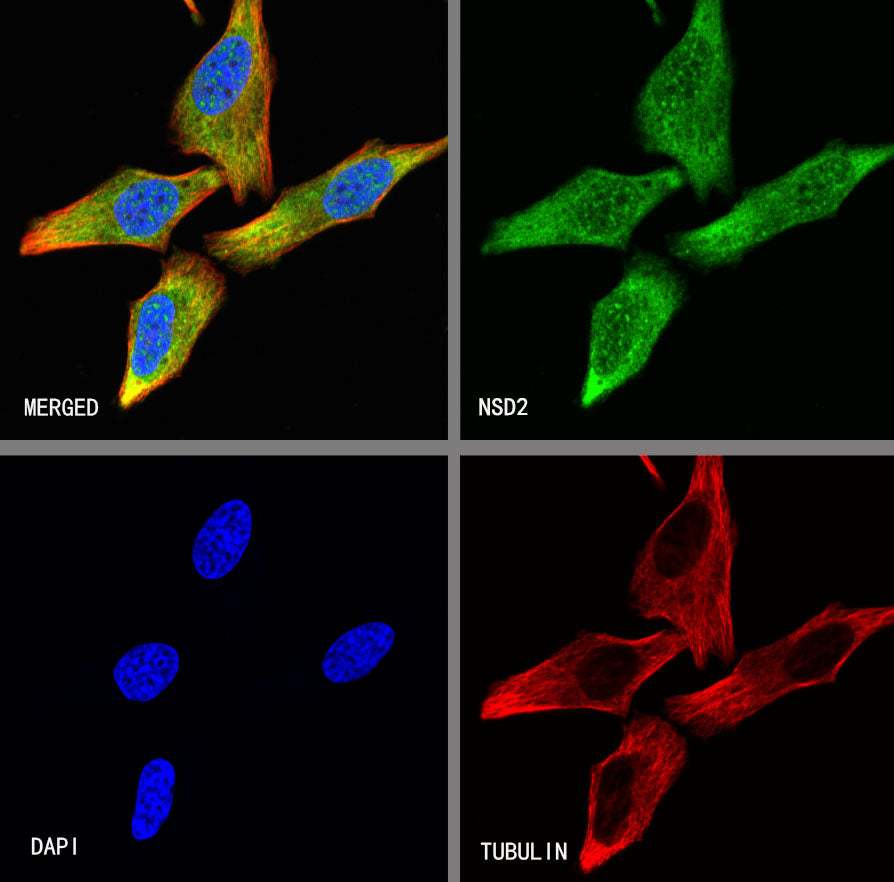
Immunocytochemistry
ICC shows positive staining in HeLa cells. Anti- NSD2 antibody was used at 1/500 dilution (Green) and incubated overnight at 4°C. Goat polyclonal Antibody to Rabbit IgG - H&L (Alexa Fluor® 488) was used as secondary antibody at 1/1000 dilution. The cells were fixed with 100% ice-cold methanol and permeabilized with 0.1% PBS-Triton X-100. Nuclei were counterstained with DAPI (Blue). Counterstain with tubulin (Red).