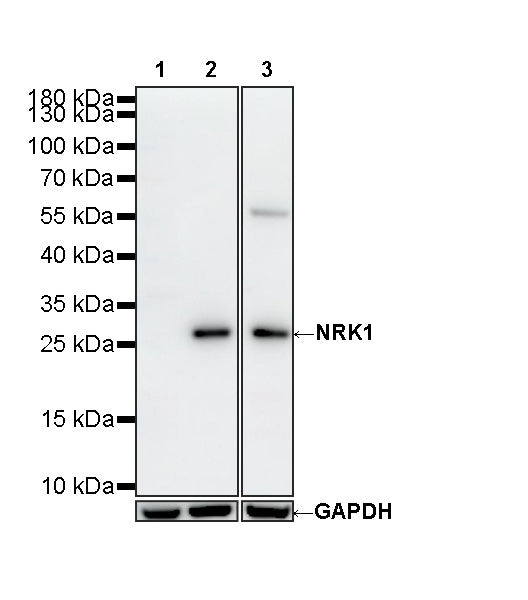
WB result of NRK1 Recombinant Rabbit mAb
Primary antibody: NRK1 Recombinant Rabbit mAb at 1/1000 dilution
Lane 1: SH-SY5Y whole cell lysate 20 µg
Lane 2: U266B1 whole cell lysate 20 µg
Lane 3: RPMI-8226 whole cell lysate 20 µg
Negative control:SH-SY5Y whole cell lysate
Secondary antibody: Goat Anti-Rabbit IgG (H+L), HRP conjugated at 1/10000 dilution
Predicted MW: 24 kDa
Observed MW: 26 kDa
NRK1 Recombinant Rabbit mAb (S-4979-71)
NRK1 Recombinant Rabbit mAb (S-4979-71)
Price:
Regular price
$100 USD
Regular price
Sale price
$100 USD
Unit price
per
For shipping services or bulk orders, you may request a quotation.
Secure checkout with

View full details
Product Details
Product Details
Product Specification
| Host | Rabbit |
| Antigen | NRK1 |
| Immunogen | Synthetic Peptide |
| Location | Cytoplasm |
| Accession | Q9NWW6 |
| Clone Number | S-4979-71 |
| Antibody Type | Recombinant mAb |
| Isotype | IgG |
| Application | WB |
| Reactivity | Hu |
| Positive Sample | U266B1, RPMI-8226 |
| Purification | Protein A |
| Concentration | 1 mg/ml |
| Conjugation | Unconjugated |
| Physical Appearance | Liquid |
| Storage Buffer | PBS, 40% Glycerol, 0.05% BSA, 0.02% sodium azide |
| Stability & Storage | 12 months from date of receipt / reconstitution, -20 °C as supplied |
Dilution
| application | dilution | species |
| WB | 1:500-1:1000 | Hu |
Background
NRK1 (nicotinamide riboside kinase 1, gene name NMRK1/C9orf95) is a key enzyme in the cytoplasmic NAD⁺ salvage synthesis pathway. It consists of 199 amino acids, and its crystal structure reveals that the active site lies in a groove between a central parallel β-sheet core and the LID and NMP-binding domains, with Asp56 and Arg129 recognizing the ribose hydroxyl groups and Asp36 acting as the catalytic base. NRK1 catalyzes the phosphorylation of nicotinamide riboside (NR) to generate nicotinamide mononucleotide (NMN), representing an important route of NAD⁺ biosynthesis that is independent of the Preiss-Handler pathway; it can also phosphorylate NR analogues such as the antitumor drug tiazofurin. Recent studies have revealed that NRK1 plays important regulatory functions in immunometabolism: upon CD4⁺ T cell activation, NRK1 expression is upregulated, and by locally elevating cytosolic NAD⁺/H levels it enhances glycolytic efficiency and drives NADPH production, thereby maintaining reduced glutathione and reducing reactive oxygen species accumulation, which in turn promotes NFAT nuclear translocation and suppresses excessive inflammatory responses, while also promoting effector T cell survival by regulating Bcl-2 family proteins. In fungal and viral infection models, T cell-intrinsic NRK1 function is essential for maintaining effector CD4⁺ T cell numbers and pathogen clearance.
Picture
Picture
Western Blot