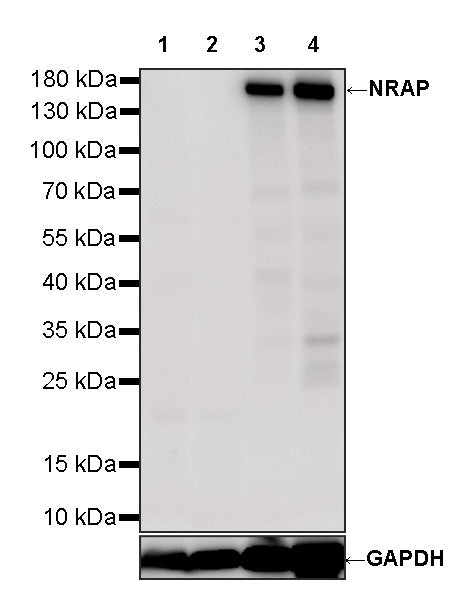
WB result of NRAP Recombinant Rabbit mAb
Primary antibody: NRAP Recombinant Rabbit mAb at 1/1000 dilution
Lane 1: mouse liver lysate 20 μg
Lane 2: mouse spleen lysate 20 μg
Lane 3: mouse heart lysate 20 μg
Lane 4: mouse skeletal muscle lysate 20 μg
Negative control: mouse liver lysate; mouse spleen lysate
Secondary antibody: Goat Anti-Rabbit IgG (H+L), HRP conjugated at 1/10000 dilution
Predicted MW: 197 kDa
Observed MW: 197 kDa
NRAP Recombinant Rabbit mAb (S-4533-5)
NRAP Recombinant Rabbit mAb (S-4533-5)
Price:
Regular price
$100 USD
Regular price
Sale price
$100 USD
Unit price
per
For shipping services or bulk orders, you may request a quotation.
Secure checkout with

View full details
Product Details
Product Details
Product Specification
| Host | Rabbit |
| Antigen | NRAP |
| Immunogen | Synthetic Peptide |
| Accession | Q80XB4 |
| Clone Number | S-4533-5 |
| Antibody Type | Recombinant mAb |
| Isotype | IgG |
| Application | WB |
| Reactivity | Ms, Rt |
| Positive Sample | mouse heart, mouse skeletal muscle, rat heart, rat skeletal muscle |
| Purification | Protein A |
| Concentration | 0.5 mg/ml |
| Conjugation | Unconjugated |
| Physical Appearance | Liquid |
| Storage Buffer | PBS, 40% Glycerol, 0.05% BSA, 0.02% sodium azide |
| Stability & Storage | 12 months from date of receipt / reconstitution, -20 °C as supplied |
Dilution
| application | dilution | species |
| WB | 1:1000-1:2000 | Ms, Rt |
Background
NRAP (Nebulin-related anchoring protein) is a large sarcomeric protein specifically expressed in striated muscle (skeletal and cardiac muscle), encoded by the NRAP gene located on human chromosome 10q25.3, containing approximately 1,731 amino acids with a theoretical molecular weight of about 197 kDa. Its structure consists of an N-terminal LIM zinc-binding domain and a C-terminal actin-binding domain containing multiple nebulin repeats, with the C-terminal region comprising approximately 44 nebulin repeats. The functional localization of NRAP is highly specific: it is enriched at the myotendinous junction in skeletal muscle and localizes to the intercalated disc in cardiac muscle. It is thought to play a key role in sarcomere assembly and mechanical signal transduction by anchoring actin filaments at the ends of myofibrils to submembranous protein complexes and transmitting myofibrillar tension to the extracellular matrix. Its interaction network includes cytoskeletal and adhesion-related proteins such as actin, α-actinin, KLHL41, TLN1, and VCL. Clinically, biallelic loss-of-function mutations in the NRAP gene have been demonstrated to cause recessive dilated cardiomyopathy, highlighting its importance in the maintenance of myocardial structure and function.
Picture
Picture
Western Blot
WB result of NRAP Recombinant Rabbit mAb
Primary antibody: NRAP Recombinant Rabbit mAb at 1/1000 dilution
Lane 1: rat liver lysate 20 μg
Lane 2: rat spleen lysate 20 μg
Lane 3: rat heart lysate 20 μg
Lane 4: rat skeletal muscle lysate 20 μg
Negative control: mouse liver lysate; mouse spleen lysate
Secondary antibody: Goat Anti-Rabbit IgG (H+L), HRP conjugated at 1/10000 dilution
Predicted MW: 197 kDa
Observed MW: 197 kDa