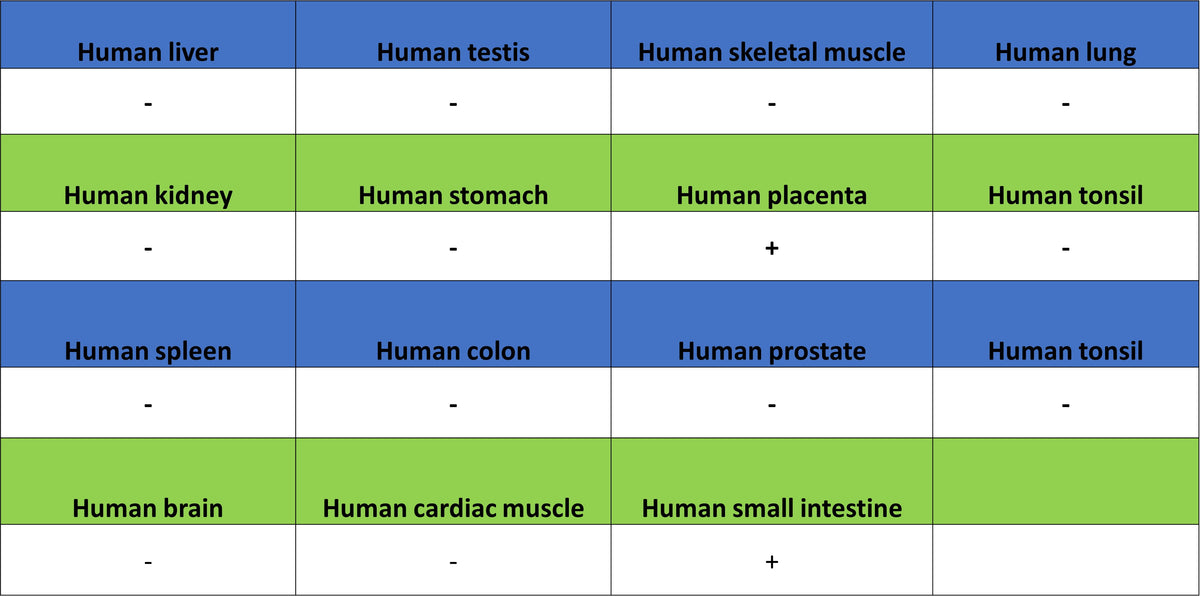
IHC shows positive staining in paraffin-embedded human small intestine. Anti-NOD2 antibody was used at 1/500 dilution, followed by a HRP Polymer for Mouse & Rabbit IgG (ready to use). Counterstained with hematoxylin. Heat mediated antigen retrieval with Tris/EDTA buffer pH9.0 was performed before commencing with IHC staining protocol.
NOD2 Recombinant Rabbit mAb (SDT-3245-112)
NOD2 Recombinant Rabbit mAb (SDT-3245-112)
Price:
Regular price
$100 USD
Regular price
Sale price
$100 USD
Unit price
per
For shipping services or bulk orders, you may request a quotation.
Secure checkout with

View full details
Product Details
Product Details
Product Specification
| Host | Rabbit |
| Antigen | NOD2 |
| Synonyms | Nucleotide-binding oligomerization domain-containing protein 2; Caspase recruitment domain-containing protein 15; Inflammatory bowel disease protein 1; CARD15 |
| Immunogen | Synthetic Peptide |
| Location | Cytoplasm, Mitochondrion, Cell membrane |
| Accession | Q9HC29 |
| Clone Number | SDT-3245-112 |
| Antibody Type | Recombinant mAb |
| Isotype | IgG |
| Application | IHC-P, IF |
| Reactivity | Hu |
| Purification | Protein A |
| Concentration | 0.5 mg/ml |
| Conjugation | Unconjugated |
| Physical Appearance | Liquid |
| Storage Buffer | PBS, 40% Glycerol, 0.05% BSA, 0.03% Proclin 300 |
| Stability & Storage | 12 months from date of receipt / reconstitution, -20 °C as supplied |
Dilution
| application | dilution | species |
| IHC-P | 1:500 | Hu |
| IF | 1:100 | Hu |
Background
NOD2 (nucleotide-binding oligomerization domain 2) is a 1,040-amino-acid intracellular pattern-recognition receptor that senses muramyl dipeptide from bacterial peptidoglycan through its C-terminal leucine-rich repeat domain; ligand binding relieves autoinhibition, enabling the centrally located NOD/NACHT domain to self-oligomerize, after which the dual N-terminal CARD domains recruit the adaptor kinase RIP2/RICK to activate NF-κB and MAPK cascades that drive transcription of pro-inflammatory cytokines and antimicrobial peptides, while also interacting with ATG16L1 to trigger autophagy, thereby orchestrating innate defense in macrophages, dendritic and Paneth cells—yet more than 100 germ-line mutations disrupt these processes, conferring risk for Crohn’s disease (loss-of-function LRR variants), Blau syndrome or early-onset sarcoidosis (gain-of-function NOD-domain variants) and highlighting NOD2’s critical role in balancing microbial sensing, intestinal homeostasis and autoinflammatory pathology.
Picture
Picture
Immunohistochemistry
Negative control: IHC shows negative staining in paraffin-embedded human placenta. Anti-NOD2 antibody was used at 1/500 dilution, followed by a HRP Polymer for Mouse & Rabbit IgG (ready to use). Counterstained with hematoxylin. Heat mediated antigen retrieval with Tris/EDTA buffer pH9.0 was performed before commencing with IHC staining protocol.
Negative control: IHC shows negative staining in paraffin-embedded human colon. Anti-NOD2 antibody was used at 1/500 dilution, followed by a HRP Polymer for Mouse & Rabbit IgG (ready to use). Counterstained with hematoxylin. Heat mediated antigen retrieval with Tris/EDTA buffer pH9.0 was performed before commencing with IHC staining protocol.
Negative control: IHC shows negative staining in paraffin-embedded human kidney. Anti-NOD2 antibody was used at 1/500 dilution, followed by a HRP Polymer for Mouse & Rabbit IgG (ready to use). Counterstained with hematoxylin. Heat mediated antigen retrieval with Tris/EDTA buffer pH9.0 was performed before commencing with IHC staining protocol.
Immunofluorescence
IF shows positive staining in paraffin-embedded human small intestine. Anti-NOD2 antibody was used at 1/100 dilution (Green) and incubated overnight at 4°C. Goat polyclonal Antibody to Rabbit IgG - H&L (Alexa Fluor® 488) was used as secondary antibody at 1/1000 dilution. Counterstained with DAPI (Blue). Heat mediated antigen retrieval with EDTA buffer pH9.0 was performed before commencing with IF staining protocol.