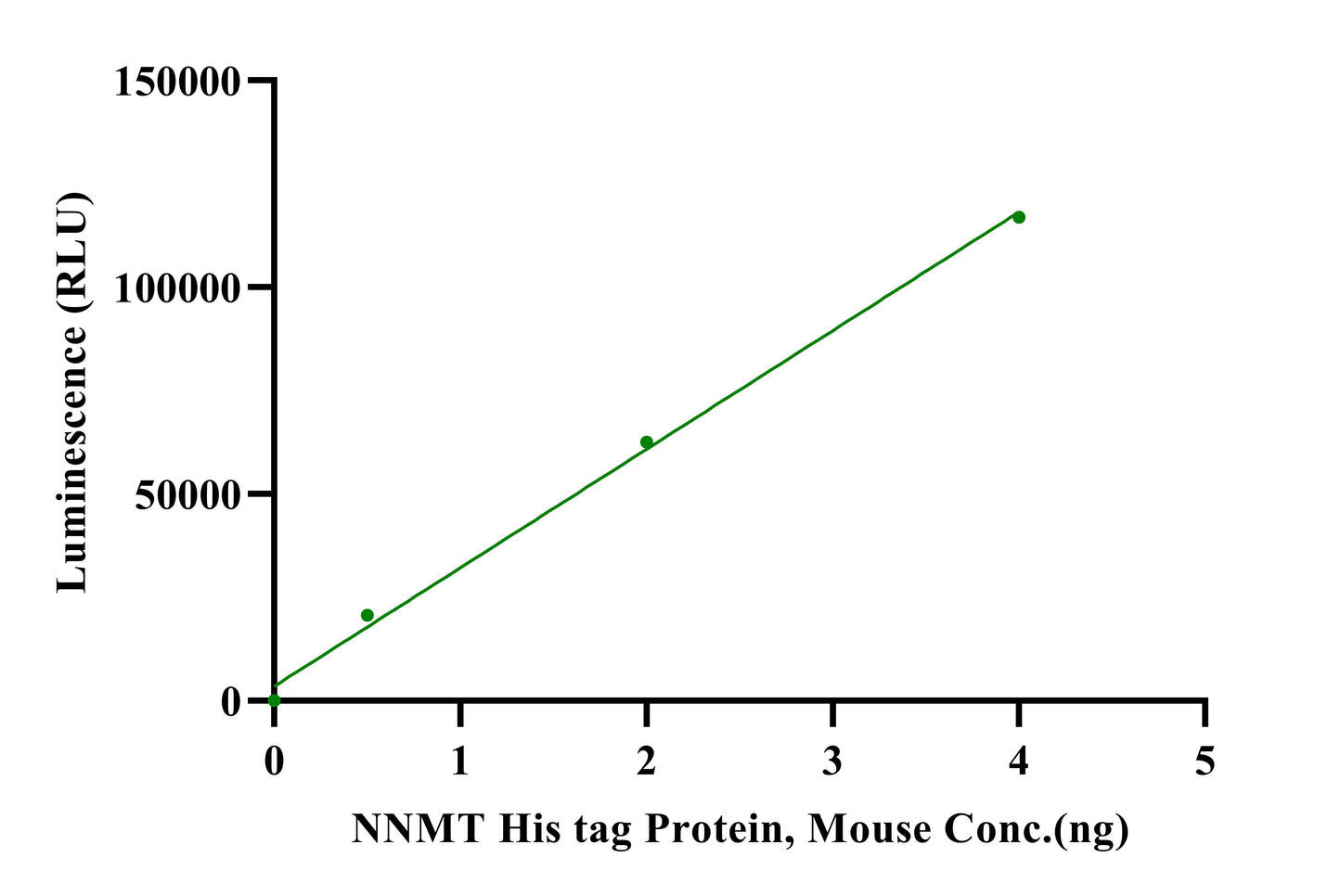
The specific activity of NNMT was determined to be >210 nmol /min/mg as per activity assay protocol.
NNMT His Tag Protein, Mouse
NNMT His Tag Protein, Mouse
Price:
Regular price
$470 USD
Regular price
Sale price
$470 USD
Unit price
per
For shipping services or bulk orders, you may request a quotation.
Secure checkout with

View full details
Product Details
Product Details
Product Specification
| Species | Mouse |
| Synonyms | Nicotinamide N-methyltransferase |
| Accession | O55239 |
| Amino Acid Sequence | Met1-Glu264 with His Tag at the C-Terminus |
| Expression System | E.coli |
| Molecular Weight | 25-35kDa (Reducing) |
| Purity | >95% by SDS-PAGE |
| Conjugation | Unconjugated |
| Tag | His Tag |
| Physical Appearance | Liquid |
| Storage Buffer | 50mM Tris, 200mM NaCl, 20% Glycerol, pH7.5 |
| Stability & Storage | Stable for 12 months upon stored at -80℃ from the date of receipt. And avoid repeated freeze-thaws cycles. |
| Reference | 1.Pissios P. Nicotinamide N-Methyltransferase: More Than a Vitamin B3 Clearance Enzyme. Trends Endocrinol Metab. 2017 May;28(5):340-353. |
Background
NNMT (Nicotinamide N-methyltransferase) is a cytosolic methyltransferase whose crystal structure has been resolved in rhesus macaques and mice at a resolution of 1.88 Å, belonging to the methyltransferase superfamily. This enzyme utilizes S-adenosylmethionine as a methyl donor to catalyze the methylation of nicotinamide into 1-methylnicotinamide, thereby regulating NAD⁺ metabolic homeostasis; it is highly expressed in the liver, adipose tissue, and brain, and participates in energy expenditure, lipid metabolism, and insulin sensitivity modulation through the NAD⁺/Sirt1 pathway. Clinical studies have demonstrated that upregulated NNMT expression is closely associated with obesity, type 2 diabetes, and metabolic syndrome, while its levels are also significantly elevated in specific brain regions of patients with Parkinson's disease and Alzheimer's disease, suggesting that NNMT serves not only as a biomarker for metabolic disorders but also as a promising therapeutic target for drug intervention.
Protocol
Assay protocol
Principle: The MTase-Glo™ Methyltransferase Assay can measure the activity of NNMT based on the reaction product S-adenosyl homocysteine (SAH). After the methyltransferase reaction is complete, just add the MTase-Glo™ Reagent and MTase-Glo™ Detection Solution to convert SAH to ATP and measure the light from the luciferase reaction.
Materials
1.Assay Buffer: 20mM Tris-HCl, pH 8.0, 50 mM NaCl, 1 mM EDTA, 3 mM MgCl2, 0.1 mg/ml BSA. Add 1mM DTT prior to use.
2.NNMT His tag Protein, Mouse
3.MTase-GloTM Methyltransferase Assay (Promega, Catalog #: V7601)
4.Substrate: Nicotinamide (Sigma, Catalog #: N481907-100GM)
5.Solid white multi-well plate (384-well plate) (Corning, Catalog #3572)
6.Plate Reader (PerkinElmer)
Produce
1. Thaw the active NNMT and all Methyltransferase-GloTM Assays kit reagents on ice.
2. Prepare the following working solutions with Methyltransferase Reaction Buffer on ice:
2X final concentration of Active NNMT: 0.4 μg/mL, 0.2 μg/mL, 0.1 μg/mL, 0.05 μg/mL, 0 μg/mL
2X Substrate Cocktail: 40 μM of SAM and 80 μM of Nicotinamide in Reaction Buffer
3. In a 384-well plate, add the following components to bring the initial reaction volume to 20 μL:
Component 1. 10 μL of 2X Substrate Cocktail
Component 2. 10 μL of 2X Active NNMT
4. Mix the reaction on an orbital shaker for 2 minutes. Seal the plate with a plate seal and incubate at 37°C for 60 minutes.
5. Dilute 10X Methyltransferase-GloTM Reagent with equal volume of nanopure water, and add 5 μL of the 5X Methyltransferase-GloTM Reagent to all reaction wells.
6. Mix on an orbital shaker for 2 minutes and then incubate at room temperature for 30 minutes.
7. Add 25 μL of MTase-GloTM Detection Solution to all reaction wells. Mix for 2 minutes and then incubate at room temperature for 30 minutes
8. Read at luminescence, respectively in endpoint mode.
9. Using the SAH standard curve, determine the concentration of SAH produced (pmol) and calculate the methyltransferase specific activity as outlined below.
Specific Activity (pmol/min/µg) = |
SAH (pmol)-Blank |
Incubation time(min) ×amount of enzyme (μg) |
Picture
Picture
Bioactivity
SDS-PAGE
1μg (R: reducing condition, N:non-reducing condition).