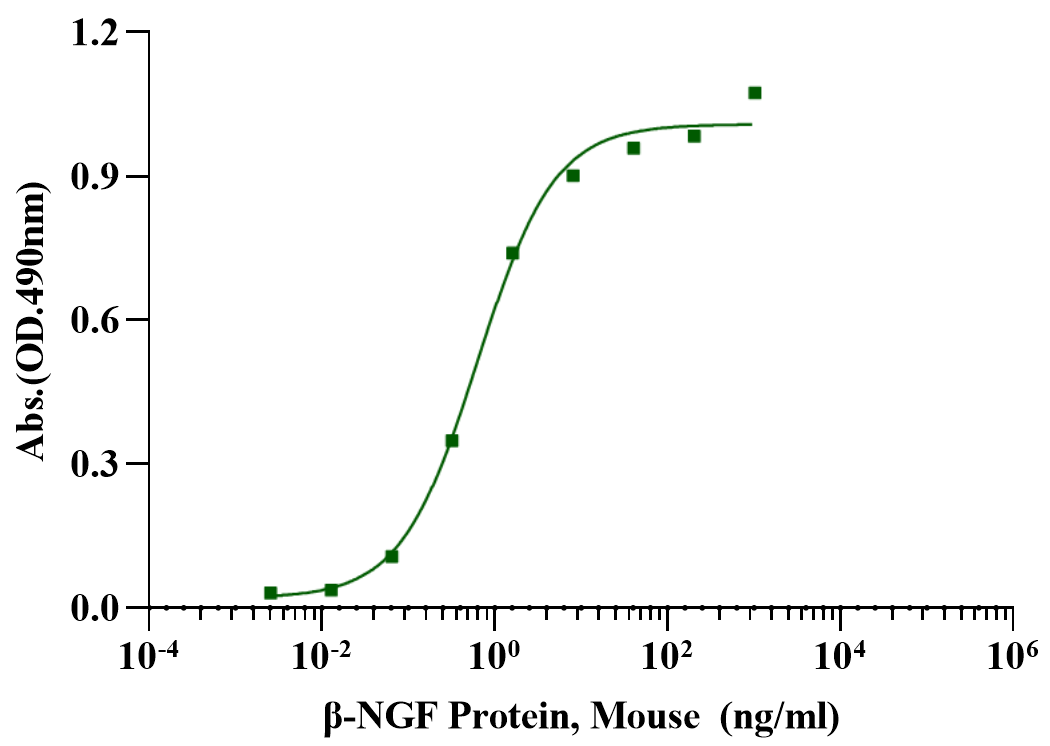
Measured in a cell proliferation assay using TF‑1 human erythroleukemic cells. The EC50 for this effect is 0.48-0.84 ng/ml.
β-NGF Protein, Mouse
β-NGF Protein, Mouse
Price:
Regular price
$130 USD
Regular price
Sale price
$130 USD
Unit price
per
For shipping services or bulk orders, you may request a quotation.
Secure checkout with

View full details
Product Details
Product Details
Product Specification
| Species | Mouse |
| Synonyms | Beta-nerve growth factor, Beta-NGF |
| Accession | P01139 |
| Amino Acid Sequence | Ser122-Gly241 |
| Expression System | E.coli |
| Molecular Weight | 12-13 kDa (Reducing) |
| Purity | >95% by SDS-PAGE. |
| Endotoxin | <0.1EU/μg |
| Conjugation | Unconjugated |
| Tag | No Tag |
| Physical Appearance | Lyophilized powder |
| Storage Buffer | PBS, pH7.4 |
| Reconstitution | Reconstitute at 0.1-1 mg/ml according to the size in ultrapure water after rapid centrifugation. |
| Stability & Storage | ·12 months from date of receipt, lyophilized powder stored at -20 to -80℃. |
| Reference | Neurol Res. 2006 Jul;28(5):505-12. |
Background
Beta-nerve growth factor (β-NGF) is a neurotrophic factor encoded by the Ngf gene in Mus musculus, located on chromosome 3. It belongs to the NGF-beta family and is synthesized as a precursor protein (proNGF) that undergoes proteolytic processing to generate the mature, biologically active β-NGF homodimer. Mature mouse β-NGF consists of approximately 118 amino acids and forms a non-covalent homodimer stabilized by three disulfide bonds essential for its activity. In the mouse submaxillary gland, β-NGF (also known as 2.5S NGF) exists as part of a larger 7S complex with the stoichiometry α₂βγ₂, where the alpha and gamma subunits are members of the glandular kallikrein family that must be dissociated for biological activity. β-NGF exerts its functions by binding to two receptor types: the high-affinity tropomyosin receptor kinase A (TrkA), which activates PI3K, Ras, and PLC signaling pathways to promote neuronal survival and differentiation, and the low-affinity p75 neurotrophin receptor (p75NTR), which can mediate apoptotic signaling when bound by proNGF. The gene is broadly expressed in multiple tissues including the nervous system, limb, alimentary system, and genitourinary system.
Picture
Picture
Bioactivity
SDS-PAGE
2μg (R: reducing condition, N: non-reducing condition).