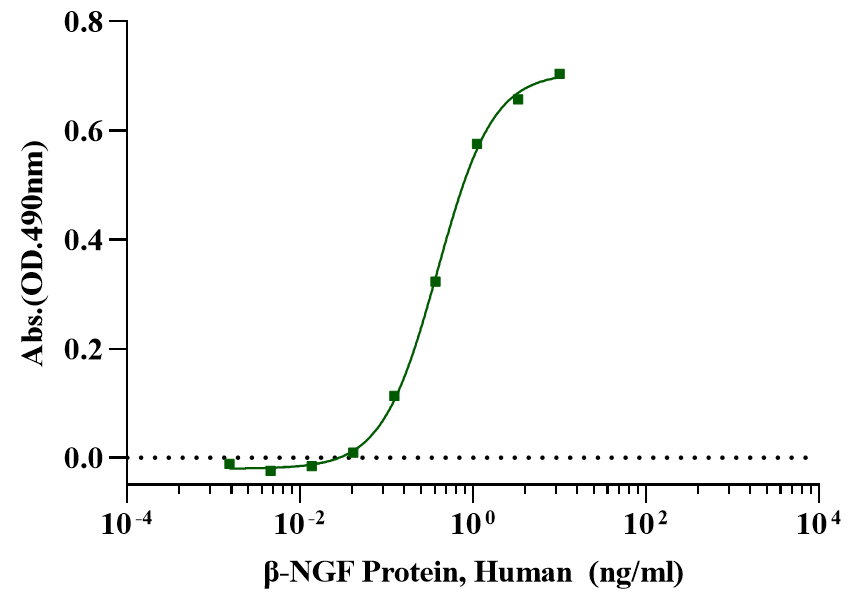
Measured in a cell proliferation assay using TF‑1 human erythroleukemic cells. The EC50 for this effect is 0.36-0.42 ng/ml.
β-NGF Protein, Human
β-NGF Protein, Human
Price:
Regular price
$65 USD
Regular price
Sale price
$65 USD
Unit price
per
For shipping services or bulk orders, you may request a quotation.
Secure checkout with

View full details
Product Details
Product Details
Product Specification
| Species | Human |
| Synonyms | Beta-nerve growth factor, Beta-NGF |
| Accession | P01138 |
| Amino Acid Sequence | Ser122-Ala241 |
| Expression System | E.coli |
| Molecular Weight | 12-13 kDa (Non-Reducing) |
| Purity | >95% by SDS-PAGE & HPLC. |
| Endotoxin | <0.1EU/μg |
| Conjugation | Unconjugated |
| Tag | No Tag |
| Physical Appearance | Lyophilized Powder |
| Storage Buffer | PBS, pH7.4 |
| Reconstitution | Reconstitute at 0.1-1 mg/ml according to the size in ultrapure water after rapid centrifugation. |
| Stability & Storage | ·12 months from date of receipt, lyophilized powder stored at -20 to -80℃. |
| Reference | Cureus. 2025 Jun 11;17(6):e85814. |
Background
β-NGF is the biologically active form of Nerve Growth Factor (NGF), a founding member of the neurotrophin family essential for neuronal development, survival, and function. Human β-NGF is a homodimeric protein composed of two identical 118-amino acid polypeptide chains. It is processed from a larger precursor (proNGF) through proteolytic cleavage.
β-NGF represents a fundamental neurotrophic factor with broad applications spanning from basic neuroscience research to clinical therapeutics. While recombinant human β-NGF and gene therapy approaches aim to harness its neuroprotective properties for neurodegenerative diseases, the most significant industrial success has been the development of anti-NGF monoclonal antibodies for chronic pain management. The dual role of NGF—promoting neuronal survival in development while mediating pathological pain in adulthood—highlights the complexity of targeting this pathway therapeutically.
Picture
Picture
Bioactivity
SDS-PAGE
2μg (R: reducing condition, N: non-reducing condition).
RP-HPLC
>95% as determined by RP-HPLC.