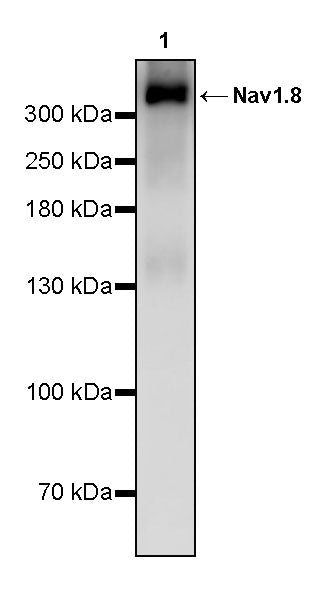
WB result of Nav1.8 Recombinant Rabbit mAb
Primary antibody: Nav1.8 Recombinant Rabbit mAb at 1/1000 dilution
Lane 1: unboiled mouse brain lysate 20 µg
Secondary antibody: Goat Anti- rabbit IgG, (H+L), HRP conjugated at 1/10000 dilution
Predicted MW: 220 kDa
Observed MW: 350 kDa
Nav1.8 Recombinant Rabbit mAb (S-3631-104)
Nav1.8 Recombinant Rabbit mAb (S-3631-104)
Price:
Regular price
$100 USD
Regular price
Sale price
$100 USD
Unit price
per
For shipping services or bulk orders, you may request a quotation.
Secure checkout with

View full details
Product Details
Product Details
Product Specification
| Host | Rabbit |
| Antigen | Nav1.8 |
| Synonyms | Sodium channel protein type 10 subunit alpha; Peripheral nerve sodium channel 3 (PN3; hPN3); Sodium channel protein type X subunit alpha; Voltage-gated sodium channel subunit alpha Nav1.8; SCN10A |
| Immunogen | Recombinant Protein |
| Location | Cell membrane |
| Accession | Q9Y5Y9 |
| Clone Number | S-3631-104 |
| Antibody Type | Recombinant mAb |
| Isotype | IgG |
| Application | WB |
| Reactivity | Hu, Ms, Rt |
| Purification | Immunogen Affinity |
| Concentration | 2 mg/ml |
| Conjugation | Unconjugated |
| Physical Appearance | Liquid |
| Storage Buffer | PBS, 40% Glycerol, 0.05% BSA, 0.02% sodium azide |
| Stability & Storage | 12 months from date of receipt / reconstitution, -20 °C as supplied |
Dilution
| application | dilution | species |
| WB | 1:1000 | Hu, Ms, Rt |
Background
Nav1.8 (encoded by the SCN10A gene) is a voltage-gated sodium channel subtype that is named for its tetrodotoxin resistance and predominant distribution in peripheral nociceptive sensory neurons, such as dorsal root ganglia, where it serves as a key molecule in pain signal transduction. This channel consists of a single α subunit that functions independently, containing four homologous domains, each with six transmembrane helices, in which the S4 segment acts as a voltage sensor to perceive changes in membrane potential, while the S5-S6 segments and their connecting loops form a central pore that selectively permits sodium ion passage. Nav1.8 possesses unique electrophysiological properties: it has a relatively high activation threshold and extremely slow inactivation, allowing this channel to remain open and mediate sodium influx even when other sodium channels have already been inactivated, thereby supporting repetitive firing of nociceptive neurons under sustained or high-frequency stimulation. Precisely because of its central role in pain transmission, Nav1.8 has become a prominent target for the development of non-opioid analgesic drugs.
Picture
Picture
Western Blot
WB result of Nav1.8 Recombinant Rabbit mAb
Primary antibody: Nav1.8 Recombinant Rabbit mAb at 1/1000 dilution
Lane 1: unboiled rat brain lysate 20 µg
Secondary antibody: Goat Anti- rabbit IgG, (H+L), HRP conjugated at 1/10000 dilution
Predicted MW: 220 kDa
Observed MW: 350 kDa