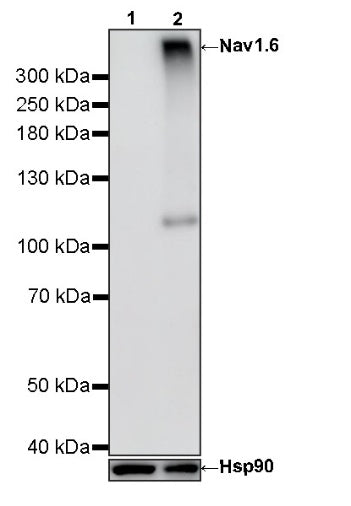
WB result of Nav1.6 Recombinant Rabbit mAb
Primary antibody: Nav1.6 Recombinant Rabbit mAb at 1/1000 dilution
Lane 1: unboiled mouse liver lysate 20 μg
Lane 2: unboiled mouse brain lysate 20 μg
Negative control: mouse liver lysate
Secondary antibody: Goat Anti-Rabbit IgG (H+L), HRP conjugated at 1/10000 dilution
Predicted MW: 225 kDa
Observed MW: 350 kDa
Nav1.6 Recombinant Rabbit mAb (S-4298-3)
Nav1.6 Recombinant Rabbit mAb (S-4298-3)
Price:
Regular price
$100 USD
Regular price
Sale price
$100 USD
Unit price
per
For shipping services or bulk orders, you may request a quotation.
Secure checkout with

View full details
Product Details
Product Details
Product Specification
| Host | Rabbit |
| Antigen | Nav1.6 |
| Synonyms | Sodium channel protein type 8 subunit alpha; Sodium channel protein type VIII subunit alpha; Voltage-gated sodium channel subunit alpha Nav1.6; Nbna1; Scn8a |
| Immunogen | Synthetic Peptide |
| Location | Cell membrane |
| Accession | Q9WTU3 |
| Clone Number | S-4298-3 |
| Antibody Type | Recombinant mAb |
| Isotype | IgG |
| Application | WB |
| Reactivity | Ms, Rt |
| Purification | Protein A |
| Concentration | 0.5 mg/ml |
| Conjugation | Unconjugated |
| Physical Appearance | Liquid |
| Storage Buffer | PBS, 40% Glycerol, 0.05% BSA, 0.02% sodium azide |
| Stability & Storage | 12 months from date of receipt / reconstitution, -20 °C as supplied |
Dilution
| application | dilution | species |
| WB | 1:1000 | Ms, Rt |
Background
Nav1.6, encoded by the SCN8A gene, is a voltage-gated sodium channel that serves as a critical regulator of neuronal excitability in both the central and peripheral nervous systems, with its core function being the initiation and propagation of action potentials. Recent breakthroughs in structural biology, particularly the elucidation of the Nav1.6 cryo-electron microscopy structure at 3.1 Å resolution, have provided unprecedented insights into its molecular assembly and functional regulatory mechanisms. The channel's unique electrophysiological properties, such as generating persistent currents and resurgent currents, enable it to finely tune neuronal firing patterns, and over 250 SCN8A gene mutations have been confirmed to be closely associated with distinct epilepsy phenotypes—gain-of-function mutations often lead to severe epileptic encephalopathies, while loss-of-function mutations are linked to generalized epilepsy. Moreover, the pathological significance of Nav1.6 extends far beyond this: in Alzheimer's disease, it mediates amyloid-β oligomer-induced neuronal hyperexcitability and participates in regulating the expression of key secretases; in multiple sclerosis, the redistribution of Nav1.6 on demyelinated axons drives calcium influx, leading to axonal damage; it is also involved in reactive astrocyte-mediated motor deficits in Parkinson's disease, and plays important roles in pathological processes such as cortical hyperexcitability in amyotrophic lateral sclerosis, chronic pain, and traumatic brain injury. Given its critical roles, therapeutic strategies are evolving from non-selective blockers toward precision medicine approaches, including highly selective pore blockers, allosteric modulators, and even gene therapies such as CRISPR-based interventions.
Picture
Picture
Western Blot
WB result of Nav1.6 Recombinant Rabbit mAb
Primary antibody: Nav1.6 Recombinant Rabbit mAb at 1/1000 dilution
Lane 1: unboiled rat liver lysate 20 μg
Lane 2: unboiled rat brain lysate 20 μg
Negative control: rat liver lysate
Secondary antibody: Goat Anti-Rabbit IgG (H+L), HRP conjugated at 1/10000 dilution
Predicted MW: 225 kDa
Observed MW: 350 kDa