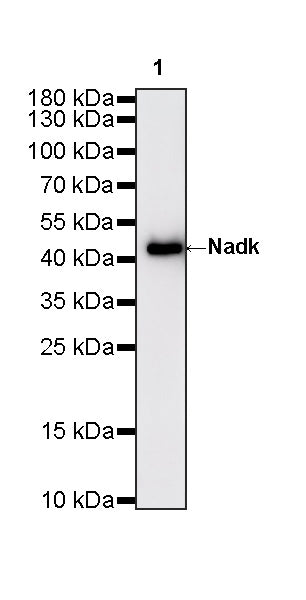
WB result of Nadk Recombinant Rabbit mAb
Primary antibody: Nadk Recombinant Rabbit mAb at 1/1000 dilution
Lane 1: U-2 OS whole cell lysate 20 µg
Lane 2: HeLa whole cell lysate 20 µg
Lane 3: RPMI-8226 whole cell lysate 20 µg
Negative control: U-2 OS whole cell lysate
Secondary antibody: Goat Anti-Rabbit IgG (H+L), HRP conjugated at 1/10000 dilution
Predicted MW: 49 kDa
Observed MW: 49 kDa
Nadk Recombinant Rabbit mAb (S-4113-65)
Nadk Recombinant Rabbit mAb (S-4113-65)
Price:
Regular price
$100 USD
Regular price
Sale price
$100 USD
Unit price
per
For shipping services or bulk orders, you may request a quotation.
Secure checkout with

View full details
Product Details
Product Details
Product Specification
| Host | Rabbit |
| Antigen | Nadk |
| Synonyms | NAD kinase; NADK |
| Immunogen | Synthetic Peptide |
| Location | Cytoplasm |
| Accession | O95544 |
| Clone Number | S-4113-65 |
| Antibody Type | Recombinant mAb |
| Isotype | IgG |
| Application | WB |
| Reactivity | Hu, Ms, Rt, Mk |
| Positive Sample | HeLa, RPMI-8226, Neuro-2a, RAW264.7, rat colon, COS7 |
| Purification | Protein A |
| Concentration | 0.5 mg/ml |
| Conjugation | Unconjugated |
| Physical Appearance | Liquid |
| Storage Buffer | PBS, 40% Glycerol, 0.05% BSA, 0.02% sodium azide |
| Stability & Storage | 12 months from date of receipt / reconstitution, -20 °C as supplied |
Dilution
| application | dilution | species |
| WB | 1:1000 | Hu, Ms, Rt, Mk |
Background
NADK is the sole key enzyme responsible for the de novo synthesis of NADP+ in organisms, catalyzing the phosphorylation of NAD+ to generate NADP+. NADPH, as a reducing equivalent, is crucial for maintaining intracellular redox balance and anabolic metabolism. Human NADK consists of 446 amino acids with a molecular weight of approximately 49 kDa and exists as a homotetramer in its active form. Its activity is finely regulated: the N-terminus contains an inhibitory regulatory domain. Upon activation of the PI3K-Akt signaling pathway, Akt can phosphorylate three serine sites (Ser44/46/48) within this domain, relieving autoinhibition and thereby activating the enzyme to accelerate NADP+ production. In addition, NADK has multiple transcript isoforms, among which isoform 3 exhibits constitutively high activity due to the deletion of the N-terminal regulatory region. In melanoma metastasis, tumor cells upregulate isoform 3 transcriptionally through NRF2 to enhance antioxidant capacity and counteract oxidative stress during the metastatic process. In mitochondria, its homologous isoform MNADK (NADK2) independently regulates intramitochondrial NADP(H) levels, and its loss of function is closely associated with metabolic diseases such as type 2 diabetes and non-alcoholic fatty liver disease.
Picture
Picture
Western Blot
WB result of Nadk Recombinant Rabbit mAb
Primary antibody: Nadk Recombinant Rabbit mAb at 1/1000 dilution
Lane 1: Neuro-2a whole cell lysate 20 µg
Lane 2: Raw 264.7 whole cell lysate 20 µg
Secondary antibody: Goat Anti-Rabbit IgG (H+L), HRP conjugated at 1/10000 dilution
Predicted MW: 49 kDa
Observed MW: 49 kDa
WB result of Nadk Recombinant Rabbit mAb
Primary antibody: Nadk Recombinant Rabbit mAb at 1/1000 dilution
Lane 1: rat colon lysate 20 µg
Secondary antibody: Goat Anti-Rabbit IgG (H+L), HRP conjugated at 1/10000 dilution
Predicted MW: 49 kDa
Observed MW: 49 kDa
WB result of Nadk Recombinant Rabbit mAb
Primary antibody: Nadk Recombinant Rabbit mAb at 1/1000 dilution
Lane 1: COS7 whole cell lysate 20 µg
Secondary antibody: Goat Anti-Rabbit IgG (H+L), HRP conjugated at 1/10000 dilution
Predicted MW: 49 kDa
Observed MW: 49 kDa